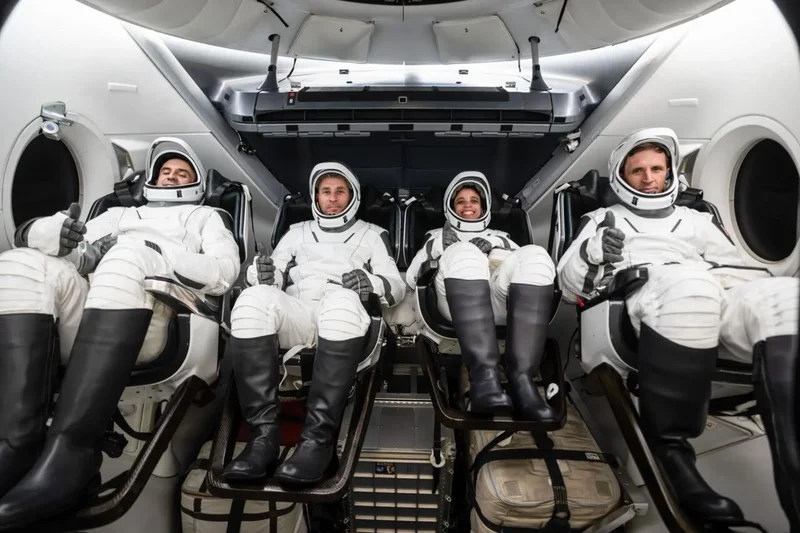
A crew of four astronauts is preparing to depart Earth on board a SpaceX rocket and head to the International Space Station (ISS). Should something go wrong on the launchpad, astronauts would normally escape in an armored military-grade vehicle that can withstand heavy explosions. But for the upcoming Crew-13 mission, the astronauts will be whisked to safety in a tacky, stainless steel pick-up truck.
NASA revealed that the Tesla Cybertruck will be replacing the Mine-Resistent Ambush Protected vehicles (MRAPs) to transport astronauts away from the launchpad in case of an emergency, Space Policy Online reported. SpaceX decided to move to a private rescue capability to avoid conflict over resources for upcoming launches, Richard Jones, deputy program manager for NASA’s Commercial Crew Program, said during a recent press conference.
Cybertrucks have faced multiple safety recalls over hardware and software defects and are banned from the streets of Europe and the United Kingdom but are now the go-to vehicle in case of a rocket-related emergency.
Safety measures
NASA’s SpaceX Crew-13 mission is scheduled for liftoff on September 12. NASA astronauts Jessica Watkins and Luke Delaney, Canadian Space Agency astronaut Joshua Kutryk, and Roscosmos cosmonaut Sergey Teteryatnikov will launch on board a SpaceX Falcon 9 rocket from Cape Canaveral Space Force Station in Florida.
For the first time, a Cybertruck will be waiting near the launchpad to transport the crew to safety in case of an emergency. NASA normally relies on MRAPs for the critical task, a specialized tactical military transport with a V-shaped hull that’s designed to withstand explosive blasts, heavy shrapnel, and toxic chemical fires.
MRAPs essentially act as a moving bunker on wheels, with each vehicle weighing around 45,000 pounds (20,400 kilograms). NASA began relying on MRAP vehicles in 2013, having them on standby during crewed launches in case the astronauts and pad personnel need to be evacuated.
NASA is now handing its precautionary measures to its commercial partner, SpaceX, which has designated the Cybertruck as the safety escape vehicle. âThe speed at which a Cybertruck can exit the blast danger area is definitely one of the reasons why SpaceX has chosen to go in that direction,” Jones said during the press conference. “But I think really the main thing that I want to iterate is that it decouples a conflict in terms of trying to compete for the same resources for an MRAP for the personnel associated with those operations. So SpaceX is just going in a direction that they have freedom to manage those resources.â
A trusted vehicle?
The Tesla Cybertruck has been recalled 11 times by the National Highway Traffic Safety Administration. The multiple recalls have spanned software glitches, the windshield flying off, and the pedal pad dislodging. In late 2025, Tesla recalled nearly all Cybertrucks on the market because it used the âwrong glueâ to attach the stainless steel panels.
The all-electric, battery-powered pickup truck has faced heavy scrutiny since its launch, and it can’t be legally registered or driven in Europe and the U.K. because it fails to meet pedestrian and vehicle safety regulations.
Tesla claims that Cybertruck’s stainless steel exoskeleton is tough enough to withstand small impacts, in addition to the vehicle’s ultra-strong armor glass. Although, I think we all remember when the bulletproof windows famously shattered during Cybertruck’s unveiling in 2019.
SpaceX already uses Cybertrucks as its own emergency escape vehicle during launches, and now NASA has formally approved its use for upcoming missions. Let’s hope that the crew of astronauts isn’t forced to hop in the wonky vehicle for safety.