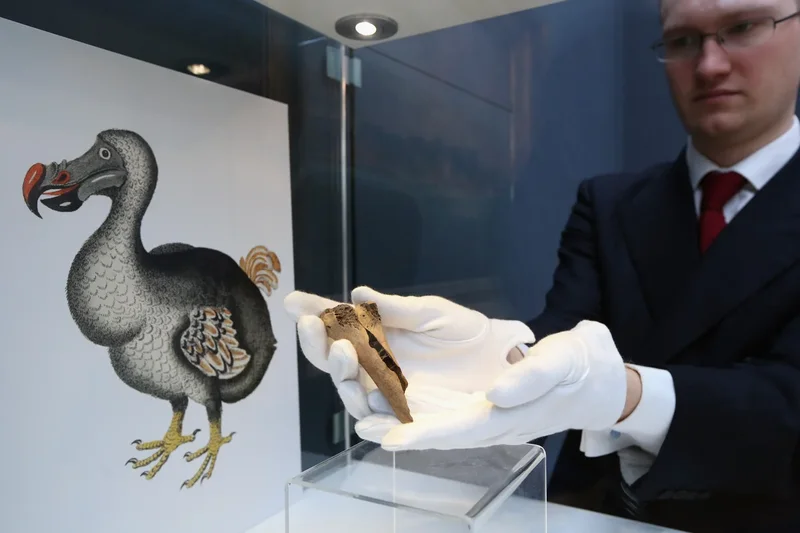
The now-extinct dodo was actually quite smart but gained a reputation as an unintelligent bird because it trusted humans, according to new research.
Scans of dodo skulls held in museum collections revealed the part of its brain governing cognition was exactly the size expected for a bird of its bulk, according to a study published in the Zoological Journal of the Linnean Society.
“There is no evidence that the dodo was any less intelligent than its relatives, and we know that pigeons are pretty smart," Andrew Iwaniuk, associate professor at the University of Lethbridge, Canada, and the study's senior author, said.
The dodo had the most unusual skull with a strangely domed head but the part of its brain that determined cognition was exactly as big as what one would expect for a bird of its size.
Researchers used computed tomography, the same scanning technique employed in hospitals, to build 3D models of three dodo skulls and compared them with a range of pigeon species, including the extinct Rodrigues solitaire, the dodo's closest relative and the largest pigeon that ever lived. Because a bird's brain leaves an imprint on the inside of the skull, the scans allowed researchers to measure the shape and size of a brain that has not existed for more than 300 years.
The dodo lived only on Mauritius, an island in the Indian Ocean about 1,100 miles east of Madagascar, and was extinct within about a century of Dutch sailors reaching it in 1598, killed off by hunting and by the rats, pigs and monkeys the ships brought with them. It has since become the shorthand for extinction caused by people and, thanks in part to Lewis Carroll and to the sailors’ accounts, for foolishness.
That reputation, researchers said, came from behaviour rather than brainpower. Dodos approached humans without alarm and gathered around distressed members of their own group, which allowed hunters to kill large numbers quickly.
"Dodos have always been portrayed as silly or confused birds, a reputation that probably came from their trusting behaviour that resulted in hundreds of animals being killed in a very short time," noted Sara Citron, a PhD student at Lethbridge and the study's lead author.
Like many species that evolved on islands without predators, she said, they had no reason to learn fear, and calling them stupid for that made it sound as though they deserved to die out.
The study also found the dodo was probably active at dusk or after dark, a habit unknown in any other pigeon. The scans showed it had slightly larger eyes than expected but unusually small optic lobes, the part of the brain responsible for processing vision, a combination found in birds known for hunting or foraging in low light.
"We see similarly small optic lobes in many nocturnal birds, like the elusive Australian night parrot or the New Zealand kakapo, indicating they relied little on sight and were active mainly at night," said Vera Weisbecker, professor of evolutionary biology at Flinders University in Australia and a study co-author. The team said the dodo's vision was likely coarser than that of its daytime relatives but more sensitive to dim light.
If correct, that would make the dodo the only pigeon known to have lived by night, out of more than 300 species. Ms Citron suggested the habit may have let it avoid competing for food with the giant tortoises that once covered Mauritius in large numbers.
The team was less certain about a third finding. The region of the brain associated with smell was large in the dodo and not in the solitaire or other pigeons, which may mean the bird relied heavily on scent to find food, though Aubrey Keirnan, a PhD student at Flinders and a study co-author, said there was not enough comparative data from other species to test the idea properly.
The study drew on specimens from the Smithsonian Institution in Washington, National Museums Scotland and the Natural History Museum of Denmark.
Researchers have released their scan data in the hope that others will use it. No complete dodo skeleton from a single bird survives anywhere and the species is known mainly from some bones collected in a marsh on Mauritius in the 19th century and from a handful of sailors' drawings.