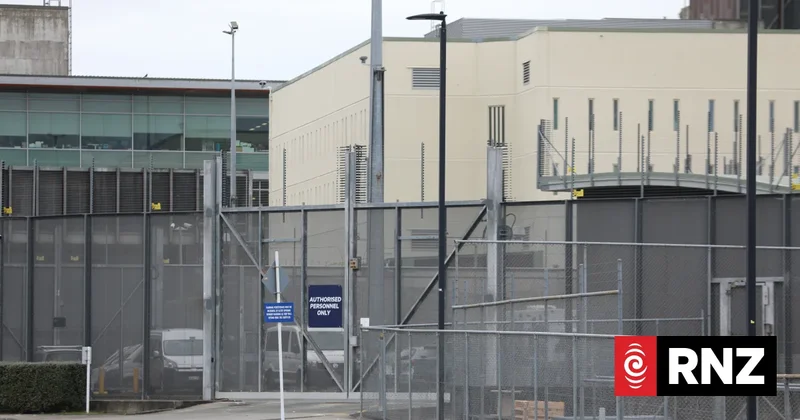
Corrections is undertaking a comprehensive review of the country's second-largest prison, RNZ can reveal.
Corrections says the review of Mt Eden Prison comes after it has experienced "significant changes and challenges in recent years".
In response to questions from RNZ, Deputy Commissioner of Northern Men's Prisons Liz Hawthorn said the "safe and secure operation of our prisons was a top priority".
"Mt Eden Corrections Facility has experienced significant changes and challenges in recent years, due in part to its increasing prison population. It is the country's second-largest prison and the only solely remand-focused facility, housing people awaiting trial or sentencing.
"The Corrections system has historically been designed around managing sentenced prisoners. Significant changes to the remand population have fundamentally changed how people move through the criminal justice system and access programmes and services."
Do you know more? Email sam.sherwood@rnz.co.nz
Hawthorn said remand prisoners were generally managed as high security and had more complex needs.
"They have much shorter stays and the constant, fast-paced movement of people entering and leaving custody puts additional pressure on staffing and infrastructure.
"For this reason, we have established an initiative at Mt Eden Corrections Facility, which will thoroughly analyse the current operation of the site and continuously identify improvements to ensure the safety of staff and prisoners."
The announcement of a review comes after a series of incidents at the prison in recent years.
In May, NZ Police revealed 20 people had been arrested following a nearly year long investigation into corruption within several prisons. Those arrested included Corrections officers, reintegration officers and members of the public associated to prisoners.
Police began the investigation, dubbed Operation Jasper, in relation to alleged criminal activity at the Mt Eden Corrections Facility (MECF) in July 2025.
The investigation initially focused on the activities of sentenced and remand prisoners at Mt Eden.
Detective Inspector Colin Parmenter of the National Organised Crime Group earlier said several Corrections officers were identified as being involved in the offending, he said.
"Several staff working in Mt Eden were allegedly involved in smuggling mobile phones, drugs, tobacco and other contraband into prison in exchange for cash," Parmenter said.
"Police believe the phones were used by prisoners to continue drug importation and distribution activities from within the Mt Eden facility."
RNZ earlier revealed there had been three homicides involving inmates in double-bunk cells at the prison in just over 12 months.
In December, Johnathan Peter Trubuhovich died 10 days after allegedly being assaulted by his cellmate at Mt Eden prison.
Trubuhovich's death followed that of another inmate in June.
RNZ earlier revealed that both men, who were in a double-bunked cell, were known to mental health services. The victim had recently been in a mental health unit in Whangārei as part of a compulsory treatment order and was in custody after breaching bail, and the murder-accused had a history with mental health services.
The killing came nine months after Andrew Chan Chui died at the prison. A 23-year-old inmate, who shared a double-bunk cell with Chan Chui, has been charged with murdering him.
After Trubuhovich's death, RNZ revealed Corrections was reviewing a risk assessment tool used in deciding whether prisoners are suitable to share a cell.
Corrections use the SACRA tool to review the compatibility of individuals before they were placed in a shared cell.
The SACRA tool identified key risk factors to consider before placing a person in a shared cell.
If a person was deemed not suitable to double bunk, a Not to Double Bunk (NTDB) alert was activated on their profile.