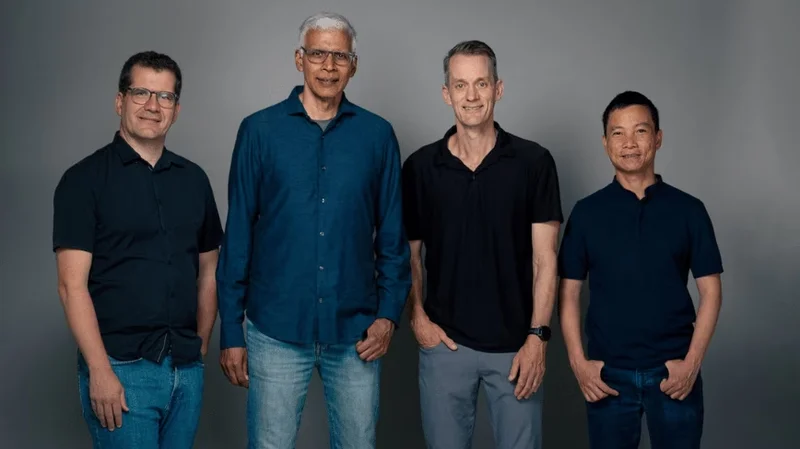
Sundar Pichai’s memo on Wednesday thanked Jeff Dean for “an incredible 27-year run” and said he was off to start a company with Sanjay Ghemawat. He posted the same two names on X. Discovery Loop’s website names four. The two Google skipped are Quoc Le, who co-founded Google Brain, and Oriol Vinyals, whose X bio reads “Gemini co-lead”.
Dean’s own LinkedIn says “Gemini overall co-technical lead”.
So on the day Google named the executive who will build Gemini 4, both of Gemini’s co-technical leads walked out.
The part Google did announce
Demis Hassabis is giving up the day-to-day running of Google DeepMind. He becomes its chair and chief scientist of Alphabet, keeps Isomorphic Labs, and moves into DeepMind’s new Platform 37 offices in London. Koray Kavukcuoglu, the lab’s technology chief, takes over as senior vice president and reports straight to Pichai. He gets Gemini 4, CNBC reported.
Kavukcuoglu has spent 13 years at DeepMind. He started its deep learning team and led the work behind WaveNet and DQN. He is not an outsider parachuted in, and nobody has questioned the choice.
The departures were paragraph four.
Thirteen years, one email
Vinyals said goodbye on X, and the note is worth reading twice. He arrived at Google 13 years ago after “a quick email exchange” with Dean. He worked on seq2seq and distillation, then co-led AlphaStar and Gemini.
Then the twist. “The best part? The same person who brought me in is challenging me to take the next leap.”
Dean recruited him in 2013 and has now recruited him out.
A company with no office
Discovery Loop barely exists yet. Steven Levy, who interviewed all four for Wired, reports the idea came together only weeks ago. There are no staff and nowhere to sit. “Our immediate order of business is to find office space,” Dean wrote.
The timing is almost too neat. On 25 July, Dean stood in front of 6,000 would-be founders at Y Combinator’s Startup School and gave a talk billed as the number one rule for building in AI. The interviewer asked what areas startups should tackle. Eleven days later he announced his own.
They pitched a handful of VC firms with a deck. Few founders have a prior-work slide that lists TensorFlow and TPUs.
The bet: AI as the researcher
“Scientific discovery is bottlenecked,” the site argues. Not the method, which it calls one of humanity’s great inventions, but the execution. Someone still has to propose an experiment, run it, read the results, and go again, one loop at a time.
Discovery Loop wants to automate the loop and run thousands in parallel. It starts with machine learning research, then does something telling: it points those capabilities at its own stack and becomes its own first customer. Only then does it go after the National Academy of Engineering’s Grand Challenges, from better medicines to clean water to securing cyberspace.
Le, who spent years automating model design at Google, sees the first target clearly. “It might be that we will discover a different transformer architecture,” he told Wired.
Vinyals named the hole in the plan. “One of the things that we’ll be obviously very focused on is how these models come up with new ideas to try,” he said. “That’s not something that currently they’re super strong at.”
Vinod Khosla, who is funding it, was less measured. Backing the four could produce something “larger than the impact that Google had”, he wrote. His thesis, as he put it to Wired, is a swap of roles. People have been using AI to do research. Here, AI is the researcher.
Alphabet is on the cap table
This is not a raid, and Google is not pretending otherwise. Radical Ventures and Khosla Ventures co-led the seed round. Lightspeed, Kleiner Perkins, Doerr Capital and Alphabet itself joined, and the New York Times reports Google holds a stake. Nobody is disclosing the size or the valuation.
Radical’s Jordan Jacobs takes a board seat. Google is the cloud partner and will supply the compute for year one. It also wants a joint research framework on machine learning systems.
“Jeff and Sanjay helped to drive some of the most significant technology transitions,” Pichai wrote, “from our early search infrastructure to the neural networks that helped create the modern AI era.” Warm, and entirely true. It still names two.
The market read it as subtraction
Alphabet fell around 5%, touching $362.31 in New York, Bloomberg reported. It called the overhaul seismic and said it cast doubt over the leadership of a critical growth area just as competition sharpens.
The backdrop is unhelpful. Google’s next flagship model has slipped several times this year, Business Insider reported, including one Gemini Pro delay over coding performance. The company also turned cash flow negative for the first time on record last quarter, while guiding to capital spending of up to $205bn.
The commentary ran harsher than the coverage. “Game over,” wrote Tae Kim, calling Dean and Hassabis the two most important AI executives at Google. The researcher Nathan Lambert reckoned the episode will be studied for years as the incumbent that held every advantage and could not get moving. Axios was cooler and no kinder, placing the reshuffle inside a company “struggling to keep pace with OpenAI and Anthropic”.
Not everyone read a verdict. Steven Sinofsky, who once ran Windows, called the four’s work truly generational. He noted that fusing research with product has been a brass ring of corporate labs for as long as computer science has existed. Researchers leaving to build is the oldest story in the industry.
Google’s own numbers cut the other way too. The Gemini app is past 950 million monthly users and Gemma downloads are past 900 million, a quarter after Pichai told doubters Google is not losing the AI race.
Hassabis goes long
Hassabis framed his move as a choice about where to spend himself. “We have arrived at a pivotal moment in human history,” he wrote. “I’ve been working towards AGI my whole life and now, like many of you, I feel it is close at hand.” He wanted the time and space for the big picture rather than daily operations.
The rest goes to drug discovery. “It’s time for AI to prove its unequivocal value to the world, and what better way to demonstrate that than to help finally cure diseases like cancer.” Isomorphic, now moving into trials, is where that claim gets settled.
One detail travels badly from California. Alphabet’s chief scientist, the person it has put in charge of thinking about AGI, will be sitting in London.
Two companies, one claim
Put Wednesday’s two documents side by side and the same boast appears in both.
Pichai’s memo calls Google “the only company that has the full stack”, world-class at every layer from infrastructure to frontier models to applications. Discovery Loop’s site says its founders have “true full-stack depth that spans chips, hardware infrastructure, software infrastructure, ML models, and products”.
One of those companies employs tens of thousands of people. The other has four and no office. Their shared credit list runs from Search and MapReduce through Spanner, TensorFlow, TPUs, AlphaFold and Gemini, which makes the claim cheeky rather than absurd.
None of this is new pressure on Google. TNW has covered the morale and talent strain inside DeepMind before. What is new is the arithmetic: one promotion announced, four researchers gone.
The site closes on the line Google will find hardest to answer. “Imagine a future where a handful of people can conduct scientific research and engineering tasks much more rapidly, and with higher quality, than massive teams of scientists and engineers do today.”
Four people just left a massive team to test it, on compute Google is selling them, with Alphabet’s money in the round. Gemini 4 will tell us who was right.
Get the TNW newsletter
Get the most important tech news in your inbox each week.