Sign in. It’s quick, free and it’s up to you.
An account is an optional way to support the work we do. Find out more.
DONALD TRUMP DESERVES three resounding cheers from all of us, and no mistake. Fair fecks to the main man – he has done this country a solid.
Just as we’re all being assailed by the post-summer blues thanks to the return of cranky school runs, of emulating glaciers along the (ha!) ‘rush-hour’ M50, of resolutely ignoring holiday credit card bills that would put the frighteners on Elon Musk himself – up pops POTUS, right on time.
His upcoming visit to Dublin and Doonbeg is a gift, offering us the opportunity for one last massive holiday hooley, for a Yellapalooza, a festival of effs, a golden chance to drink deeply of the last of the summer whine. Autumn – the season of red mists and bellowing fretfulness – is arriving with a bang. Time to break out the snarky posters, witty placards, whistles, flasks of tay, and unleash the dogs of, well, grievance and outrage.
What do we want? A protest. When do we want it? The second Friday in September will do very nicely thanks very much.
We can’t really blame our government for landing us with President Trump. The Taoiseach and various political poobahs may paste on smiles and mutter céad míle fáiltes until the cows come home, are milked and snoring in their byres, but we all didn’t paddle en masse up the Liffey in a massive canoe. We know he more or less invited himself, akin to a beaming American backpacker you once met in a bar in Kathmandu who took your drunken invitation to “come and stay anytime” seriously, and has turned up at short notice on your doorstep with a few pals who’ll be no trouble at all.
The government needs this visit like a hole in the head – in fact, members of our political establishment would in all likelihood welcome a serious cranial injury, if only it could be traded for a presidential reverse ferret on visiting what mercifully is not his auld country.
Any visit by America’s commander-in-chief is a security nightmare, but a visit by this particular White House incumbent is less nightmare and more full-blown ayahuasca psychedelic fever-dream.
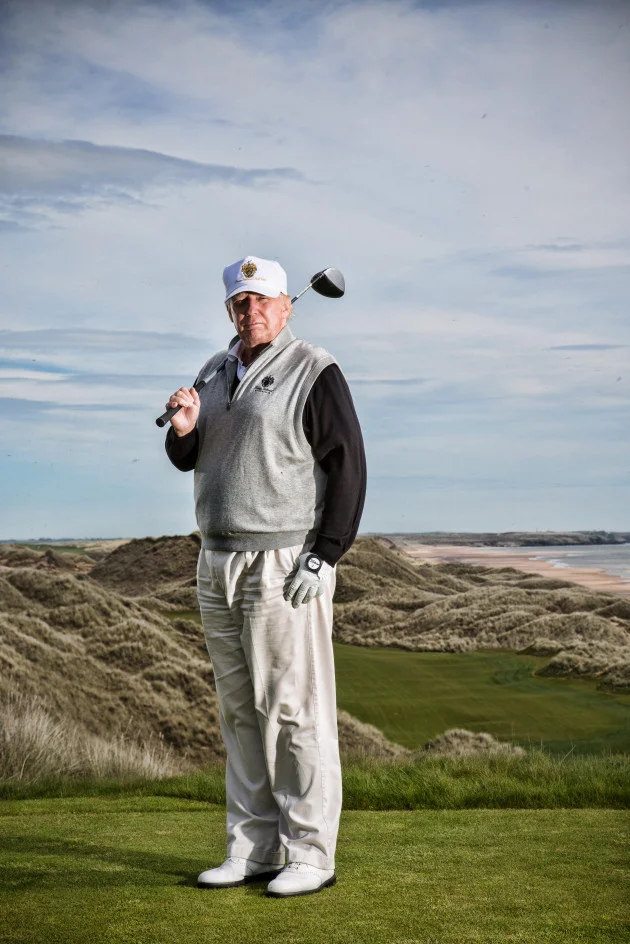
The gardai and security forces are up to their oxters already, providing protection for the steady stream of European bigwigs in and out of the country during Ireland’s current presidency of the EU Council, and now the thin blue line will have to extend itself around Trump’s travelling zoo. One newspaper reports this week that there could be up to 1,000 people in his entourage, including, presumably, official burger-tasters, embedded Russian spies, some minions to quietly kick his balls (golf ones) onto the fairway from the rough – oh, and several hundred travelling media.
Those media will want plenty of copy, so the citizenry may oblige by turning out en masse for a peaceful protest.
It’s been a fair while since we’ve had a grand day out, and we’re really rather good at protests (the violent and hate-fuelled thuggery which wreaked havoc in Dublin city in 2023 doesn’t count – it had nothing to do with democracy or with ordinary decent people).
After all, it was Ireland who added the word “boycott” to the dictionary of dissent in 1880 during the Land Wars, when the attempted evictions of tenants by land agent Captain Charles Boycott from the properties of absentee landlord Lord Erne led to the total social ostracisation of the agent. The concerted cold shoulder – Boycott’s workers left his fields and stables and his house, and local businessmen stopped trading with him, and the local postman refused to deliver his mail – led to an armed escort from the estate and his abrupt return to England.
But in more recent times, protests have served various purposes with varying success, whether as part of an effort to drag Irish society towards newfangled notions such as equality and secularism, or to vent ire at cockamamie policies or decisions foisted on the electorate by governments, or to express opposition to unjust wars and solidarity with those suffering as a result of them.
The 1970s and ‘80s were marked by a particularly febrile period of protests – unsurprising, given the grimness of many aspects of life in Ireland at the time. Some were large, others small but perfectly formed.
Second wave feminism had crashed onto our shores, and the sisterhood was gloriously on the march. In 1971, a platoon of doughty dames from the Irish Women’s Liberation Movement protested the illegality of contraception in the Republic by hopping a train from Dublin to Belfast, where the sales of such dread items were legal, if restricted. They returned to a tumult of international media, triumphantly waving condoms and spermicide jelly – unable to buy the pill without prescriptions, they bought hundreds of packets of aspirin, as they realised that the majority of the Customs officials would not know what the pill would look like.
They swung back into action in 1974, staging an “invasion” of the Forty Foot, the south Dublin men-only swimming area. Journalist Nell McCafferty, who was among the posse, later reminisced, “Some of the men, who often swam naked at the spot and were upset by the invasion, waved their genitals at the invaders.”
Also in the 1970s were the anti-nuclear power concerts in Carnsore, county Wexford, and the titanic but doomed struggle to save Wood Quay, a significant Viking settlement on the capita’s quayside which was to become the foundations for possibly Ireland’s ugliest edifice, Dublin Corporation’s HQ. Over 20,000 joined in a march in 1978, and to the forefront of that protest was Labour Senator and future president, Mary Robinson.
In fact, future presidents pop up in relation to various protests. Reporting for RTÉ on the gigantic PAYE protest marches in 1980 calling for a more equitable tax system – 700,000 took to the Irish streets, including 350,000 in Dublin – was journalist Mary McAleese. In 1984, it was a far smaller but nonetheless voluble demonstration which greeted President Ronald Reagan at Shannon Airport, including Michael D. Higgins, protesting what he viewed as American interference in Nicaragua.
Over the years the highways and byways have been taken over by the A to Z of Irish society, from farmers to students, ranging from the estimated 100,000 people who protested against the Iraq war in 2003, to the rowdy rally by the ‘gray army’ of pensioners in 2008 who, irate at proposed changes to medical card entitlements, put the heart crossways on the government who executed a speedy climbdown, to the rancorous belligerence of the fuel protests earlier this year. There was the 35-year-long protest against the 8th Amendment: the anti-referendum campaigns in 1983, the huge X case march in 1992, the mingled anger and grief of the vigils and rallies following the death of Savita Halappanavar in 2012. And then there were the powerful waves of demonstrations in 2015 which were sparked by the introduction of water charges, but were really a collective cri de coeur from a populace still battered by austerity and shell-shocked by the destruction of our economy.
But it’s been a while since we’ve had a mind to stage an all-hands-on-deck sort of massive march; the last occasion Donald Trump has been on Irish soil as a sitting president was in 2019, but he remained in his relatively secluded – and reasonably easily secured – Doonbeg golf resort in the west.
This time he may be in the capital also, turning the sod on the new US embassy in Dublin 4, and possibly even visiting President Connolly in the Park; undoubtedly she’s busy polishing the best china (or Chyyyna). Whether it’s used to serve him a Diet Coke or hurl it at him during a ‘robust exchange of views’ is anyone’s guess.
Ireland being a democracy, his MAGA supporters can organise their own welcome party for their hero, of course. It’ll be the biggest welcome party of all time; nobody will ever have seen a crowd like it before. Not Clinton. Definitely not Obama.
And this is the great thing about Donald Trump. He ticks all of the protest boxes. Against the wars in Iran and Gaza? Check, check. Opposed to US support for Putin’s invasion of Ukraine? Check. Against the evisceration of climate change measures? Check. Pro-science-based medicine? Check. Anti-toxic misogyny? Check. Anti-FIFA money-grab? Check. Pro-Pope Leo? Pro-Europe? Anti-authoritarian? Check, check, check.
Some protests have a clear or unified aim. But at other times it’s simply about standing up to be counted, an offering of solidarity with those in non-democracies who aren’t as lucky.
We protest because we can.
So what do you think? Is there anything to be said for another mass demo?
*Lise Hand is a journalist and writer. This column runs every Wednesday. *
To embed this post, copy the code below on your site