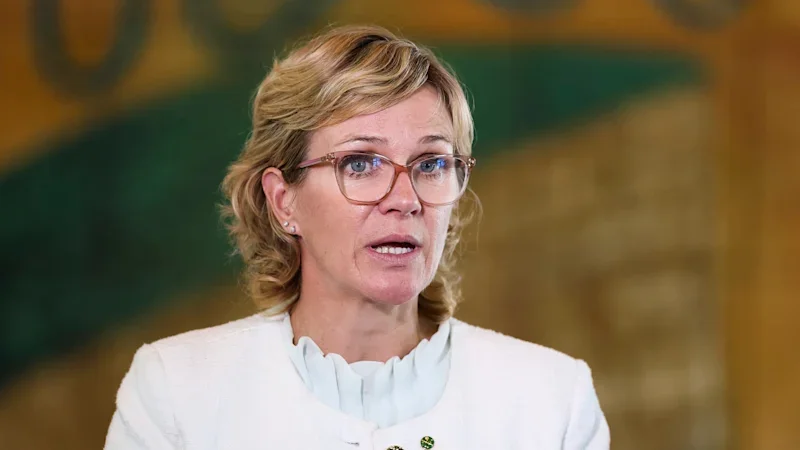
Independent MPs representing suburbs where house values are falling at the fastest rate in the nation have backed the federal government’s negative gearing and capital gains tax changes, saying they will finally give young people a chance to buy a home.
Zali Steggall in Sydney and Monique Ryan in Melbourne said house prices in their electorates were beyond the reach of too many people, with values climbing for too long and at an unsustainable rate.
Figures released by Cotality this week showed dwelling values fell by 0.9 per cent in July, the fourth successive monthly fall. Steep falls in Sydney and Melbourne house values led the decline, although every capital city market is slowing.
The slowdown began at the start of the year, coinciding with the increase in official interest rates by the Reserve Bank. Cotality and other property experts say rate rises, poor affordability levels and the budget’s property tax changes have all contributed to the drop.
The biggest fall over the past three months has been in the top quarter of the property market. Values in the bottom quarter have grown slightly.
Data compiled by Cotality for this masthead shows the biggest hits to value have been in some of the nation’s most expensive suburbs.
The single largest drop over the past year has been in North Sydney, in Steggall’s electorate of Warringah.
The area’s median dwelling value has slipped by 8.9 per cent, taking it down to just over $1.5 million. Even at that level, it is still $300,000 above Sydney’s median dwelling value of $1.2 million.
Steggall, who recently started new political party Community Strong Australia with fellow independent Allegra Spender, said she understood that falls in home values would be a concern for homeowners, particularly those who were highly leveraged.
“However, Australia faces a genuine housing affordability crisis,” she told this masthead.
“My electorate has some of the least affordable housing in Australia, and some of the lowest rental availability. That creates real housing stress.”
Steggall backed the federal government’s budget changes to property tax settings, saying the current downturn would even out over the longer term.
“Government modelling indicated that, after an adjustment period, house prices would return to more measured growth,” she said.
“The previous growth rate was unsustainable, and locked younger generations out of homeownership, which does not benefit our communities.”
Of the 10 areas with the largest declines in Sydney, nine all have values still well above the city’s median value. That includes Ku-ring-gai in the seat of Mackellar, where despite a 7 per cent drop the median value is almost $2.8 million.
In Melbourne, the biggest fall has been in the Boroondara area that sits largely within the seat of Kooyong, which Ryan retained at the 2025 election. Values in Boroondara have fallen by 8.8 per cent over the past year to almost $1.5 million.
Melbourne’s median dwelling value is $797,000.
Ryan said the drop in values in Sydney and Melbourne was welcome news to young people and first home buyers who had experienced high house prices and cost-of-living pressures for years.
She noted a recent community survey in her electorate showed 73 per cent of respondents backed the government’s changes to capital gains tax while 85 per cent supported the restriction on negative gearing.
“Most Australians have understood for a long time that housing has become increasingly unaffordable, especially for first home buyers, and that the price of housing had become a threat to our social fabric,” she told this masthead.
“We need to hold fast to the principle that we need housing to become more affordable and accessible in Australia, govern such as to facilitate that, and not overreact in the face of fluctuations in an inherently variable market.”
Outside the nation’s two largest property markets, the recent drop in values still leaves even the worst-performing areas well up over the past 12 months.
The smallest increase in Brisbane has been in the city’s inner east where values have risen by 9 per cent over the past year to a record $1.4 million. There were also “modest” 10 per cent increases in Enoggera ($1.3 million median value), Nathan ($1.3 million), Mt Gravatt ($1.4 million) and Carindale ($1.6 million).
Across the city, the median dwelling value is $1.1 million.
In a sign of how strong the Perth market has been, no suburb has gone backwards over the past year. The smallest increase in values has been in the Cottesloe-Claremont area, where they have lifted by 8.5 per cent and the median value is now $2.6 million.
Three parts of Perth made the bottom 10 areas despite their values having soared by more than 20 per cent.
The MPs appear to be in line with public opinion. Sixty-one per cent of people backed a fall in property prices, the most recent Resolve Political Monitor Poll found, with a majority of every age, political and income group agreeing that prices were too high.
The same poll, of 2252 people, also found support for a drop in the price of their own home. While 15 per cent said they wanted the price of their property to keep climbing, 23 per cent backed no change while the remaining 62 per cent supported a fall. Fourteen per cent supported a drop of at least 20 per cent.
The Coalition claims that falls in property values are particularly large in areas where first home buyers are most using the federal government’s expanded 5 per cent deposit scheme.
Acting Coalition leader Jane Hume was in Perth on Wednesday, saying people who had used the deposit scheme were now potentially in negative equity.
“That’s pretty scary,” she said.
The Reserve Bank, which next week is expected by financial markets to leave official interest rates on hold, believes examples of negative equity – where a person’s mortgage is larger than the value of their property – are rare.
In a major speech last week, bank governor Michele Bullock noted that despite recent price falls, negative equity was “very limited” with less than 1 per cent of borrowers affected.
“Of that small group, our estimates suggest that only a small share of borrowers are facing severe difficulty with their loan repayments,” she said. “This is not to downplay that this would be stressful for those affected. But it does indicate that financial stability risks are contained, and borrowers, in aggregate, have built up considerable savings buffers over recent years.”
The most recent increase in negative equity was in 2019 when it reached about 2 per cent.