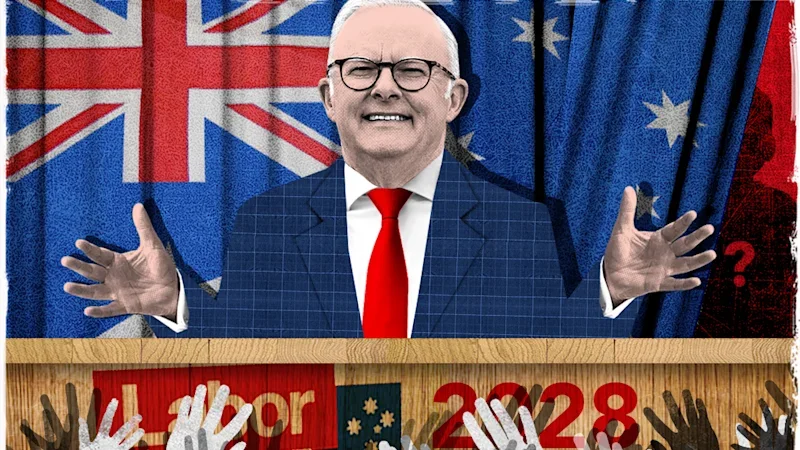
For someone who claims not to have considered himself leadership material until he reached 50, Anthony Albanese is certainly racking up some impressive stats. He’s led the Labor Party for seven of the 13 years since his moment of self-revelation. By the end of next week, Albanese will have served longer as prime minister than Paul Keating.
Next year he’ll become the fourth-longest-serving Labor leader, overtaking Kim Beazley and Andrew Fisher. By the likely time of the next election in May 2028, he will have overtaken Bob Hawke’s eight years and 314 days, and only Gough Whitlam and John Curtin will have led the party for longer. That is storied company, given Labor’s habitual focus on its history.
One more number: if Albanese leads Labor to victory in 2028, securing a third term of office, he’ll be 65 – the same age as John Howard when Howard scored his last election victory in 2004. Sixty-five is old. It used to be the official age of retirement. But is it necessarily too old? As medical knowledge and treatments progress and lifestyles change, it’s getting harder to determine just how seriously old “old” is. All the same, it’s worth asking how much longer Albanese plans to remain in the job.
Albanese has improved in the prime ministerial role as he’s continued to inhabit it. Success can help with that. One advantage he has over most of his five prime ministerial predecessors, going back to Kevin Rudd, is that when he became prime minister he was a parliamentary veteran. (He’s now in his 31st year as the member for Grayndler.) When you’ve survived for that long, you’re not easily intimidated by individuals or events.
Obviously, leaders have always mattered, but in an impatient, ever more distracted world in which technologies and so much of the culture elevates the individual, they matter more than ever.
All too often in our politics, a leader is expected to solve a party’s woes, and if their magic wand doesn’t work, it’s then assumed that they’re either part of the problem or the chief cause of it, so a new one needs to be appointed. This conviction has become a feature of the federal Coalition’s behaviour. In the 19 years since its 2007 election loss, the Liberals have had eight changes of leader.
The thing is: unless you’re Albanese right now or Howard back in the early years of this century, being a leader isn’t all that great. There’s never a shortage of takers: many, many politicians either overtly or privately believe they might make a good one. Fortunately for them – and for us – their musings don’t become reality. To get the job, keep it and do something with it, you have to possess a special type of personality. A period of leadership is an extravagantly heightened example of life in miniature, something akin to a stop-motion film of a flower growing, blooming and dying all inside 30 seconds.
The moment you begin as leader, the clock ticks ever louder, counting down the seconds until your demise, and most of the deaths are ugly or at the very least humiliating. All the way through, even in the good times, a substantial proportion of your fellow citizens automatically hate your guts and don’t try to hide it: you’re stupid or a clown or evil and the proof of that is you get up every morning and go to work. This enormous chorus of naysayers is amplified in the digital media landscape.
So, the environment is unforgiving, but then there’s also an unwelcome truth: in or out of government, the job is incredibly difficult. The evidence is that more than a few of those who ascend to leadership positions don’t have the required capabilities. In fact, most political leaders, for all their often considerable personal qualities, are flops.
Jacinta Allan’s time as premier will live on as the peak domestic example of how not to execute a leadership role.
The Victorian government last week dismissed Jacinta Allan as its leader after almost three befuddling years wondering why she ever sought the job. The government in the UK recently tossed Keir Starmer out for the same reason. If you don’t have any ideas and don’t want to impose your personality on the role, then don’t sign up for it in the first place because while you’re sitting pat, voters will write their grievances on your blank space and blame you for them. Allan’s time as premier will live on as the peak domestic example of how not to execute a leadership role.
The key questions for Albanese centre on his personal mojo rating, which seems OK at this stage given how much he loves being top dog, and how viable his steady-as-she-goes demeanour will remain in the face of the ostensibly disruptive One Nation insurgency. Being a veteran is not all upside.
This is an age where there’s always an underlying desire for something new, be it information or entertainment. Albanese’s belief that consistency and constancy will provide a safe haven to which most voters will want to return come election times has weight. But every successful idea and strategy is successful until it isn’t. Audiences can tire of old acts. So, too, can a leader’s colleagues.
Albanese’s goal of establishing the Labor Party as the natural party of government by its nature assumes that he will either be succeeded or, a little more violently, replaced. Succession plans hardly ever work out in politics; the incumbent usually becomes convinced that their past victories render them irreplaceable.
That was what happened in the Howard government’s final days. With an election imminent, Howard, 68 and a parliamentary veteran like Albanese, refused to make way for his deputy, Peter Costello. Labor’s campaign team was seriously worried this might happen.
It did not end well for the Coalition: Labor under Rudd won comfortably and Howard, the great Liberal champion for so many years, suffered the indignity of losing his seat.
In politics, when you’re going well it’s only ever a temporary situation. Thus, it’s every successful leader’s obligation to think about what will come after they’ve gone and prepare the groundwork for it.
Shaun Carney is a regular columnist, an author and former associate editor of The Age.
The Opinion newsletter is a weekly wrap of views that will challenge, champion and inform your own. Sign up here.