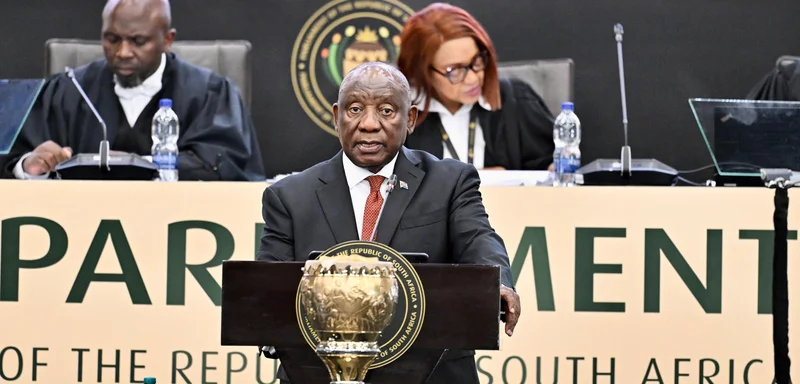
Despite previous appeals for consensus-building between political parties, on Wednesday, 5 August, it was clear the impeachment committee remained divided over who should serve as evidence leader. The choice came down to advocate Kate Hofmeyr and advocate Thandazani Madonsela, who carried the vote with nine to seven.
ANC MPs abstained in the vote, alongside the Patriotic Alliance and Al Jama-ah. Daily Maverick established that the ANC decided on this course because it did not want to be accused of double standards, as an ANC study group previously received a legal opinion from Madonsela.
Earlier, parliamentary lawyer Sueanne Isaac told MPs Madonsela had declared this, saying he had been briefed by âa firm of attorneys representing a study groupâ, but that his role had been âminimalâ, limited to overseeing a junior before the brief ended on 5 July 2026.
The ANC lawmakers previously opposed advocate Vuyani Ngalwanaâs nomination because of an opinion critical of President Cyril Ramaphosa, and on Wednesday, before the vote, continued to sharply criticise him for bias. ANC MP Mikateko Mahlaule also cited posts on X, formerly Twitter, including one from August 2023 when Ngalwana called Ramaphosa a âconstitutional delinquentâ.
ANC MP Cameron Dugmoreâs call for the impeachment committee to vote to exclude Ngalwana fell on deaf ears as other political parties objected to how the advocate was being treated.
Ramaphosa may be compelled to testify
The question of whether Ramaphosa could be compelled to testify, a previous sticking point, was met with less contestation.
âIt will be difficult in our constitutional framework for the President not to testify,â said Isaac.
Parliamentâs constitutional mandate to oversee and hold the executive to account meant the President could be compelled to testify, although established practice was to first issue an invitation.
Silence was not an option, as it could be in criminal matters, but in line with existing rules, testimony may not be used in other proceedings. That a president called to account by the National Assembly for allegations of serious violations of the Constitution or the law had a right to remain silent was âcontradictory to the⦠constitutional schemeâ, according to parliamentary legal opinion.
The decision to call the President meant the draft terms of reference dropped the ifs and mays from the section on the Presidentâs testimony, although a final version of these terms of reference will be considered only when the impeachment committee meets in two weeks.
Standard of proof
Tensions instead rose over whether the standard of proof was beyond reasonable doubt or on a balance of probability, court standards in criminal and civil trials respectively.
Parliamentary legal opinion held the criminal standard of proof of beyond reasonable doubt as âunsuitableâ and the civil standard of on a balance of probability as inadequate. Instead, it recommended lawmakers should set a standard of âcogent, reliable and persuasive evidence sufficient to satisfy constitutional requirements of legality, rationality and procedural fairnessâ.
ANC MPs repeatedly asked for details of what that meant, citing criminal and civil trial standards, despite the precedent of the section 194 impeachment of former public protector Busisiwe Mkhwebane. That inquiry did not define a standard of proof, but conducted a fact-finding and tested facts against the requirements for impeachment. Mkhwebane was removed from office by 318 votes against 43 on 11 September 2023.
âTime-wastingâ
Amid this circuitous discussion, EFF leader Julius Malema accused them of time-wasting.
âWe cannot deal with a criminal matter; we are not judges. We cannot deal with a civil matter; we are not judges. We are politicians in a political institution, Parliament,â he said.
âWe must be alive [to that] not all of us want this thing to proceed⦠As we do this process, we have to find evidence, we interrogate people and evidence put before us and tested. And there must be consensus that will stand the test of time.â
The discussion on the terms of reference stood out for its lack of MPsâ input when previously every detail attracted comment from every MP, even if only to repeat previous points. Gana appealed to MPs to agree to transcripts within four days over cost considerations, while African Christian Democratic Party (ACDP) MP Steve Swart, a lawyer by training, challenged that the committee had to first agree to cross-examine witnesses before MPs could ask questions, as is the parliamentary norm.
Political tensions
Wednesdayâs impeachment committee proceedings, from the vote on the evidence leader, legal opinion and the contestation around standards of proof, signal underlying political tensions.
The pact between the PA and ANC is clear, with Al Jama-ah falling into the fold. Though fellow government of national unity coalition partners, the DA, Freedom Front Plus and IFP, often join that side, itâs not a given. For example, the DA supports the committeeâs appeal over the interdicted public impeachment hearings.
On the other side is a front of the EFF, MK party, African Transformation Movement (ATM) and United African Transformation (UAT). More often than not, the ACDPâs Swart is in support, while the ActionSA and Build One South Africa (Bosa) reps on the committee move across the broad oppositional groupings.
For ANC MPs, the impeachment committee is an uncomfortable space. The lawmakers participate in what could have serious consequences for their ANC President without the comfort of sufficient numbers in the House to defeat undesired outcomes.
In December 2022, the ANC voted down the section 89 independent report recommendation that Ramaphosa had a case to answer over the forex theft from sofa cushions on the Presidentâs Phala Phala game farm. When the Constitutional Court in March 2023 refused the President direct access to challenge that Section 89 report, Ramaphosa let the matter rest.
That changed when the Constitutional Court found that the parliamentary vote was unconstitutional and invalid and referred the impeachment proceedings back to Parliament. Ramaphosa subsequently launched a review of the section 89 report and, after Parliament declined his request to halt proceedings, successfully also obtained an interdict against public impeachment proceedings.
The possibility of further litigation by the losing side in the review application could see lengthy delays in the impeachment proceedings.
An appeal by the EFF, ATM, MK party and parliamentary impeachment committee is set down as Ramaphosaâs review of the section 89 independent panel report starts in the first week of September. DM