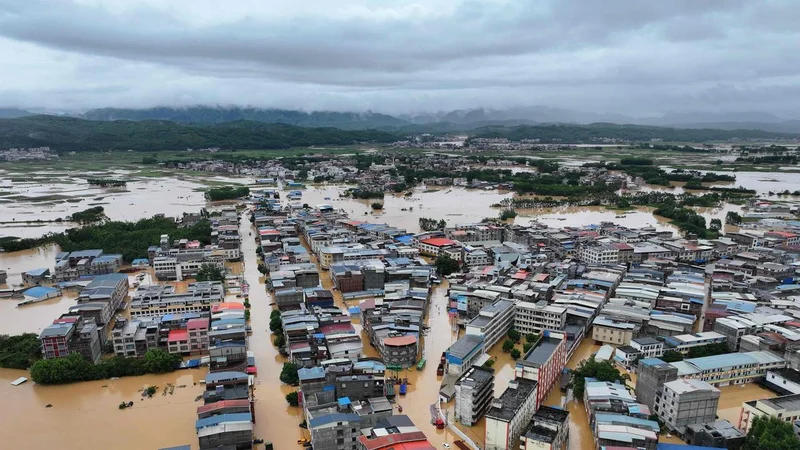
This year, El Niñodelayed the monsoon in India. When the rains arrived, they were intense, with cities such as Mumbai and Surat receiving a month’s rainfall in a matter of days. Regions in Assam and Odisha have experienced severe flooding, resulting in loss of life and damage to infrastructure. Similar conditions have recently affected large swathes of China’s provinces, particularly Guangxi, Shaanxi and Gansu. Such extreme weather events are becoming increasingly common, threatening economic growth, food security, and public well-being in the two most populous countries.
In both cases, experts attribute these short, high-intensity bursts to climate change which is causing higher atmospheric temperatures and rapidly warming oceans. Mitigating and recovering from these frequent and large-scale events will become increasingly important for China and India to address. Given the scale of the challenge, could climate resilience become an opening for India-China cooperation?
Similar climate extremes
India and China confront remarkably similar challenges. Rapid urbanisation has replaced wetlands, forests, and permeable surfaces with concrete. Changing weather patterns, combined with outdated drainage systems, poor waste management, rapid urbanisation, and a lack of green spaces, have aggravated waterlogging and flooding. Coastal megacities face the combined risks of extreme precipitation, storm surges, and sea-level rise, while inland cities grapple with heatwaves, droughts, and flash floods occurring in quick succession. These challenges demand scientific collaboration, technological innovation, stronger local governance, and community participation. The costs of inaction include disrupted supply chains, economic losses, declining productivity, and mounting public health risks. This may be the right moment for renewed engagement between India and China. After years of strained ties, bilateral relations are showing tentative and slow signs of improvement.
In April 2026, the visit by a Chinese delegation led by China’s Special Envoy for Climate Change to New Delhi suggests that climate cooperation remains a priority. Within the area of climate and clean energy, identifying key issues for engagement is important. Collaboration in areas such as green technology and critical minerals remains challenging due to economic competition and geopolitical tensions. Disaster mitigation and urban resilience could offer a relatively low-risk pathway for rebuilding trust.
Past engagement, sister city agreements
A mapping of India and China’s climate engagement in a recent paper by the Centre for Social and Economic Progress (CSEP) shows that there is precedent for such engagement. Beginning from the early 1990s until 2020, there were several summit-level joint statements, agreements and Memoranda of Understanding (MoUs) calling for practical cooperation on climate change. Topics included climate-induced disasters such as floods, earthquake, droughts and extreme weather events. These MoUs promised facilitation of joint research and development, hydrological, oceanic and seismic data sharing, and exchange of governance practices. During the six Strategic Economic Dialogues, policymakers discussed sustainable urban planning, waste management, sewage treatment, water efficiency and capacity building.
Practical implementation of joint projects in these areas was formally agreed upon in the multiple sister city agreements — Delhi-Beijing, Mumbai-Shanghai, and Chennai-Chongqing. Yet, disruptions in diplomatic engagement resulted in little on-ground action.
China demonstrates the importance of embedding resilience into core urban and rural planning investment decisions. This includes using data-driven approaches to drive policies in transport, housing and drainage systems. India’s strength lies in adaptive governance, spearheading community-led strategies for targeted interventions in vulnerable populations.
Successes in India have been seen in early warning systems, heat action plans, cool roofs and nature-based solutions. There has to be engagement between state and non-state actors. Officials from municipal governments can enable knowledge and policy exchanges on urban design such as sponge cities, drainage modernisation and waste management.
Beyond urban issues, rural livelihoods and resilient agricultural practices for food security become salient points for mutual learning. Joint collaboration between planning agencies and academic institutions can improve systems for hydrological modelling and integrating regional and indigenous knowledge into climate adaptation strategies. A critical aspect will be addressing challenges of the melting glacial systems in the shared Himalayan ecosystem. While India and China had agreements on shared water resources, they ceased to function in 2022.
The finance gap
A major barrier to climate adaptation remains financing, with both countries relying heavily on public funds to carry out their policies. Bridging this gap requires greater private sector participation through tools such as blended finance, municipal bonds, and credit enhancement. However, these are nascent ecosystems, constrained by limited local capacity and regulatory gaps. Evidence-based studies and knowledge exchanges between India and China on these models could provide an innovative avenue for engagement. Such cooperation would not only benefit both countries but also enable them to shape climate resilience norms across the Global South through stronger standards, metrics, and fiscal frameworks.
Climate change impacts transcend national borders, from Europe’s heatwaves to Asia’s heavy monsoon floods. Greater coordination and cooperation could provide India and China with a pathway for a low-risk, win-win engagement.
Shruti Jargad is a Non-Resident Research Associate at the Centre for Social and Economic Progress (CSEP); Pooja Ramamurthi is a Fellow at the Centre for Social and Economic Progress (CSEP). The views expressed are personal
Published - August 06, 2026 12:08 am IST