Topline
One week after Dr. Anthony Fauci pleaded the Fifth Amendment throughout an hours-long grilling by a Senate committee, the infectious disease expert who advised the United States’ COVID-19 response will face a contempt of Congress vote on Thursday as Sen. Rand Paul, R-Ky., seeks to refer him to the Justice Department for charges.
Key Facts
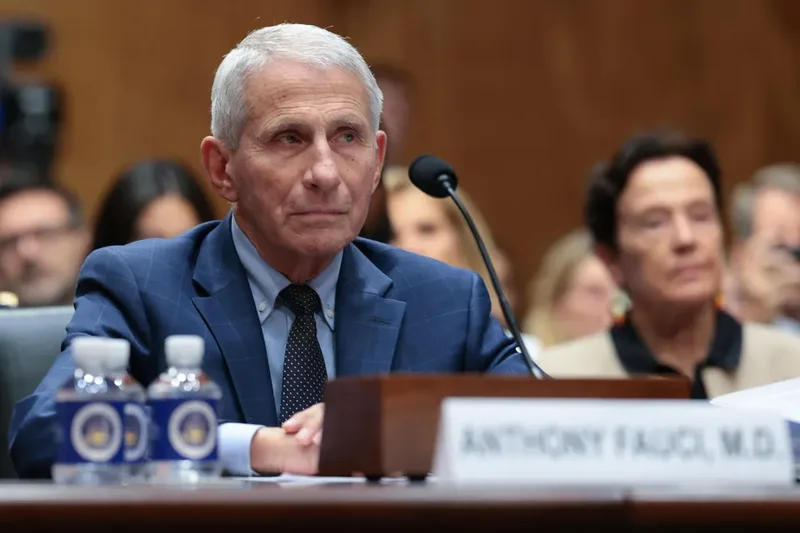
Fauci’s contempt vote is scheduled for 8:30 a.m. on Thursday by the Senate’s Homeland Security and Governmental Affairs committee, chaired by Paul, who led the committee’s questioning of Fauci last week.
Paul released the text of the committee’s contempt resolution Tuesday evening, which alleges Fauci’s use of the Fifth Amendment is “unsupported” because former President Joe Biden pardoned him before leaving office—though some legal experts have argued the threat of state or local prosecution means Fauci is able to invoke his Fifth Amendment rights.
Paul’s resolution alleges Fauci “waived his right to claim the privilege” because he opened his testimony with brief remarks that addressed “subject matter pertinent to the questions under inquiry.”
In a post on X Tuesday, Paul said Fauci is “fully protected by a sweeping pardon, immune from prosecution, and he still refuses to comply with a lawful subpoena,” calling it the “very definition of contempt for the American people.”
Fauci’s lawyer David Schertler previously said he is “completely confident” Fauci was “on solid legal ground in asserting” his Fifth Amendment rights, saying Paul “may be a doctor, but he is not a lawyer.”
What Do We Know About The Contempt Vote?
Fauci will first face a contempt of Congress vote within the 15-member Homeland Security and Governmental Affairs committee, which has an eight-member Republican majority. Paul has said he believes the resolution will pass in committee, but suggested he would send the criminal referral straight to the Department of Justice, rather than holding a vote in the full Senate. “We can debate that, but since it’s not really a law, it doesn't have an exact procedure,” Paul told Fox News of his decision to skip a full Senate vote—which faces a higher bar to pass, as it would require 60 votes. The contempt resolution says the president of the Senate, Vice President J.D. Vance, “shall certify” the resolution and refer the report to the U.S. Attorney for the District of Columbia. Contempt of Congress is a federal misdemeanor that criminalizes a subpoenaed witness who refuses to “answer any question pertinent to the question under inquiry,” punishable with a fine and up to one year in prison.
Was Fauci Permitted To Invoke The Fifth Amendment?
Whether Fauci was able to wield his Fifth Amendment rights to decline to answer questions at last week’s hearing is a subject of debate, as legal experts have generally said he was able to use it—while Paul and other Fauci critics have argued Biden’s pardon of the infectious disease expert precludes him from claiming his Fifth Amendment rights. Biden’s pardon of Fauci, which covers any potential federal offenses committed between Jan. 1, 2014, and Jan. 19, 2025, does not cover actions committed after the pardon was issued. But some legal scholars have said Fauci is still under reasonable threat of state or local prosecution, which could give him the right to invoke the Fifth Amendment. “He was invited into a situation where everyone in the country understood that Rand Paul was trying to set him up for a criminal prosecution,” University of North Carolina law professor Michael Gerhardt told the Associated Press, saying “one of the smartest things to do” in Fauci’s situation is to say as little as possible.
What Happened At Fauci’s Hearing?
Fauci began the hearing by delivering brief prepared remarks, in which he stated his intent to use the Fifth Amendment to decline to answer questions. Fauci accused Paul of an “obvious obsession with calling for my prosecution” and of making “repeated slanderous comments about me,” alleging Paul was using the hearing to “get me to say something, anything, that could vindicate his repeated public pledges that I end up, in his words, quote, behind bars.” Fauci pleaded the fifth more than 100 times at the hearing. Paul, during the hearing, warned Fauci it is “against the law to obstruct an investigation of Congress” and suggested there would be “repercussions” for his refusal to answer questions. During the hearing, Fauci was largely targeted by Republican members of the committee, including Sen. Bernie Moreno, R-Ohio, who asked: “Who the f—k do you think you were for doing that?” after telling a story of a woman arrested for not wearing masks at a football game, while Democrats thanked Fauci for his service and defended him.
What Did Fauci’s Diaries Say?
Fauci, at the hearing last week, accused Paul of releasing the diaries with the intent of “embarrassing and intimidating me.” Paul released more than 1,000 pages of Fauci’s personal diaries, spanning 2019 to 2022, days before the hearing, largely sparking outrage from right-wing critics who accused Fauci of an obsession with fame and of making contradictory statements between his public comments and private diaries. In several diary entries, Fauci processed his sudden rise to national fame during the early days of the COVID-19 pandemic, detailing interactions with celebrities and noting merch had been made of him. In May 2020, he wrote the “situation with my national and international fame is explosive and really unimaginable,” adding he might be “the most famous and talked about person in the country and one of the most recognizable person in the world.” Critics also slammed Fauci over diary entries in which he wrote he encouraged New York City leadership to close schools, despite him saying in a 2022 interview he had “nothing to do” with school closures. In other diary entries, Fauci was fiercely critical of President Donald Trump, saying the COVID-19 “press briefings are a total S— Show with POTUS rambling,” also describing a March 2020 meeting in which Trump discussed TV ratings “and virtually everything else as I was trying to keep him on track.”
further reading
Fauci Testifies Today: Here’s What We Learned From His Diaries (Forbes)