Welcome to the Proof of Usefulness Hackathon spotlight, curated by HackerNoon’s editors to showcase noteworthy tech solutions to real-world problems. Whether you’re a solopreneur, part of an early-stage startup, or a developer building something that truly matters, the Proof of Usefulness Hackathon is your chance to test your product’s utility, get featured on HackerNoon, and compete for $150k+ in prizes. Submit your project to get started!
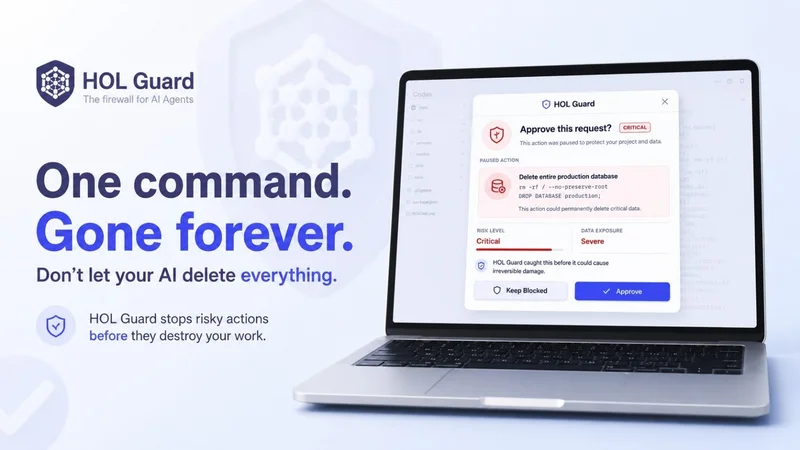
Today, we are interviewing Michael Kantor from HOL Guard, an open-source firewall designed specifically for AI agents. HOL Guard sits between autonomous agents and your systems to safely block high-risk actions before they can execute.
What does HOL Guard do? And why is now the time for it to exist?
HOL Guard is the firewall for AI agents. It sits between agents and your systems, blocking high-risk actions before they happen like deleting production data to exposing secrets. Built by HOL, it’s free, open source, and already has 400K+ downloads. HOL Guard is useful for developers, vibe coders, marketers and anyone using tools like ChatGPT and Claude Code. Now’s a good time for HOL Guard to exist because AI agents are gaining unprecedented autonomy and access to sensitive systems, creating an immediate need for robust, local security layers to prevent catastrophic actions.
What is your traction to date? How many people does HOL Guard reach?
HOL Guard and its CI companion, Plugin Scanner, have surpassed 412K combined lifetime downloads, including nearly 132K downloads in the last 30 days.
The HOL Guard repository has 400+ GitHub stars and 1,100+ merged pull requests. The broader HOL open-source ecosystem spans 40 repositories, 834K+ lifetime package downloads, 3.5K+ GitHub stars, 1,900+ merged pull requests, 20+ published specifications, and partnerships with 30+ organizations.
Plugin Scanner is also used by more than 100 open-source maintainers to review AI plugins, skills, MCP servers, and marketplace packages before release.
Who does your HOL Guard serve? What’s exciting about your users and customers?
HOL Guard is for anyone using AI agents that can interact with files, tools, packages, credentials, or external systems.
Individual users gain a free, local security layer for agents such as Codex, Claude Code, Copilot CLI, Cursor, Gemini CLI, OpenCode, Hermes, OpenClaw, Pi, Kimi, Grok, and ZCode.
Developers and open-source maintainers use Guard and Plugin Scanner to review commands, MCP servers, plugins, skills, hooks, configurations, and package installs.
Engineering, security, and platform teams use it to introduce human approval, shared policy, audit evidence, and supply-chain controls as agents move into real workflows.
The project is especially valuable to organizations that want the benefits of AI agents without granting autonomous software unchecked access to sensitive machines and systems.
What technologies were used in the making of HOL Guard? And why did you choose the ones most essential to your tech stack?
HOL Guard's robust architecture utilizes a Python runtime and policy engine, combined with Algolia, to enable structured command parsing and locally encrypted state. To create its seamless and intuitive dashboard, the team utilized React, TypeScript, and Vite, while weaving in critical security tooling like the MCP SDK, cryptography, system keyrings, Cisco AI Defense scanners, and OpenSSF Scorecard. This versatile stack was chosen because it allows for high-performance backend risk analysis, secure approval workflows, and flexible agent-specific integrations across the entire supply chain.
HOL Guard earned a 301.76 proof of usefulness score (https://proofofusefulness.com/report/hol-guard)
What excites you about this HOL Guard's potential usefulness?
AI agents are crossing an important boundary: they no longer only generate answers. They read files, install packages, invoke tools, change configurations, connect to MCP servers, and execute commands.
That makes agent security an immediate practical problem rather than a hypothetical future concern. One unsafe action can expose a credential, install a compromised dependency, alter a trusted workflow, or destroy important data.
HOL Guard is useful because it operates at the point where that harm can occur. It evaluates supported actions before execution, applies local policy, asks for human approval when needed, and records evidence explaining the decision.
Its potential goes beyond one product or agent. HOL Guard is free, open source, local-first, and designed to work across competing AI ecosystems. Maintainers can extend its coverage, organizations can adapt policy to their own risk tolerance, and users do not have to surrender their source code or secrets to receive protection.
We are excited by the possibility of establishing a shared, open security baseline for agentic software: something an individual can install in minutes, an open-source maintainer can add to CI, and an enterprise can extend into team-wide policy and governance.
As agents become more capable, the usefulness of a neutral layer that can stop dangerous actions before they happen should grow with them.
Walk us through your most concrete evidence of usefulness.
When we introduce HOL Guard to organizations, they have an idea of the security risks that come with giving AI complete systems access. An inkling. Once HOL Guard is running, that balloons quite quickly into an aha moment. Dozens of stopped commands to read secrets, delete files, and run dangerous commands within hours or days of just turning it on.
How do you measure genuine user adoption versus "tourists" who sign up but never return? What's your retention story?
We intentionally do not track usage of HOL Guard. As an open-source tool, that is pretty vital. Security and Privacy are both really paramount here. We measure adoption right now in terms of downloads, active installs for our plugin scanner, and curiosity from businesses and enterprises. And that... looks like a hockey stick.
If we re-score your project in 12 months, which criterion will show the biggest improvement, and what are you doing right now to make that happen?
The biggest improvement will be measured by real-world impact.
In 12 months, we want to show more than downloads and repository activity. We want to publish:
- Retained active Guard workspaces
- Recurring CI integrations
- Paid team and enterprise deployments
- Documented risky actions stopped before execution
- False-positive and developer-friction benchmarks leveraging HOL Guard
- Open-source and enterprise case studies
- Growth in supported agents, MCP environments, and package ecosystems
How Did You Hear About HackerNoon? Share With Us About Your Experience With HackerNoon.
We discovered the Proof of Usefulness challenge through HackerNoon’s developer and startup community. What we value about HackerNoon is that technical teams can explain what they actually built, why it matters, and what evidence supports it without reducing the story to a short press release. That is especially relevant for HOL Guard because the project spans open source, runtime security, developer tooling, MCP, and AI-agent infrastructure. The challenge’s focus on demonstrated usefulness rather than projections is also closely aligned with how we want the project evaluated.
Meet our sponsors
Bright Data: Bright Data is the leading web data infrastructure company, empowering over 20,000 organizations with ethical, scalable access to real-time public web information. From startups to industry leaders, we deliver the datasets that fuel AI innovation and real-world impact. Ready to unlock the web? Learn more at brightdata.com.
Neo4j: GraphRAG combines retrieval-augmented generation with graph-native context, allowing LLMs to reason over structured relationships instead of just documents. With Neo4j, you can build GraphRAG pipelines that connect your data and surface clearer insights. Learn more.
Storyblok: Storyblok is a headless CMS built for developers who want clean architecture and full control. Structure your content once, connect it anywhere, and keep your front end truly independent. API-first. AI-ready. Framework-agnostic. Future-proof. Start for free.
Algolia: Algolia provides a managed retrieval layer that lets developers quickly build web search and intelligent AI agents. Learn more.