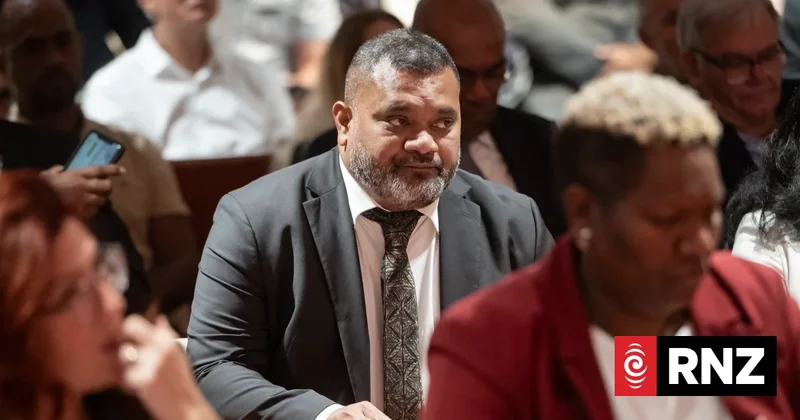
The president of New Caledonia's government unveiled of his "collegial" cabinet ministers on Wednesday, with the announcement of how the portfolios are now distributed among the 11-member team.
President Milakulo Tukumuli, 42, announced his cabinet line-up at a news conference, following his election by the French Pacific territory's Congress on 31 July.
Tukumuli said his main priority was to address major issues facing New Caledonia, including pressing economic ones, such as the dire situation faced by domestic transport airline Air Calédonie.
Apart from the president's traditional civil security and external relations portfolios, has now taken over the sensitive health, social protection regimes and transport portfolios. He will also be his government's spokesperson.
No more portfolio redundancies
Other sensitive portfolios have also been assigned to pro-France cabinet members, such as Christopher Gygès (who is also the vice-president and retains economy-related key attributions, including economy, tax and telecommunications).
Gygès will also be in charge of customs, "economic attractiveness", external trade and "food sovereignty".
Milakuli's predecessor, Alcide Ponga, is now in charge of nickel mining-related and energy matters, a sector severely affected by a profound crisis for the past four years with two of the three smelters currently mothballed while a process is underway to identify potential buyers.
Pro-France Nina Julié becomes minister for education, youth and sports and childhood protection.
Laurent Bonnefond takes charge of urbanism and land-use planning, a topic also related to New Caledonia's reconstruction process after the destructive riots and civil unrest that caused over €2.2 billion in material damage, as well as 14 dead and a drop of an estimated 13.5 percent of the French territory's Gross Domestic Product (GDP).
Philippe Blaise also joins New Caledonia's 19th cabinet to take care of the budget, finance and the public service.
In the same collegial government, some members are also representing the pro-independence camp.
These are veteran politician Gilbert Tyuienon (from Union Calédonienne -UC- party), who has been tasked to attend to labour, employment vocational training and social dialogue matters.
From the same camp, newcomer Johanito Wamytan is now in charge of a revamped fisheries, ocean and the Coral Sea natural park, as well as research and climate issues.
Ernest Déméné is now the new minister for culture, equality and citizenship matters.
Méryl Marlier is the new minister for social economy, solidarity and water policies.
The only representative of the other pro-independence party, UNI (Union pour l'Indépendance), has been handed over the portfolio of custom, traditional affairs, as well as indigenous Kanak cultural heritage. He is also in charge of relations with the Customary Senate, New Caledonia's version of a Great Council of Chiefs.
Keywords: efficiency, reforms
The main aim of the cabinet's portfolios organisation was now to "be efficient to redress New Caledonia" and "avoid never-ending portfolio redundancies".
Some terms such as "tourism" and "agriculture" have therefore disappeared from the list of portfolios.
Tukumuli said this was for the sake of "coherence" and cost-effectiveness, and these matters would be directly addressed and dealt with by New Caledonia's three provinces, under their respective jurisdictions.
Get the country back on its feet
"[New Caledonia] is in a quasi bankruptcy situation. We need about 13 billion French Pacific Francs (US$125 million) before the end of this month and we don't have that kind of money right now", he told local reporters, alluding to a potential "shut down" situation.
Tukumuli is due to pronounce his general policy maiden speech before New Caledonia's Congress at a yet unspecified date in the coming days.
Planned visit to Paris
Tukumuli is also planning to lead a bipartisan delegation in Paris later this month, in order to seek fresh deals and support from France, especially on the immediate financial support side.
One of the mooted options would be to request that some of the loans contracted be turned into non-refundable grants.
Since the May 2024 destructive unrest, France has also launched a series of financial packages, some by way of loans, others by grants, to help New Caledonia recovers from one of its gravest economic and social crises in its recent history.
"After Covid, we borrowed 50 billion French Pacific Francs, (CFP, around US$486m), then another 140 billion CFP (US$1.3b) after the May 2024 riots, so we have a debt of about 190b CFP. So it's this debt that we have to get cancelled," Tukumuli said.
Domestic air transport crisis
Meanwhile, specifically on domestic air transport, which is on the verge of collapse, he is due to fly to the Loyalty Islands on Thursday to resume talks with protesters and other stakeholders.
"I think we have to take a bit of perspective, to see the bigger picture," he said, suggesting not only the air transport issue, but the whole transport sector should be considered as a whole "mobility framework".
Air Calédonie is targeted by blockades on its domestic outer island airports, due to a protest movement launched early March 2026 by a collective of customers who are protesting against the decision to transfer all domestic operations from the small airport of Magenta, in Nouméa, to the international airport of La Tontouta, over 50 kilometres away from the capital.
The measures was perceived as necessary to mutualise costs with Air Calédonie's international branch, Air Calédonie International (or AirCalin), operating from its base of La Tontouta airport.
The blockades initially affected flights from Nouméa to all airports on the three Loyalty Islands (Maré, Lifou and Ouvéa), as well as on the Isle of Pines (off the capital Nouméa).
Since March, traffic has been allowed to resume Lifou and the Isle of Pines.
On Monday and Tuesday this week, on Ouvéa and Maré Islands, marches were organised by islanders who voiced their anger against the remaining airport blockades that have been ongoing since 2 March.
Placards were brandished, denouncing the fact that passengers were "taken hostage" by the blockades, which severely affects not only passengers, but also freight as well as education or medical emergencies to and from the main island of Grande Terre.
Tourism sector companies are also severely affected.
"This is untenable ... Ouvéa is a dead island, it's agonising," Ouvéa Mayor Maurice Tillewa told local media, invoking the basic notion of freedom of movement.
But Air Calédonie has also filed for bankruptcy and placed the company under judicial supervision from a Trade Tribunal, which is now tasked to review the company's situation every six months to decide whether it is allowed to continue operations or be liquidated.
This bi-yearly ruling will also depend on the company's performance and sustainability.
"The airstrips on Ouvéa and Maré need to re-open to allow (Air Calédonie) to stay alive", Tukumuli said.
"It is in great difficulty because it once transported about 300,000 passengers per year and now, after the (May 2024) riots, it's gone down to 180,000 and the figure for this year look like 120,000.
"So you have a company that was designed for 300,000 passengers and it required compensation, we need 1.4b CFP (around US$13.5m)", Tukumuli told public broadcaster NC la Première over the weekend.