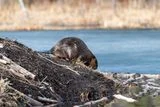
Geronimo had just parachuted out of a plane. When handlers approached, the old male beaver did the last thing they might have expected. He climbed back into the wooden box that had carried him. If Elmo Heter’s experiment worked, dozens more beavers would follow.
The unlikely test had a serious purpose. As people built homes around McCall and Payette Lake, beavers kept doing what beavers do. Their dams flooded property and disrupted orchards, culverts, and irrigation systems. Yet the Idaho Department of Fish and Game knew that the same handiwork could create valuable wetlands in the remote Chamberlain Basin. Rather than kill the animals, officials decided the beavers needed a new home.
Getting them there was the hard part. Trucks stopped where the roads ended, leaving horses and mules to carry the boxed beavers into the backcountry. Some animals overheated or became so stressed that they refused to eat and died before release.
In his 1950 report, "Transplanting Beavers by Airplane and Parachute," published in the Journal of Wildlife Management, Heter, an employee of the Idaho Department of Fish and Game, laid out his faster solution. He would carry the animals by air to wilderness streams in purpose-built boxes suspended beneath surplus World War II parachutes.
How Idaho’s Parachuting Beaver Experiment Worked
Heter’s first idea was a woven willow carrier that the beavers could chew through after landing. The animals began gnawing immediately, raising the alarming prospect of loose beavers aboard the plane.
So, Heter switched to a carrier with two wooden compartments connected at the base. Cords kept the container shut during its descent but released it once the parachute reached the ground. Geronimo completed repeated test drops while Heter refined the design and release height, according to BBC Wildlife.
Once the system was ready, Geronimo joined three female beavers in the first group sent into the wilderness.
Beavers Take to the Air
On Aug. 14, 1948, a twin-engine Beechcraft lifted off with a pilot, a wildlife officer, and eight crates of beavers. Over the following days, crews sent 76 beavers drifting down toward backcountry meadows.
Seventy-five reached the ground alive. Only one died after working its way partly out of a container and falling near the end of the descent. The others came out from their carriers and began exploring their new surroundings.
How Parachuted Beavers Improved Idaho’s Wilderness
New dams appeared as colonies formed around the release areas, marking the operation as an ecological success, according to BBC Wildlife.
Idaho Fish and Game’s Steve Liebenthal later told Boise State Public Radio that the beavers created valuable habitat in what is now a vast protected wilderness. He believed their descendants were still there, reshaping its waterways.
A dam slows a stream and spreads water into nearby soil. Over time, that water can form ponds and wetlands, limit erosion, and provide habitat for fish, amphibians, insects, and birds. Wetter ground also helps vegetation survive dry conditions.
Elsewhere in Idaho, Baugh Creek offers a modern example of what beaver dams can do, according to BBC Wildlife. When wildfire swept through the area in 2018, vegetation beside stretches with more beaver activity remained mostly green. Satellite views later revealed wider corridors of plant growth where dams retained water. Baugh Creek is separate from the Chamberlain Basin release site, but it shows how beaver engineering can help a landscape long after the animals arrive.
Beavers now live across Idaho’s major river systems, and their numbers remain stable, according to an Idaho Statesman retrospective. The parachutes are long gone, but wildlife managers still trap and relocate problem beavers when needed.
Near people, the beavers’ dams had made them a nuisance. In the Chamberlain Basin, the same dam-building instincts held water, formed wetlands, and gave other wildlife places to live.
Article Sources
Our writers at Discovermagazine.com use peer-reviewed studies and high-quality sources for our articles, and our editors review for scientific accuracy and editorial standards. Review the sources used below for this article:
- This article references information from the Journal of Wildlife Management: Transplanting Beavers by Airplane and Parachute
- This article references information from BBC Wildlife: US officials parachuted 76 beavers into the Idaho wilderness – then something astounding happened
- This article references information from Boise State Public Radio: Parachuting beavers into Idaho's wilderness? Yes, it really happened
- This article references information from The News Tribune: It’s been 75 years since Idaho parachuted beavers into backcountry