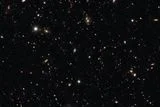
In a galaxy roughly 500 million light-years away from our Solar System, a star died.
In March 2026, the Einstein Probe detected a brief flash of soft X-rays from the star. Soon after, ground-based telescopes from across the world set their sights on the flash, named EP260321a. Collectively, the telescopes began monitoring and gathering data on EP260321a and found that it was a rapidly brightening supernova.
From there, astronomers named the supernova SN 2026gzf, and two research teams began observing this event. Their findings have been published in The Astrophysical Journal Letters and reveal how unique this supernova actually is.
Read More: A Bright Blob Emitting X-Rays Near the Center of the Milky Way May Have Been Forged by a Supernova
Supernova SN 2026gzf Produced a Unique Shock Breakout
The two teams were led by Jillian Rastinejad, a NASA Einstein Fellow at the University of Maryland, College Park, and Brendan O’Connor, an astronomer and McWilliams Fellow at Carnegie Mellon University.
Each team independently verified that the initial bursts of X-rays were from a “shock breakout,” or the moment when the shock wave caused by a stellar explosion erupts through a star's surface. This event is what releases the first light of a supernova, according to one of the studies.
A shock breakout is to be expected from a supernova, though it is pretty rare to observe, as they can last anywhere from a few seconds to a few hours. Researchers have only been able to confirm a few shock breakout events.
An Absence of Gamma Rays
During their observations, the teams were also able to confirm that the type of explosion from the star was a broad-lined Type Ic (Ic-BL) supernova. Astronomers typically link these explosions to gamma-ray bursts and they commonly contain jets made of relativistic material moving close to the speed of light.
But after examining SN 2026gzf more closely, the teams each found that this supernova was rather unique. Firstly, the shock breakout was one of the faintest ever observed from an Ic-BL supernova, though the explosion was not as weak.
Secondly, the explosion showed no traces of a gamma-ray burst, even though it matched other Ic-BL supernovae that did have gamma-ray bursts.
“SN 2026gzf looks remarkably similar to other energetic supernovae that have been previously linked to gamma-ray bursts. Yet multi-wavelength follow-up observations using the most sensitive facilities found no evidence for a relativistic jet or an afterglow, which are typically seen in those events,” O’Connor said in a press release. “One possibility is that the jet was ‘choked,’ either by the surface of the star or by circumstellar material surrounding the star.”
How International Collaboration Helps Us Understand Supernovae
Because of the unique nature of this supernova, the teams gathered data from an array of observatories around the globe, including the Dark Energy Spectroscopic Instrument (DESI), the NSF–DOE Vera C. Rubin Observatory’s COSMOS Deep Drilling Field and Babamul, the DOE-fabricated Dark Energy Camera (DECam), mounted on the NSF Víctor M. Blanco 4-meter Telescope at Cerro Tololo Inter-American Observatory (CTIO) in Chile, NASA's Chandra X-ray Observatory and the National Radio Astronomy Observatory’s Very Large Array (VLA), among others.
“DESI’s spare-fiber program gave us the opportunity to return to SN 2026gzf repeatedly and follow how its spectrum changed as the explosion evolved,” Xander Hall, a graduate student at Carnegie Mellon University, a member of O’Connor’s team, and second author of the paper, said in a press release.
“This sequence of observations demonstrates the power of using DESI’s spare fibers for rapid transient follow-up and classification as Rubin continues to ramp up its transient alert stream over the next decade,” Hall added.
Through the collective observations, the teams concluded that the progenitor (the star going supernova) was likely a Wolf-Rayet star, about 20 times as massive as the sun that had shed its outer hydrogen and helium layers before collapsing.
From what the teams could tell, before going supernova, the star underwent irregular episodes of mass loss that released hydrogen and helium.
The mass-loss events helped create multiple material shells around the star. One of the shells created the initial X-ray burst while a different shell produced the first visual signs of the supernova.
“This is the first time we’ve mapped out the pre-explosion environment of a star that has been stripped of hydrogen and helium,” Gokul Srinivasaragavan, a recent Ph.D. graduate from the University of Maryland, a member of Rastinejad’s team, and second author on the paper, said in the press release. “Going forward, I’m excited to observe more shock breakout events in similar detail to test if all stripped stars have a similar ‘lifestyle’ prior to collapse and what, if any, differences we see.”
While researchers continue to observe this unique supernova, it offers new information on how the process starts and finishes. The study also points out the benefits of collaboration between multiple teams and observatories and the data they can collect when they work together.
Read More: Newly Detected Supernova Exploded When the Universe Was Just 730 Million-Years-Old
Article Sources
Our writers at Discovermagazine.com use peer-reviewed studies and high-quality sources for our articles, and our editors review for scientific accuracy and editorial standards. Review the sources used below for this article:
- This article references information from a study in The Astrophysical Journal Letters:EP260321a/SN 2026gzf: The Faintest Shock Breakout Associated with a Broad-lined Supernova
- This article references information from a study in arXiv: A Multi-Wavelength View of the First Type Ic-BL Supernova with an Einstein Probe X-ray Shock Breakout