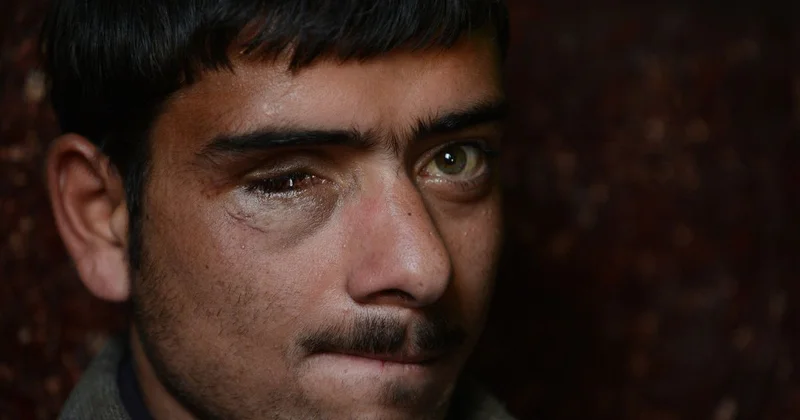
On July 13, over 10 years after 14-year-old Insha Mushtaq was blinded by pellet guns fired by security forces, the Jammu and Kashmir government announced that it will give her Rs 41 lakh in compensation.
Mushtaq was one among 6,000 people in Kashmir injured by pellets in 2016, when the Valley erupted in protests over the killing of popular militant commander Burhan Wani.
The Omar Abdullah government’s decision comes at a time when the use of pellet guns in student protests in Delhi has led to calls for accountability of Union Home Minister Amit Shah. At least four people were injured by pellets during the youth protests at Jantar Mantar, one of them has lost vision in one eye. Two of them have moved the Supreme Court seeking a ban on the use of pellet guns.
In Kashmir, where the pellet guns have caused extensive injury, most of the victims – unlike Mushtaq – have not received any compensation or jobs. “We are like living corpses about whom nobody cares,” said Mohammad Ashraf Wani, a 36-year-old man blinded by pellets in 2016.
Efforts by pellet gun victims to mobilise themselves and demand compensation died out in 2019, when the Narendra Modi government scrapped the special status of Jammu and Kashmir and turned it into a Union territory. Many said they stopped their activism after increased scrutiny from government agencies.
The current debate, many pellet survivors in Kashmir say, opens a window to voice their grievances after a prolonged silence.
“We are not against the compensation to Insha,” said Wani. “But if hundreds of people lose their eyesight, you can’t just compensate only one victim.”
Wani was 26 when he was hit by pellets in his native village of Pulwama district in August 2016.
Since then, Wani, father to two children, has undergone at least nine surgeries, costing him nearly Rs 9 lakh. “No amount of money can compensate for what we have lost but at least there should be some support for everyone who has lost his or her eyesight due to pellets,” he said.
Scroll texted Jammu and Kashmir Chief Minister Omar Abdullah, asking if the government was planning to rehabilitate or provide compensation to other pellet victims who have lost their vision. The story will be updated if he responds.
A one-off compensation
In July 2016, 14-year-old Insha Mushtaq had opened the window of her house in south Kashmir’s Shopian district as protests raged on the street outside. It was three days after security forces had killed Wani in an encounter and Kashmir was aflame.
In a flash, Mushtaq was hit by a volley of pellets fired by security personnel trying to quell protesters. She lost her vision.
A school-going teenager from Shopian’s Sedow village, Mushtaq had lived a quiet life until that July morning. “Our lives turned upside down that day, forever,” said Mushtaq Ahmad Lone, her father.
A small-time farmer, Lone had also found himself in a difficult spot financially after his daughter suffered injuries.
With some support from the government and intervention of a local non-governmental organization, Mushtaq underwent multiple surgeries in Delhi and Mumbai but her vision could not be restored.
To compensate her for her loss, the Mehbooba Mufti-led Jammu and Kashmir government in 2017 announced a gas distribution agency in Mushtaq’s name. “At that time, only a godown and a room were constructed,” said Lone.
On July 31, the Omar Abdullah government released Rs 41 lakh so that work on the agency could be completed. Lone said: “After a decade, the government has finally decided to fulfil its promise. But no compensation or money is worth what loss.”
A reign of blindness
Pellet guns were introduced in Jammu and Kashmir for the first time in 2010, when widespread protests broke out against the extrajudicial killing of three civilians in Machil.
As dozens of civilians were shot dead by security forces, then Jammu and Kashmir chief minister Omar Abdullah had requested the Centre to provide a “non-lethal” alternative for crowd control.
The pellets proved anything but non-lethal. A study by Kashmir’s premier Sher-i-Kashmir Institute of Medical Sciences, Soura, revealed that at least six people were killed and nearly 200 were injured due to pellets during the four-months-long protests in 2010. At least six people had lost vision in one or both eyes due to pellets, the study said.
The most extensive use of pellet guns was in 2016, when a Bharatiya Janata Party-Peoples Democratic Party coalition government was in power.
In 2018, then Jammu and Kashmir chief minister Mehbooba Mufti informed the state Assembly that more than 6,000 people had been injured by pellet guns in Kashmir between July 8, 2016 and February 27, 2017. Out of these, 728 had been hit by pellets in their eyes. At least 54 individuals had their vision impaired due to pellets.
Rights groups and organized groups of pellet victims, however, put the number of those blinded by pellets somewhere between 100 and 350.
According to official figures present in Parliament, 17 civilians died of pellet injuries between July 2016 and August 2017.
Pellet guns also resulted in injuries to dozens of civilians protesting in the Valley after the scrapping of Jammu and Kashmir’s special status under Article 370 and 35A of the Indian Constitution in 2019. At least, one protester was killed.
Survivors organise
In January 2017, the Jammu and Kashmir government, led by CM Mehbooba Mufti, announced government jobs for those blinded by pellets.
In some instances, the government also extended financial assistance to those affected by pellets.
But the assistance reached only a few.
A year later, Mehbooba Mufti told the state Assembly that the government had provided jobs to only 13 pellet victims on compassionate grounds. In addition, the government had also provided financial assistance to at least 22 pellet victims.
Given the sheer number of those hit by pellets and government apathy, a group of pellet victims set up a trust to raise money and support in 2017. “There were 1,600 pellet victims registered with us. By 2024, we had raised Rs 9 lakh that was distributed to different victims,” said Wani, one of the men behind the idea of the trust.
According to Wani, 92 victims registered with the trust had lost vision in both eyes.
However, political developments in the state cut short the activism.
In June 2018, the Mehbooba Mufti-led BJP-PDP coalition government collapsed and Jammu and Kashmir came under the direct rule of New Delhi. In 2019, the erstwhile state was split into two union territories and its semi-autonomous status was scrapped.
Multiple pellet survivors campaigning for the rehabilitation and compensation alleged that they faced heightened scrutiny from the security agencies after the scrapping of Article 370. “The trust has been dysfunctional since 2024,” said Wani. “We were being summoned by different agencies for no reason. Eventually, we gave up on it.”
Another pellet survivor, speaking anonymously, said they had tried to compile a record of people blinded by pellets during the 2016 protests in order to push for a ban on the use of pellet guns.
“While we were still documenting them, we were summoned by the National Investigation Agency who questioned us about who paid the youth to pelt stones and help militants escape during the gunfights,” he said. “Therefore, we stopped talking about a ban on the use of pellet guns.”
In December 2021, the High Court of Jammu and Kashmir and Ladakh dismissed a public interest litigation seeking ban on the use of pellet guns by observing that it’s “not inclined to prohibit the use of pellet guns”.
‘Nothing can replace vision’
Insa Mushtaq is now 24. The young woman is living testimony of the horrors wrought by pellets. Yet, her life has also been a lesson in hope.
Despite losing her eyesight, Mushtaq never quit her studies. She learnt Braille and continued her education with the aid of screen readers and online classes.
In 2018, she passed her Class 10 examination. With the assistance of a helper, Mushtaq has been able to qualify several other examinations.
Currently, Mushtaq is pursuing graduation in arts through a distance mode “I am not quitting studies,” Insha Mushtaq told Scroll.
But the trauma has left its mark. When she heard that pellet guns had been used in Delhi on July 20, she was distraught. “Pellets should be banned across India,” she said. “They ruin lives. I am a living example of that.”
We welcome your comments at letters@scroll.in.