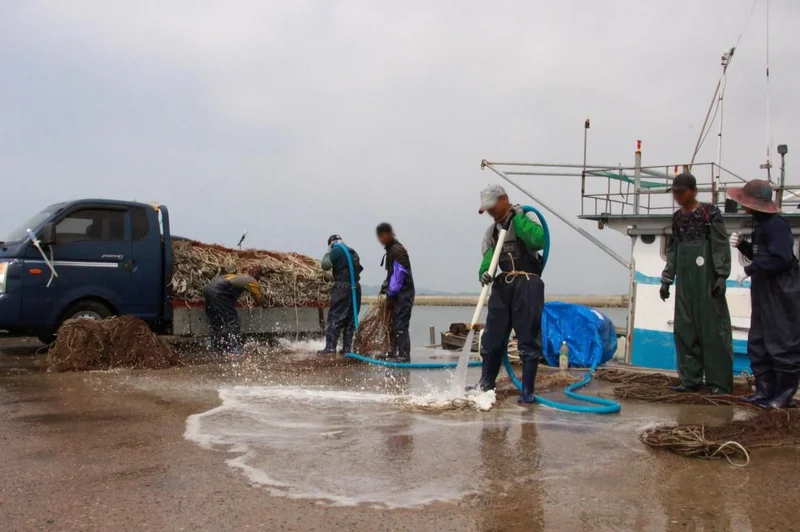
On construction sites and factory floors across Korea, supervisors barking orders at foreign laborers often address them not by their given names, but by blunt, casual Korean pronouns: "hey" or "you."
Now, a nationwide campaign led by government officials, regional authorities and labor rights foundations is attempting to reshape that workplace culture, starting with a simple act of human recognition: giving migrant laborers hard hats printed with their actual names.
The Ministry of Employment and Labor partnered with local officials and four major labor rights organizations — including the Jeon Tae-il Foundation and the Financial Industry Public Interest Foundation — to host the Migrant Worker Labor Respect Campaign on Thursday in Asan, an industrial hub in South Chungcheong Province. Gathered inside a local community center, roughly 150 business leaders, union delegates and foreign laborers watched as workers were formally presented with custom hard hats bearing their names in clear, bold lettering.
The initiative stems from a joint agreement signed in April to promote the rights and dignity of foreign laborers. Organizers hope that replacing dismissive daily colloquialisms with respectful honorific titles like "nim" or "ssi" (the Korean equivalents of Mr. or Ms.) will help dismantle entrenched casual discrimination. The core goal is to foster an industrial environment where migrant staff are recognized as equal colleagues rather than nameless, disposable labor.
The campaign comes at a pivotal moment for Korea as it confronts a severe demographic shift. Facing one of the lowest birthrates globally and a rapidly aging domestic population, the nation's manufacturing, agriculture and construction sectors have grown heavily reliant on foreign workforce inflows to sustain basic economic output. Despite this economic dependency, social integration and workplace safety for noncitizens remain persistent friction points.
The event in Asan marks the latest stop on a rolling national circuit.
Organizers launched the movement in the industrial city of Ulsan in southeastern Korea in April, expanding through regional centers such as Gwangju in May and Yecheon in June, with plans to cover the rest of the country in the coming months.
Alongside the personalized gear distribution, representatives from regional business associations and major trade unions — including the Korean Confederation of Trade Unions and the Federation of Korean Trade Unions — signed a landmark joint declaration. The document commits both labor and management to collaborate on ensuring safe working conditions, guaranteeing fair labor terms and conducting routine field checks to uphold human rights standards on site.
“Calling someone by their name is the most fundamental act of acknowledging their presence and dignity as a worker,” Labor Minister Kim Young-hoon said during his opening remarks. “Though our nationalities may differ, the value of our sweat remains the same. Making a habit of using proper names is the essential starting point toward building a safer, more inclusive workplace for every member of our community.”
This article was published with the assistance of generative AI and edited by The Korea Times.