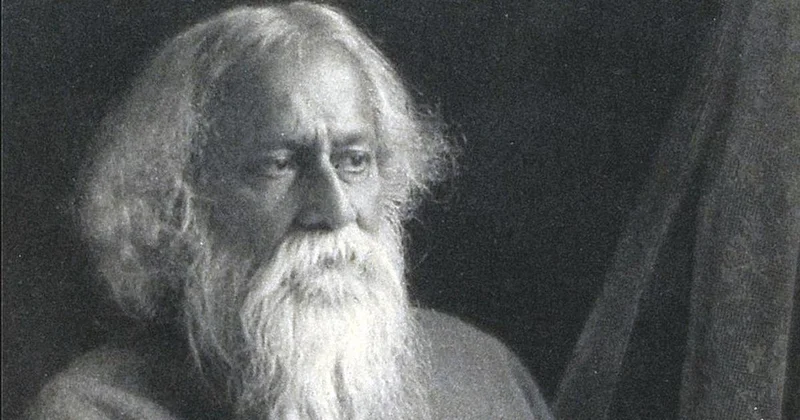
Just as he allowed me to wander the mountains at will, so [Father] left me free to select my path in the quest for truth.
— My Reminiscences, by Rabindranath Tagore.
1873 was an important year for Rabindranath Tagore. It brought him into close contact with his father for the first time. It also took him out of the house at Jorasanko for a few months on his first major expedition.
But before that, he had to pass through a ceremony, upanayan – the investiture of the Brahmin’s sacred thread – which marked the transition of a Brahmin boy to adulthood. The Maharshi believed in this custom, however unorthodox his spiritual beliefs. So did Rabindranath, however self-mocking he was in describing the rituals. These began with Rabindranath and two other boys of the family learning from the Maharshi how to chant the Upanishads. Next, after some days of chanting, with shaven heads and gold rings in their ears, the three “budding Brahmins” went into three days’ retreat in a portion of the top storey of the house. Here, instead of meditating, they had fun. The earrings were a good handle for pulling each other’s ears. A small drum that chanced to be in one of the rooms was another opportunity. Whenever a servant appeared down below them, they rapped a tattoo. First, the man would look up, then he would avert his eyes and beat a hasty retreat.
I am convinced that boys like us must have been common in the hermitages of old. If some ancient document has it that the ten or 12-year-old Saradwata or Sarngarava [two novices mentioned by Kalidasa] spent the whole of his boyhood offering oblations and chanting mantras, we are not compelled to put unquestioning faith in the statement; because the book of Boy Nature is even older and is also more authentic.
Once more, Rabindranath was called into his father’s presence. How would he like to accompany him to the Himalayas? How? “I would have needed to rend the skies with a shout to give some idea of How!” Apart from the excitement of the trip, he had been worrying about the reaction to his shaven head from the Eurasian boys at school: their reverence for Brahmins was minimal, as he well knew. It was a great relief to avoid their jeers.
Father and son (the latter wearing a gold-embroidered velvet cap on his hairless head and “newly sacred-threaded” in the sarcastic phrase of an anti-Brahmo Bengali newspaper) left Calcutta by train on February 14. They travelled on the line that some 30 years previously Dwarkanath Tagore had hoped to build. (He died too soon.) That same evening, after a journey of a hundred miles or so, they reached Bolpur station in the district of Birbhum. Close by was Shantiniketan. Rabindranath was about to set foot in the place that would eventually become linked with his name worldwide.
It was, however, his father who discovered it. The purchase of the land – nearly seven acres – dated from 1863. Maharshi Debendranath bought it from a local zamindar named Sinha, a friend of his. The story goes that he stopped his palanquin there in order to meditate under a pair of chhatim trees and fell in love with the spot. (A marble prayer seat was later constructed under the trees.) A gang of dacoits were said to have come up, seen the Maharshi and been so affected by his still poise that they left him alone and in due course even took up service under him.
The place was already called Shantiniketan (Abode of Peace), possibly after a small hut known by that name. The hut and the chhatim trees apart, there was nothing else there: just denuded red soil and the plain of Bengal stretching beyond a line of distant palm trees towards infinity. This utter bareness was what first appealed to Debendranath. Soon afterwards, he brought good soil, trees and plants and established a mango grove. In 1866, a house was started, which would gradually be extended during the coming decades. But in 1873, there were barely two habitable rooms.
Rabindranath probably knew nothing of all this. Instead, he had been fed a story by a mischievous nephew and had believed everything he was told. Getting into the palanquin at Bolpur at twilight, he shut his eyes, so as to preserve the wonders mentioned by his nephew until dawn. As he remarked ruefully forty years later, reading the Mahabharata and Ramayana was not a good training for determining “the line between the possible and the impossible.” He hunted without success for a path from the house to the servants’ quarters which, though not covered, “did not allow a ray of sun or a drop of rain to touch anybody passing along it.” And he searched in vain for the cowherd boys said to be frolicking in the fields of ripening rice. But there was a marvellous compensation: “What I could not see did not take me long to get over – what I did see was quite enough. There was no servant rule, and the only ring which encircled me was the blue of the horizon, drawn around these solitudes by their presiding goddess. Within this, I was free to move about as I chose.”
It was a significant episode. Shantiniketan, in Rabindranath’s mind, from the very first meant freedom, a realm where ordinary rules were suspended. His school and later his university would be projections of this boyish imagining onto the physical world. A bare tract of land in a poverty-stricken district of Bengal became, in his mind, a utopia. But in taking concrete steps to realize the dream as an adult, Rabindranath risked breaking his spell. Only if one could preserve one’s faith in magic could the dream and the reality of Shantiniketan coincide.
After happy weeks, the father and son crossed India by train and stopped at Amritsar in the Punjab (near what is now the border with Pakistan). For about a month, they settled in a place not far from the Golden Temple of the Sikhs. The Maharshi was drawn to the temple by the rousing worship in the middle of the sacred lake, and Rabindranath went too. Sometimes the Maharshi joined the hymns. No Sikh ever objected. Here was a prime lesson in religious tolerance. For the rest of his life, Rabindranath regarded Sikhism (along with Buddhism and Brahmoism) as a reforming movement within Hinduism, not as a separate religion. In 1937, aged 76, he informed Gandhi:
I do not find anything in their [the Sikhs’] religious practices and creeds which hurts my human dignity. My father often used to offer his worship in Amritsar Gurdwara where I daily accompanied him but I never could imagine him at the Kali’s temple in Calcutta. Yet, in his culture and religion he was a Hindu and in his daily living maintained a purer standard of Hinduism than most of those who profess it by words of mouth [sic] and pollute it in their habits.
Here in Amritsar, aged 11, Rabindranath composed his first song. He also began to sing for his father. Evening was their time. The Maharshi would sit on the verandah facing the garden. “I can see the moon risen; its beams, passing through the trees, falling on the verandah floor; and I am singing in raga Behag”:
You are my friend in all difficulty and doubt And companion in the darkest passage of life.
“My father with bowed head and clasped hands listens intently. I recall the evening scene quite clearly.”
They also read together in Sanskrit and in English. One of the books was Proctor’s Popular Astronomy. Debendranath explained it in easy language, which Rabindranath then rendered into Bengali; thus began his lifelong interest in the science of the heavens, which influenced all his writing, including his poems. Another book was a biography of Benjamin Franklin. The Maharshi, according to his son, thought the book would be both entertaining and instructive. But not far in, he became disillusioned with Franklin. “The narrowness of his calculated morality disgusted my father.” Sometimes, while reading, Franklin Debendranath would burst out in denunciation. For himself, he had had sent from Calcutta the 12 volumes of Gibbon’s History of the Roman Empire. Rabindranath looked at them and wondered why adults should ever feel the desire to read such dry tomes.
Come mid-April, when the plains of Punjab begin to burn, they and their servants set off for the Himalayas. Their destination was Dalhousie, a sparsely populated hill-station on the borders of Kashmir at 7,500 feet, where they had taken a house on the highest hilltop, Bakrota. To get there from the plains in the 1870s meant a long trek carried in a litter known as a jhampan, staying each night at bungalows. Rabindranath drank in the new sights, so utterly alien to Calcutta, Shantiniketan or the Indian plains: the climbing road, the gorges beneath, the great forest trees clustering together at bends in the road, at their feet, small waterfalls and streams babbling over black moss-covered rocks. Years later, he commented:
That is the great advantage of a first vision: the mind is not aware that there are many more to come. When this fact penetrates that calculating organ it promptly tries to make a saving in its expenditure of attention. Only when it believes something to be rare does the mind cease to be miserly. In the streets of Calcutta I sometimes imagine myself to be a foreigner, and only then do I discover how much is to be seen.
While on the move, his practical education began. Without any fuss, the Maharshi transferred his cashbox – a good prize for any hill dacoits that might have been about – from Kishori, its normal custodian, to Rabindranath. Every night, Rabindranath had to make it over to his father. Once, when he forgot, he was reprimanded. And on arrival in Bakrota, the Maharshi took over the role of Hemendranath, Rabi’s home-educator, too. Lessons began in the chill before dawn with the memorising of Sanskrit declensions. The Maharshi would be up already, sitting at his devotions in a glazed verandah, while outside, way beyond the house, the snow peaks could be seen shimmering dimly in the starlight. Sometimes a half-awake Rabindranath would see him pass softly by, wrapped in a red shawl with a lighted lamp in his hand. Then, after he had dozed off, his father would nudge him – “an excruciatingly wintry awakening from the caressing warmth of my blankets!” Next, when they had taken a tumbler of milk together (which Rabindranath always tried to evade), as the sun rose over the Himalayas, they stood and chanted the Upanishads. After that came a walk, an hour of English and at ten o’clock an ice-cold bath, an old practice of Debendranath when travelling in the mountains. Later, after a midday meal, lessons were supposed to begin again. But the adult Tagore recalled, “This was more than flesh and blood could stand. My outraged morning sleep would have its revenge and I would be toppling over with uncontrollable drowsiness. But no sooner did my father take pity on my plight and let me off than my sleepiness was off likewise: the Lord of the mountains was calling!”
Remarkably, the Maharshi never tried to stop Rabindranath from wandering in the mountains. No one accompanied him, a boy not even in his teens; all he had was a staff in his hand. Even allowing for a little later exaggeration by Rabindranath, his father’s attitude was questionable, verging on the foolhardy. But his son always honoured him for it. In every area of life, Rabindranath insisted long after the Maharshi’s death in 1905 that his father had encouraged him to develop self-discipline, independence of spirit and dislike of domineering behaviour. “He held up a standard, not a disciplinary rod.” Yet to an outsider, it will often seem that Debendranath’s influence inhibited his son, both as a man and as an artist, until the last decade or two of his life. For the moment, here is Tagore’s moving tribute to Debendranath spoken at Shantiniketan in 1936:
The impression on my mind of my father in those days is that of a man who, though shouldering all the responsibilities of a large family, always kept his spirit free, unaffected by worldly affairs, soaring in its spiritual detachment. The picture of the supremely beautiful Kanchanjungha peak of the Himalayas, which is unique in its grandeur and spotless aloofness, rises at once before my mind’s eye when I remember Debendranath. Or, as the Upanishad would say, he stood “like a tree established in heaven.”
Excerpted with permission from Rabindranath Tagore: The Myriad-Minded Man, Krishna Dutta and Andrew Robinson, Rupa Publications.
We welcome your comments at letters@scroll.in.