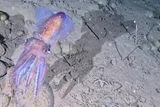
In the frigid North Atlantic waters around Northeast Greenland National Park, researchers spotted something miraculous: an Arctic bobtail squid with her eggs.
This, according to the findings published in Polar Biology, is the first time this species of squid has been spotted in the park. Arctic bobtail squid (Rossia moelleri) are a rare sight, and capturing footage of one in this national park is even rarer.
“Northeast Greenland National Park is the largest national park on Earth but one of the least biologically documented marine regions in the Arctic,” Paige Maroni, from The University of Western Australia’s School of Biological Sciences, and lead author of the study, said in a press release.
These findings highlight the importance of marine research in this mostly unexplored area and how a shifting climate could impact the species that live here in the future.
Spotting the Arctic Bobtail Squid
Maroni and team captured footage of the squid using a lightweight remotely operated underwater vehicle (ROV). From what they could see, the squid was a mature female, and three egg systems were nearby that looked similar to a cluster of grapes. The squid appeared an iridescent purple and orange color, and was about 10 centimeters (nearly 4 inches) in length.
These findings indicate that there is indeed active cephalopod reproduction in this subzero Arctic fjord system.
“The squid and eggs were recorded at a depth of 50 meters in water around −1.6 °C, which highlights the resilience of marine life in one of Earth’s most extreme environments,” Maroni said.
Read More: Giant Squids, Pygmy Sperm Whales, and Other Rare Species Detected in Australia's Deep-Sea Canyons
Why The Arctic Bobtail Squid Discovery Is Important
There are 68 species of bobtail squid, according to the Okinawa Institute of Science and Technology. Unfortunately, not every species is well documented. According to the study, biodiversity records of these squids remain unevenly distributed. There is very little information on squid biodiversity from deep polar regions. These regions, such as Northeast Greenland National Park, are also less well understood than other marine ecosystems.
Because cephalopods, such as squids, are highly sensitive to environmental change, understanding their ecosystems is crucial. This new finding could help science better understand squids that live in this region.
“Establishing knowledge of the biodiversity in this region is crucial for understanding ecosystem function and resilience under accelerating climate change,” Maroni said. “This study provides a valuable new baseline for tracking ecological change in the rapidly warming Arctic.”
Using Yachts for Science
Part of what made this research possible was an organization called Yachts for Science. Through this organization, research teams can use private yachts for shorter, specialized research trips to lesser-explored marine ecosystems.
For this specific study, Maroni and team participated in a Polar BLAST expedition aboard a Secret Atlas Micro Cruise Expedition vessel, with support from Yachts for Science.
“Our results show low-impact science and expedition tourism can help fill major biodiversity gaps in remote polar regions,” Maroni said. “In poorly studied polar ecosystems, even one verified observation can provide important insight into species distributions, reproduction and resilience under climate change.”
More study is needed to better understand the ecology of the Arctic bobtail squid, but for now, science is one step closer to learning more about these unique creatures.
Read More: This Rare Deep-Sea Squid May Trick Predators and Prey by Sticking Its Head in Mud
Article Sources
Our writers at Discovermagazine.com use peer-reviewed studies and high-quality sources for our articles, and our editors review for scientific accuracy and editorial standards. Review the sources used below for this article: