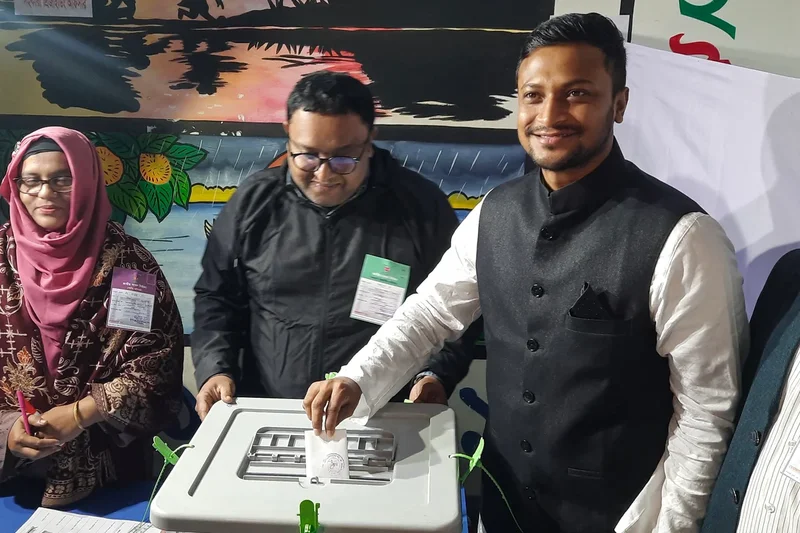
The house of a Bangladesh cricket icon and former Awami League lawmaker was attacked on Wednesday night, just hours after he appeared virtually alongside former prime minister Sheikh Hasina at an event in India’s national capital.
Police said several people vandalised Shakib Al Hasan’s property in Magura and attempted to set it on fire.
“Several miscreants threw brick chips at the house and vandalised windows. They also tried to set the house on fire,” Magura Sadar police station officer-in-charge Abdullah Al Mamun said, according to the Daily Star.
While initial reports suggested a petrol bomb had been used to target the house, Mr Al Mamun said it could not be confirmed at this stage.
Police also said it was not yet clear who was responsible.
Hasina’s Awami League political party linked the attack to Mr Hasan’s participation in the Delhi event. They posted on social media: “Torching residences: the cost of attending Awami League press conference. Neo fascism engulfs Bangladesh.”
Hasina announced on Wednesday that she planned to return to Bangladesh in December, even as she faced a death sentence over her administration’s violent suppression of anti-government protests.
Hasina, who has been living in India since fleeing Bangladesh after the student-led protests ousted her government in August 2024, made the remarks in a recorded audio message at the Delhi event commemorating the second anniversary of the uprising.
Hasina said she considered it her responsibility to return to Bangladesh voluntarily despite having been convicted of crimes against humanity.
“I know that they may put me in jail, or they may kill me, or anything may happen, but still I have to go back,” Hasina said during her address. “Fear cannot decide my duty to the people.”
A Bangladeshi court sentenced her to death in 2025 after convicting her of crimes against humanity over the crackdown on the 2024 uprising.
A United Nations report estimated that nearly 1,400 people were killed during the unrest. Hasina has denied allegations of crimes against humanity.
Bangladesh has repeatedly requested Hasina’s extradition from India, where she has been living in exile.
Hasina also called for the ban on her Awami League party to be lifted and urged the release of political prisoners.
It accused the BNP, Jamaat-e-Islami, and the National Citizen Party (NCP) of threatening media outlets ahead of the event and described the “calculated attack” as “yet another testament to ongoing genocidal campaign against Awami League activists in the name of democracy building project, hallmarks of fascism”.
This was her first public appearance in two years.
Hasina said: “Fear has entered homes, work places and educational campuses; this is not the Bangladesh we built. I call upon the international community to stand with the people of Bangladesh in their struggle for democracy and justice.”
She added: “My return is not about power, it's about putting Bangladesh back on track of development, secularism and prosperity.”
Her Delhi event has become a diplomatic issue between Dhaka and India.
The Bangladeshi government strongly condemned India for allowing Hasina to hold the event.
Bangladesh’s foreign affairs ministry said the decision had hurt public sentiment in Bangladesh and was “detrimental to efforts to build harmonious bilateral relations”, according to The Dhaka Tribune.
In a statement, Bangladesh’s foreign ministry said it raised its concerns with India in advance, warning that the event could undermine attempts to improve ties between the two countries.
It said: “Bangladesh is outraged that the absconding convicted genocider Sheikh Hasina was allowed this evening to engage in live interaction with the media in New Delhi.”
Also on Wednesday, Bangladesh prime minister Tarique Rahman inaugurated the July Mass Uprising Memorial Museum at Hasina’s former official residence in Dhaka, commemorating the 2024 movement that ousted her government.
The museum, a project launched by the interim administration led by Nobel laureate Muhammad Yunus, features audio and video exhibits, personal belongings of those killed during the protests, newspaper clippings, and displays documenting alleged political repression during Hasina’s 15 years in power.
Mr Yunus joined Mr Rahman at the inauguration.
Mr Rahman, the son of former prime minister Khaleda Zia and Hasina’s longtime political rival, was elected in February after polls overseen by Yunus’ interim government, in which Hasina’s Awami League was barred from contesting.