The Lee Jae Myung administration is sparking concerns that it is rushing through major reforms without fully assessing their risks, with critics arguing that it is hastily implementing policies and addressing unintended consequences only after they emerge.
The concerns have been fueled by a disputed revised law, set to take effect on Oct. 2, that completely strips the prosecution of its direct investigative powers and high-risk, high-return single-stock leveraged exchange-traded funds (ETFs), rolled out just ahead of the June 3 local elections.
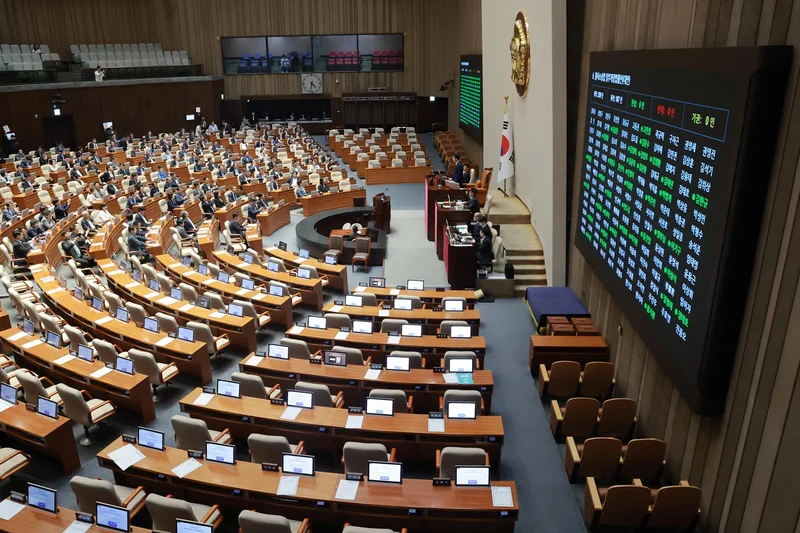
Regarding the legislation on prosecution reform, the bill was passed by the National Assembly July 31 and cleared by the Cabinet Tuesday amid controversy that it would leave shortcomings in police investigations unaddressed.
The controversy deepened particularly after allegations of police misconduct surfaced in a recent murder case involving a police officer's son.
The majority-wielding ruling Democratic Party of Korea (DPK), however, placed greater importance on its long-standing goal of preventing the prosecution's abuse of power to both investigate and press charges than on the foreseeable side effects of the reform.
As for the ETFs, Kim Yong-beom, the presidential chief of staff for policy, was behind their introduction despite concerns over their double-edged nature.
The products, which track individual semiconductor stocks that have surged amid the artificial intelligence boom, are designed to deliver multiples of the daily returns of the underlying stocks while also magnifying losses when share prices fall.
The ETFs were rolled out as the government seeks to redirect household wealth from real estate to financial markets under its housing reform agenda.
“From a common-sense perspective, both policies carried significant risks and I’d say the government pressed ahead despite the risk of negative consequences,” said Shin Yul, a political science professor at Myongji University.
The professor pointed to senior DPK lawmakers' acknowledgment of concerns over the prosecution reform, noting that they pledged additional institutional improvements after the bill's passage.
Acting party leader Han Byung-do said the party would clarify procedures and deadlines for requesting supplementary investigations — the main point of contention surrounding the reform — and further refine the new criminal justice system to address concerns over potential investigative gap.
Another senior DPK lawmaker, Seo Young-kyo, chair of the National Assembly's Legislation and Judiciary Committee, also said the party would continue improving related institutions and establish a body dedicated to gathering feedback.
A political analyst, who asked not to be named, described the "go ahead and fix the problem later" approach of both the government and the National Assembly as fundamentally flawed.
"If potential problems can be anticipated, they should be addressed beforehand to minimize harm to the public. That is the responsibility of the National Assembly and the government," he said.
"By the time problems emerge, the public has already suffered the consequences. Saying, 'We'll fix it if problems arise,' is therefore a highly irresponsible approach.”
Seoul-based civic group Citizens' Coalition for Economic Justice (CCEJ), meanwhile, criticized the presidential chief of staff for policy and the government over the introduction of single-stock leveraged ETFs after the stock market turned volatile late last month, dealing a heavy blow to investors.
Market volatility intensified last month, triggering repeated circuit breakers and sidecar trading curbs as the benchmark KOSPI experienced sharp fluctuations.
"The products should be regarded as a major policy failure behind the recent market turmoil," CCEJ said in a statement.
"The government's repeated overly optimistic signals and its creation of an environment conducive to high-risk investing expanded investors' appetite for risk and heightened market volatility."