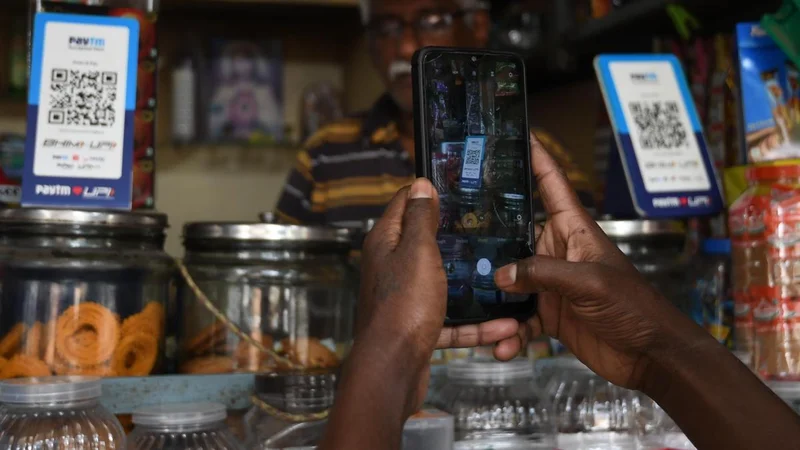
The story so far: Payments made on the Unified Payments Interface (UPI) platform have been free so far. However, a new law introduced by the government seeks to change this and allow banks and UPI companies to charge merchants for certain UPI payments.
The fear is that these merchants will, in turn, pass these charges on to customers.
What is the MDR charge?
A Merchant Discount Rate (MDR) is basically a fee that merchants have to pay banks and payment processors for the use of their networks. A typical MDR charge has four components — an interchange fee, processing charges, network fee, and tax.
The interchange fee is paid to the bank that has issued the credit or debit card. The processing charges are paid to the payment processor or gateway such as RazorPay, PayU, CCAvenue, BillDesk, etc. The network fee is paid to payment networks such as Visa, Mastercard, and the National Payments Corporation of India.
Finally, the tax on these services — in the form of the Goods and Services Tax — is paid to the government.
Since 2020, the government has mandated that transactions on UPI and RuPay debit cards would not attract any MDR charges. However, other card transactions do. For example, the MDR ranges between 0.4-0.9% of the transaction value on non-RuPay debit cards, 1.5-2.2% on domestic credit cards, 1-1.5% on netbanking, and 3-4.5% on international credit cards.
Who currently pays?
In a recent press conference, Reserve Bank of India (RBI) Governor Sanjay Malhotra said that “someone will have to pay the cost” of UPI transactions. At the moment, some of this cost is being absorbed by banks and payment processors while the rest is being borne by the taxpayers.
The government in December 2021 launched the ‘Incentive Scheme for Promotion of Low-Value BHIM-UPI Transactions (Person to Merchant - P2M)’ under which it provides a subsidy to banks for UPI transactions of less than Rs 2,000 in value. This is then shared among the other stakeholders.
According to the government, it paid ₹1,389 crore as this subsidy in 2021-22, which grew to ₹3,631 crore by 2023-24. Budget documents show that this figure has subsequently been falling, with the government budgeting ₹2,000 crore for the current financial year 2026-27.
As for the MDR on other forms of electronic payments, the merchants are currently paying those charges. Some pass these charges on to customers, while others absorb them.
What is the government’s proposal?
So far, the government has not made any official announcement regarding its plans to allow MDR charges on UPI. The only official move is currently in Parliament as part of a new Bill that would allow the government to levy such charges.
Currently, the Payment and Settlement Systems Act of 2007 instructs banks “not to impose a charge for using electronic modes of payment” if they are conducted using methods listed out in Section 269SU of the Income Tax Act, 1961. Section 269SU lists out debit cards powered by RuPay, and UPI and BHIM-UPI transactions, including those done by QR code.
In simple terms, a combination of these two Acts has so far made UPI and RuPay debit card transactions free from MDR charges. This is set to change.
The Taxation and Other Laws (Amendment) Bill, 2026 introduced in Parliament by the government on Tuesday (August 4, 2026) modifies the provision in the Payment and Settlement Systems Act to say that the government can notify the kinds of transactions that can attract such a charge.
Apart from this, sources in the government are saying that a possible MDR charge could be levied on large merchants — with an annual turnover of more than Rs 1-1.5 crore — and only on transactions that exceed Rs 2,000 in value. According to them, this would exclude about 95% of current UPI transactions from the charge.
They also say that the government is considering an MDR charge on UPI transactions of 0.25-0.4% of the transaction value.
Comment | The next DPI — how India can commoditise AI
What are the concerns?
The main concern among users is that UPI will no longer be free. While sources are currently talking about a limited application of the MDR charge, the government has not officially said anything. The new Bill in Parliament, if passed, would give the government the ability to levy this charge on any UPI transaction, should it choose to do so.
It is, however, unlikely that the government would impose such a charge on most UPI transactions. Digital and financial inclusion is a main pillar of the government’s ongoing reform programme and one of the most attractive aspects of UPI has been that it is free. The government will likely not risk pushing users back to cash by making UPI transactions more expensive.
Published - August 06, 2026 12:02 pm IST