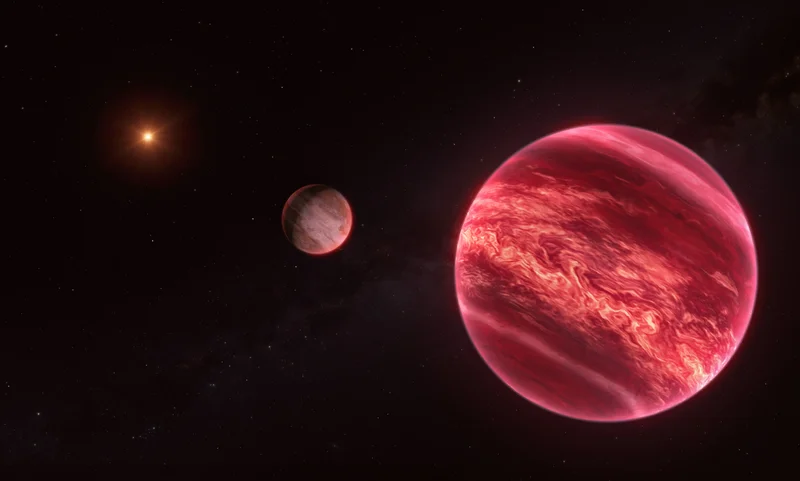
Astronomers are homing in on a distant realm where the lines between star, planet, and moon are blurred.
Researchers have recently discovered that something appears to be orbiting a brown dwarf in the CD-35 2722 system, about 73 light-years away in space, that defies the usual labels.
A brown dwarf is already something of a cosmic maverick — too large to be called a planet, too small to be a star. Experts sometimes refer to brown dwarfs as "failed stars" because they're not quite massive enough to sustain hydrogen fusion in their cores.
That leaves researchers at a loss for what exactly to call this thing circling it. Because the object orbits a brown dwarf that is orbiting a star, it's kind of an "exomoon," they said, a satellite of a planet found outside the solar system.
"Being the third wheel in this system makes us want to call it a moon, even if it is nothing like the small, rocky moons we have in our system," said Kevin Hoy, lead author of the study published in Nature, in a statement.
If confirmed, the research team believes this could be the first documented exomoon.
But it's nothing like typical moons. The new object, which the team is calling an "exosatellite" for now, is roughly the weight of Jupiter, with the brown dwarf, known as CD-35 2722 B, more than 30 times more massive.
A brown dwarf is too large to be called a planet, but too small to be a star and make its own nuclear power.
Credit: NASA illustration
At that scale, it's likely a gas giant, not rocky. Right now, there are nearly 1,000 known moons orbiting planets, dwarf planets, and asteroids — all within our own solar system.
Some scientists might argue that such an object should be considered an exoplanet. But that term doesn't fit perfectly either.
“The exosatellite is clearly massive enough to be a planet, but it does not orbit a star," Hoy said, "though it orbits an object that orbits a star."
This is not the first time astronomers have found something that appears to be orbiting a brown dwarf, but previous detections involved objects that were much more separated. Because of that, whether those companions were moons or planets is debatable. In this case, the satellite orbiting CD-35 2722 B is hugging the brown dwarf so closely, it completes a trip every 170 days.
Researchers used the European Southern Observatory's Very Large Telescope in Chile to make the discovery. Instead of taking a picture of the moon, the researchers used the observatory to see wobbles in the brown dwarf. Those tiny back-and-forth movements are caused by the gravity of something orbiting it. The method, known as the radial velocity technique, is frequently used to find new exoplanets.
Over more than two years, the team collected 23 observations. They saw a signal repeat every 170 days, suggesting that something had been tugging on the brown dwarf at regular intervals.
Astronomers have been trying to find an exomoon for many years. In 2024, for instance, a research team inferred a rocky moon around exoplanet WASP-49 b, about 635 light-years from Earth. Though they couldn't see it, the researchers proposed it as a candidate based on spectroscopic evidence of a cloud of sodium gas. The team believes volcanic eruptions from a hidden moon, similar to Jupiter's Io, is replenishing that cloud.
Years earlier, in 2018, a team found evidence of a potential Neptune-size exomoon orbiting Kepler-1625 b using the transit method, which looks for tiny, temporary dips in a star's light, caused by orbiting objects passing in front of it.
Though a handful of exomoon candidates has been reported in scientific journals over the years, none of them have been confirmed yet. The CD-35 2722 B candidate also will require more observations before it gets such a designation, but Alice Zurlo, an astrophysicist at Universidad Diego Portales in Chile and a coauthor, is convinced this is the first "plausible" detection of an exosatellite.
"As exotic as it is," Zurlo said in a statement, "this system is truly unique and represents a breakthrough."