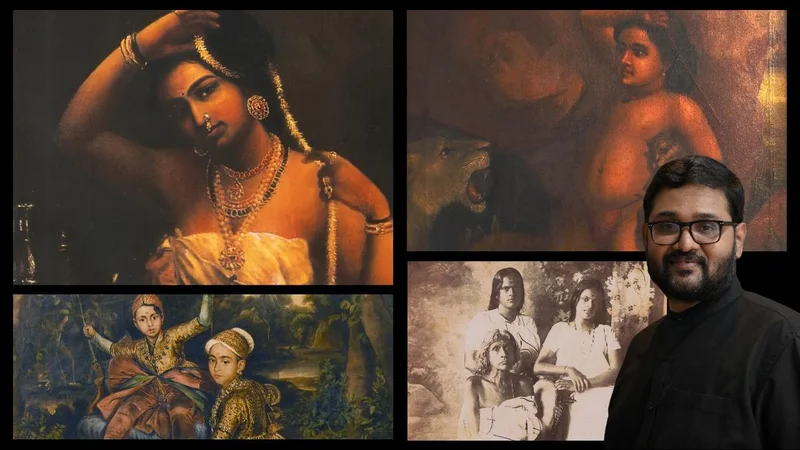
When thinking of art in Kerala, the name that usually springs to mind is Raja Ravi Varma. But the region has a richer artistic heritage featuring everything from mural paintings to Deccani miniatures. Sharat Sunder Rajeev, whose first book on the ivory carving tradition of Travancore was published by the Kerala Council for Historical Research, opens up this world of durbar painters, female artists, and itinerant European masters in his new book The Forgotten Atelier (White Falcon Publishing). Excerpts from an email interview with Rajeev, who teaches at the Department of Architecture & Planning at the College of Engineering, Thiruvananthapuram:
Kerala’s greatest art ‘export’ is Raja Ravi Varma. Yet, your book brings out a little-known detail: that the earliest painters in his family were women. Tell us more.
While Ravi Varma is rightly celebrated as one of India’s greatest painters, the artistic tradition in his family in Kilimanoor began in his grandmother’s generation. Rohininaal Tampuratti and Makamnaal Kunjikavu Tampuratti were sisters, and are believed to have learnt painting from two fugitive princes from British Malabar — a remarkable detail. Ravi Varma’s mother was also an artist, as was his sister, Mangala Bayi. Owing to strict social conventions, these women had limited exposure to the wider artistic world. Yet Mangala Bayi in particular emerged as a fine artist. Even today, this artistic legacy of the female line continues in Rukmini Varma, Raja Ravi Varma’s great-great-granddaughter in Bengaluru.
**Ravi Varma was a nobleman. But alongside him, there was another artist from a more modest background at the Travancore durbar. Why was Ramaswamy Naidu forgotten, and who was he? **
                                One of the most rewarding aspects of this project was tracing the descendants of these forgotten artists through family archives, oral histories, temple records, and scattered archival references. Their descendants have preserved photographs, paintings, and documents that have not entered mainstream scholarship so far. Their generosity in sharing these materials made it possible to recover many marginalised artists in *The Forgotten Atelier.*

                                    Ramaswamy Naidu was one such individual. He belonged to Madurai’s Naidu community, which, like the Rajus of Tanjore and Mysore, was long associated with artistic practice. During the colonial period, many of them formed part of a heterogeneous group referred to as *Moochy* painters. Naidu, in particular, was among the first Indians to master Western academic oil painting. Arriving in Travancore in the 1860s, he served a junior prince, but soon established himself as one of the court’s leading artists.
There was even a rivalry between Naidu and Ravi Varma, who was then beginning his own career. While Naidu won prizes and had influential patrons, his relatively early death prevented him becoming a greater celebrity. Besides, artists like him often left behind few written records. Many of their works remain unsigned, so histories have centred on towering figures like Ravi Varma.
One of the fascinating elements in the book is how influences travel. For instance, Deccan art comes to Tanjore, is imbibed there locally, and then transmitted to Kerala.
                                A central argument of *The Forgotten Atelier* is that artistic traditions have never been confined by boundaries. Artists, styles, and ideas moved constantly, shaped by patronage, pilgrimage, trade, politics, even warfare. Art history is a history of movement.


                                    The arrival of the Deccani style in Kerala is linked to the kingdom’s political history. During the Anglo-Mysore Wars, Travancore allied itself with the Maratha Confederacy, the Nizam of Hyderabad, and the British against Tipu Sultan. These relationships created new channels of cultural exchange. The 19th century witnessed another development. With the growing British influence, colonially-backed English-educated Marathi Brahmins were appointed as *dewans* (ministers) in Travancore. Among them was Subba Rao, who earlier served in Thanjavur. He played an important role in introducing artists from Thanjavur to the Travancore court. These painters were trained in both Deccani miniature painting and the emerging Company style.
In Kerala, they introduced new techniques, formats, and aesthetic sensibilities, giving rise to a sophisticated tradition of royal portraiture, firmly linking the Travancore court with the wider currents of southern India. In this sense, the history of Travancore’s art cannot be understood in isolation; it was shaped by a vibrant network of exchanges.
You also examine the role of European artists.
The 19th century witnessed an unprecedented interaction between Indian courts and European artists. The latter introduced new ideas of realism, perspective, anatomy, portraiture and oil painting. Their works appealed to royalty, offering a new visual language that projected authority and modernity.
Interestingly, the earliest reference to a European painting in Travancore dates to the late 18th century when a portrait of Pope Clement XIV was presented to the maharajah by a missionary. In return, the maharajah presented the pope with his own portrait. From the early 19th century, Travancore’s royals became patrons and collectors of Western art. Several Europeans painted them, among whom August Schoefft, F.C. Lewis, and Theodore Jensen are significant.
Schoefft was one of the most celebrated European portraitists in India. He is best known for his portraits of Maharajah Sher Singh of Punjab as well as his magnificent painting of Bahadur Shah Zafar, the last Mughal emperor. In Travancore, he painted Maharajah Swathi Tirunal, the great icon of Carnatic music, and his relations.
With Jensen, tradition holds that the young Ravi Varma learnt several finer aspects of oil painting by observing him at work. My research, however, points to another influence. Jensen’s paintings were publicly exhibited in Thiruvananthapuram in 1868, and this may well have been the first modern art exhibition in Kerala. It is possible that the event left an impression on Ravi Varma, shaping not only his practice but also his understanding of how art could be displayed and appreciated by a wider public.
**Why did these artistic innovations not interact with Kerala’s mural painting tradition? **
Broadly speaking, Kerala’s mural tradition flourished in temples and palaces, where its primary function remained religious and ritualistic. The 19th century Western style of painting served a different purpose. It responded to changing notions of kingship, portraiture, colonial modernity, historical documentation, and private patronage. As a result, the two streams evolved along parallel paths, catering to different audiences and artistic needs.
That said, *The Forgotten Atelier* shows how a few artists did bridge these seemingly distinct traditions. Among them was Pulakkat Raman Nair, a celebrated exponent of the *Guruvayur School* of mural painting. Artists such as Nair and N. Srinivasa Iyer mastered oil painting while continuing to depict religious themes rooted in Kerala’s traditional visual culture. Their work demonstrates a more nuanced interplay between indigenous and foreign styles.
While Ravi Varma is well known, you speak of others in his circle: Sekhara Warrier, Mukundan Tampi, and so on. Who were these artists?
One of my aims in the book was to restore visibility to a remarkable generation of artists whose contributions are overshadowed by Ravi Varma’s brilliance. They are often dismissed simply as “contemporaries and followers”, but they were more than that: accomplished artists with distinctive contributions to 19th century South Indian art.
One question that has intrigued Ravi Varma scholars is the sheer number of paintings attributed to him. He was extraordinarily prolific, and previously unknown works continue to surface today. Yet, this raises an important question: how did a single artist produce such a vast body of work over a career spanning little more than three decades?
While his brother, C. Raja Raja Varma, was his closest collaborator, he was by no means the only one. My research suggests that Ravi Varma’s studio functioned much like an atelier, where a number of artists worked alongside the master, assisting in the execution of pictures under his guidance. Ravi Varma’s associates included K. Sekhara Warrier and K. Madhava Warrier, who were his first-cousins. Although little known, their works rank among the finest produced in Ravi Varma’s circle.
Another important figure is P. Mukundan Tampi, whose connection with the family into which Ravi Varma married, gave him access to the master’s studio. A favoured disciple of Ravi Varma, Tampi was appointed court painter in Travancore in 1895 and went on to enjoy a distinguished career.
The book also reconstructs the careers of several other neglected figures, including N. Sivarama Pillai, K. Padmanabhan Tampi, A. Rama Warrier, Rama Varma Raja, K.R. Ravi Varma, C. Nilakanta Pillai, K. Ramakrishnan Achari, and N.N. Nampiyar, among others. Together, they produced portraits, and historical and devotional compositions, that today survive in palaces, museums, public institutions, and private collections.
How many years of research did the book take? And did you struggle to have it published?
The Forgotten Atelier took a decade-and-a-half to research. It involved archival work, field travel, studying palace collections, consulting family archives, and speaking with descendants of the artists whose stories had never before been documented. It often felt like assembling a vast puzzle. Every inscription, newspaper clipping, or anecdote became an important piece of the narrative.
Publishing a book like this is never easy because it appeals to a specialised readership and contains hundreds of images that increase production costs. You need networks or must already be well-known, so as to assure publishers a reliable volume of sales. I chose to self-publish, which allowed me editorial freedom and ensured that the book appeared exactly as I envisioned it. In today’s publishing economy, many illustrated works are in fact self-published. Hopefully, this will change.
The interviewer is a historian.
Published - August 06, 2026 01:18 pm IST