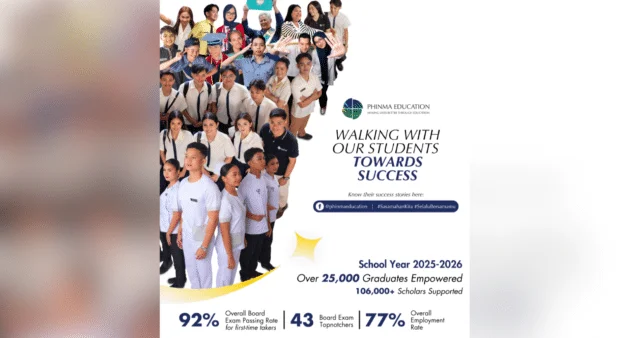
PHINMA Education students prove that success is not defined by where they start
PHINMA Education students continue to demonstrate that success is not defined by where they begin. Across its network of 14 schools in the Philippines and Indonesia, students once again posted strong performances in board licensure examinations for Nursing, Education, Pharmacy, Dentistry, and Criminology for School Year 2025-2026.
The largest private higher education network in Southeast Asia in terms of enrollment achieved a 92 percent overall first-time passing rate, including 100 percent passing rates across 17 programs, producing 5,947 newly licensed professionals and 43 board exam topnotchers.
These achievements reflect PHINMA Education’s success in creating pathways for students from diverse backgrounds to excel both academically and professionally. This commitment to student success has also driven sustainable growth for the organization.
In School Year 2025-2026, PHINMA Education welcomed 177,851 students across the Philippines and Indonesia–a 13-percent increase from the previous year. This sustained enrollment growth contributed to a 31 percent increase in net income to P2 billion, while EBITDA margin grew to 37 percent. This, alongside disciplined cost management, has allowed the organization to keep education affordable while continuing to invest in student support.
Behind these achievements are students who overcame significant barriers on their path to success. Based on PHINMA Education’s 2025 freshmen profile survey, 99 percent of incoming freshmen were initially assessed as not yet college-ready. With the right support and opportunities, they have gone on to excel.
Among its top performers is Katrina Jean Jimenez from PHINMA University of Pangasinan College Urdaneta, who placed Top 4 in the February 2026 Criminology Licensure Examination.
“One of the biggest challenges I faced in college was doubting myself. I often compared myself to my peers and sometimes felt that I wasn’t good enough. Eventually, I realized that everyone has their own journey. I stopped comparing myself to others and focused on becoming better than I was yesterday. Every day you choose to put in the effort and keep choosing your dream, and it will eventually bear fruit in ways you once thought were impossible,” Katrina shared.
For PHINMA Education, these achievements are proof that students can excel when education is designed around the realities of their lives.
“For low-income families, life is rarely straightforward. Our students are not just learners – they are breadwinners, workers, and individuals balancing multiple responsibilities and competing priorities. They carry many identities, many strengths, and the capacity to do so much more. Our role is to build an education system that recognizes this reality and helps them succeed,” said PHINMA Education Philippines Country Head Happy Tan.
Through its bare-bones, no-frills, brass-knuckles model of education, PHINMA Education in the Philippines and Horizon Education in Indonesia intentionally create pathways for working students, adult learners, gap-year returnees, and other underserved sectors by meeting them where they are.
The realities of PHINMA Education’s student population underscore why this approach matters. According to its 2025 Freshmen Profile Survey, 69 percent of freshmen in the Philippines and 76 percent in Indonesia are first-generation college students whose parents did not complete college and therefore have limited experience navigating higher education. Despite this, their ambitions remain high: 86 percent of students in the Philippines and 90 percent in Indonesia aspire to earn a bachelor’s degree or higher.
Josephine Lapuz embodies those aspirations. At 46 years old, she returned to college at PHINMA St. Jude College in Dasmariñas to pursue her lifelong dream of becoming a nurse after spending years away from school.
“You are not behind. That greatness was never lost. It is simply waiting for you to claim it again,” Josephine said.
Meanwhile, Nazril, a Horizon University Indonesia student, paused his education for a year to work and save money before returning to pursue a degree in Management. Today, he balances his studies while continuing to support his family.
“We shouldn’t have to choose between our dreams and our responsibilities. With determination and the right support, we can pursue both at the same time,” Nazril said.
Supporting students from admission to graduation requires addressing the many barriers underserved learners face, from financial constraints and academic readiness to the need for guidance and belonging. This has shaped the institution’s approach towards student success.
In the Philippines, the Hawak Kamay Scholarship reduces tuition in select programs to as low as P5,500 per semester, with no entrance examination, no maintaining grade requirement, and coverage until a student’s final year. In Indonesia, the Sahabat Horizon Scholarship provides up to 50 percent tuition assistance. Beyond financial support, the institution fosters student success through teaching approaches that promote active, effortful learning and a caring community where students receive guidance, encouragement, and support throughout their college journey.
For Farras, a nursing graduate of Horizon University Indonesia and the first in her family to earn a college degree, that support made all the difference. Her mother, Yayah, captures what that support means to families.
“Sometimes what gives parents confidence isn’t just the name of the university–it’s the people behind it, the ones who believe in their children and walk alongside them every step of the way.”
By fostering a flexible, supportive, and affordable ecosystem, PHINMA Education ensures that as students navigate the beautiful complexities of life, they always have a partner walking beside them every step of the way.
ADVT.
This article is brought to you by PHINMA Education.