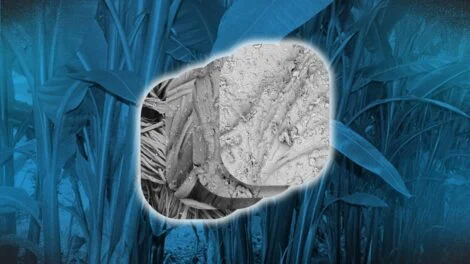
Abaca may offer sustainable protection from radiation, researchers say
MANILA, Philippines — Researchers from De La Salle University (DLSU) are investigating the potential of abaca to create more durable and sustainable protective materials for health care workers, soldiers and even astronauts.
Derived from Musa textilis and grown primarily in the Philippines, abaca has long been valued for its durability. Its strength is comparable to that of certain metals in terms of “ultimate tensile strength,” or the maximum stress a material can withstand while being pulled or stretched.
Using nanotechnology, a team led by Gil Santos, chair of the DLSU Department of Physics and head of the university’s iNano Research Facility and Solid State Physics Laboratory, examined the potential of what it described as a “robust and readily available indigenous fiber.”
Article continues after this advertisement
The team, which includes Christopher Que, Tonibeth Lopez and Normie Lacubtan, investigated abaca’s potential for high-value applications in medicine and engineering.
RELATED STORY: UP, DLSU team develops tool to compare disease, biology models
The research provides a glimpse into how locally sourced materials could help address complex challenges, DLSU said. The team is identifying which abaca varieties are best suited for specific applications.
“Because of the abundant supply of abaca — and we are the No. 1 supplier of abaca in the world — I saw the potential of this material for different applications, especially for protecting our health workers in the field, specifically from X-rays,” Santos said.
Article continues after this advertisement
He said abaca also has potential military applications as a protective shield and could be used for electromagnetic interference shielding.
“For example, when a cellphone signal weakens due to interference, that is a form of electromagnetic interference shielding,” Santos said.
The researchers said they are identifying the varieties that are more effective in radiation shielding. The abaca would function as part of a composite material, combining the flexibility of natural fibers with the protective properties of engineered particles.
Article continues after this advertisement
Beyond its technical and medical applications, the research has significant socioeconomic and environmental implications, Santos said.
Unlike conventional shielding components that rely on heavy metals, abaca-based composites offer a biodegradable and renewable alternative.
“The material’s natural growth cycle — particularly in regions like Catanduanes — also provides a steady supply, creating opportunities to strengthen local agricultural economies. By shifting from raw fiber exports to high-value manufacturing, the research could increase farmers’ incomes and expand rural industries,” he said.
“Why not use indigenous material to protect our health workers, our security and military personnel, and even astronauts? It naturally grows, so it replenishes itself. At the same time, we support local communities and promote sustainability,” Santos said.
The initiative received support from the Department of Science and Technology through the Philippine Council for Agriculture, Aquatic and Natural Resources Research and Development and the Philippine Council for Industry, Energy and Emerging Technology Research and Development.
The researchers are conducting tests and validation in coordination with the Philippine Fiber Industry Development Authority. They are also working with the Philippine Nuclear Research Institute to evaluate how the composites perform under different levels of radiation exposure.
“For further studies, researchers can explore the composite’s potential applications in defense and communications, particularly in environments where electromagnetic interference can affect signal transmission,” Santos said. /dm