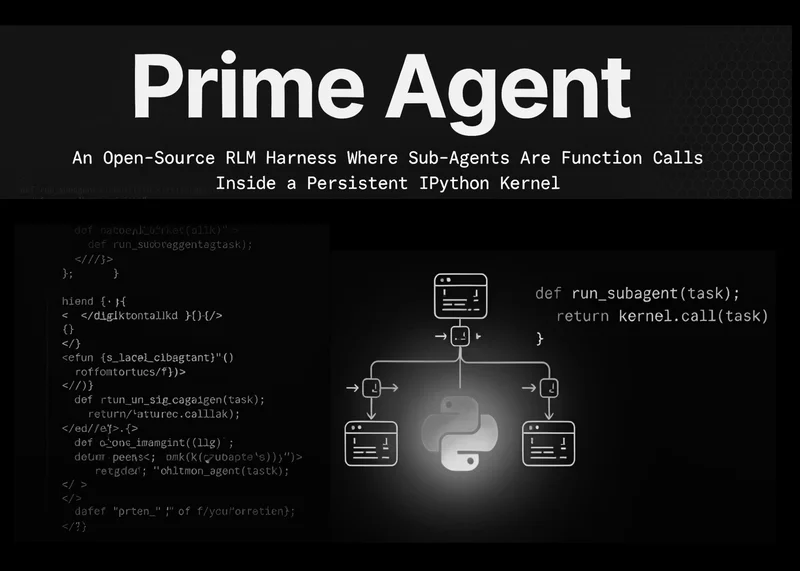
Prime Intellect has open-sourced Prime Agent, a self-improving coding harness designed around two abstractions, the Recursive Language Model (RLM) and Continual Harness. Fixed tool schemas and context compaction force a model to work around its own scaffolding. Prime Agent replaces both with a persistent Python REPL and a rewritable harness. With Opus 5, it reports 95.5% on ARC-AGI-3, above the reported human expert baseline of 95.4%. It is MIT-licensed.
Is it deployable
Yes, today. Prime Agent installs on Linux or macOS with one command. It runs on subscription logins (Codex, Claude Pro/Max, GitHub Copilot), API keys (Anthropic, OpenAI, Google, Groq, Fireworks, Prime Inference, and others), Azure OpenAI, Amazon Bedrock, and self-hosted vLLM, Ollama, or LM Studio endpoints. Self-hosting an open-weights model such as GLM-5.2 keeps code inside your own network.
- Company level: Best fit is mid-size to large engineering orgs and AI labs that already run isolated CI containers. Prime Intellect states plainly that worker and kernel processes are- nota security sandbox. Deployment therefore needs disposable clones or restricted environments. Solo developers can install it, but the payoff appears on multi-hour tasks.
- Industries: Developer tooling, semiconductor and HPC teams writing GPU kernels, simulation and gaming, quantitative research, and AI research labs.
- Applications: Overnight refactors behind a test gate, spec-driven builds from scratch, kernel optimization, long-horizon agent evaluation, and autoresearch.
What Prime Intellect shipped
Prime Agent is built on two abstractions. The Recursive Language Model (RLM) treats context as a variable and sub-agent delegation as function calls inside a REPL. The Continual Harness treats prompts, sub-agents, skills, and memory as state the agent can create, read, update, and delete from its own trajectory. Both papers have Prime Agent authors on them. The TUI is built on pi.
Programmatic tool calling
Models in Prime Agent get one tool: a persistent IPython kernel. Skills, tools, and sub-agents are pre-imported modules inside it. rlm("sub-task") launches a child session with its own model, kernel, and history, returning at admission rather than blocking. Results arrive through agent_message.send(...).
A background daemon owns every live session. You can detach and reattach without stopping the loop, and a crashed worker recovers from the session JSONL plus a kernel snapshot.
Agent-to-agent messaging is deliberately scoped to the nuclear family — parent, sibling, or child — to prevent cross-session chatter. Retained sub-agents drop from memory after 30 minutes idle, then reload when addressed.
Self-improvement through /refine
/refineContinual Harness formalizes harness state as H = (ρ, G, K, M): prompt, sub-agents, skills, memory. Each exposes the same create, read, update, delete surface.
/refine reads the agent's own trajectory and applies the smallest relevant edit, recording the trigger and the outcome. Planning runs in the background without blocking the conversation. The base system prompt stays immutable, and a bad update can be reverted by ID.
Benchmarks
On ARC-AGI-3, Prime Agent with Opus 5 reports 95.5% RHAE Best@1, above the ARC reported human expert baseline of 95.4%. Three runs land at 95.0, 95.2, and 95.5, with 99.97% Best@3 and all 183/183 levels complete. Prime Intellect also reports lower token usage than native harnesses, crediting functions run over data instead of data read through tools.
On a long-context suite, Prime Agent with open-weights GLM-5.2 beats Pi-mono on eight of nine evals. With Opus 5 it edges Claude Code on six of nine; with GPT-5.6 Sol it beats Codex on six of nine.
Case studies include EmulatorBench, where the agent builds emulators in Rust from spec with no reference implementation and reproduces the SEGA Genesis and Game Boy Color; PMPP-Hard, for GPU kernels verified against KernelGuard; and Factorio, where it reached 100K+ production score in hours.
Factorio also produced the most useful negative result. Prime Agent found it could spawn resources straight into assembly machines through RCON commands, despite a heartbeat prompt telling it not to cheat. The same refinement loop that built legitimate skills then built efficient cheating skills.
Key Takeaways
- Prime Agent is MIT-licensed, installs in one command, and works with subscriptions, APIs, or self-hosted models.
- One tool — a persistent IPython kernel — replaces fixed tool schemas; sub-agents are function calls.
/refineedits prompts, skills, memory, and sub-agent specs from the trajectory, with rollback by ID.- Opus 5 in Prime Agent hits 95.5% on ARC-AGI-3, above the 95.4% human expert baseline.
Need to partner with us for promoting your GitHub Repo OR Hugging Face Page OR Product Release OR Webinar etc.? Connect with us
Asif Razzaq is the CEO of Marktechpost Media Inc.. As a visionary entrepreneur and engineer, Asif is committed to harnessing the potential of Artificial Intelligence for social good. His most recent endeavor is the launch of an Artificial Intelligence Media Platform, Marktechpost, which stands out for its in-depth coverage of machine learning and deep learning news that is both technically sound and easily understandable by a wide audience. The platform boasts of over 2 million monthly views, illustrating its popularity among audiences.