Outside the Walmart in Senatobia, Mississippi, where police shot and killed 1-year-old Kohen Wiley, a shrine of stuffed animals sits between the garden center and the pharmacy. There are teddy bears, elephants, and kangaroos with babies in their pouches. There is a Bluey plush toy — Kohen’s favorite cartoon — along with matchbox cars, a green plastic tractor, and an array of artificial flowers.
A banner frames the display, featuring a celestial image of baby Kohen wearing gingham overalls. A handwritten sign reads, “Justice Delayed is Justice Denied.”
In the parking lot, a cop pulled a gun on a gray Ford Fusion on a Sunday afternoon and fired while Kohen’s mother held him in the passenger’s seat. A bullet struck the child on his right side, tearing through his small body and exiting his left. The driver, who was also hit, sped to a hospital, but it was too late. At 19 months old, Kohen was dead.
The killing sparked anguish and rage in Senatobia, a small city some 40 miles south of Memphis, Tennessee. At protests and press conferences, people demanded answers, while officials stayed mostly silent. It took several days for the mayor to deliver a scripted video statement that did not even include the child’s name.
The Mississippi Bureau of Investigation announced a probe into the case. Speaking before an agitated crowd, state Department of Public Safety Commissioner Sean Tindell said this could take months, refusing to say when — or even whether — his agency would provide further updates.
Until then, the official narrative would be a version of a familiar tale told by those who kill under color of law: On June 14, Senatobia police got a shoplifting call from Walmart over baby clothes and a pack of Pampers diapers. According to an MBI press release, officers tried to stop “two subjects and a juvenile child fleeing from the store.” The suspects “drove in the direction of the officers, almost striking one.” That’s when an officer fired.
Police offered nothing to back the story. A witness video captured mostly chaos as the car drove off, while a woman who asked not to be named told a local TV station she saw police chasing the car before hearing gunshots. Nevertheless, the police narrative took off. On Facebook pages like “Senatobia Happenings UNCENSORED,” commenters blamed Kohen’s mother for his death.
The accusations escalated after famed civil rights attorney Ben Crump took the family’s case, with critics accusing him of stoking racial grievances for profit. When Crump released a video of Kohen’s mother, Vel’lesiya Wiley, telling her side of the story — saying she “raised my baby up” to warn officers that Kohen was with her — a wave of racist vitriol followed. Some demanded to know why Kohen wasn’t in a car seat. Others said she’d used him as a “human shield.”
The comments were shockingly cruel. They also ignored what Black residents of Senatobia, which is about 40 percent Black, had long insisted: Police treated them with contempt and brutality.
A year earlier, at the same Walmart where Kohen was killed, a police officer forced a woman from her car in front of her children for parking in a handicapped spot — part of a string of violent incidents that made national news. In the summer of 2025, Senatobia’s board of aldermen finally voted to dismiss the police chief.
By then, the department had already hired the officer who would later be identified in the local press as involved in killing Kohen Wiley – a police sergeant who’d been previously sued for misconduct while working at two different law enforcement agencies. Just two days before Kohen was killed, a Black officer filed a complaint against him for making a racist remark.
To racial justice activist Patrick Lumumba, the decision to hire such a man was emblematic of the city’s disregard for Senatobia’s Black community. “You think they didn’t know about his past?” he asked. “But who was he gonna hurt? If he hurt anybody it wasn’t gonna be white people.”
On the last Saturday in June, as the family laid Kohen to rest, the Senatobia Walmart was relatively quiet. A police car was parked across the shopping plaza, where protesters had gathered the day before. At an empty restaurant where a TV played “Leave It to Beaver,” a young white employee said no one had come in all day, blaming the “rioters” for keeping customers away.
At the memorial site, a white woman retrieved a bouquet of dried flowers blown away by the wind. She defended the protests, adding that they had been peaceful. For all the speculation and rumor, she said, no one really knew what had happened. But nothing could justify shooting a 1-year-old boy.
“The whole thing is very, very sad,” she said. “No mother should have to bury her child.” She did not wish to share her name. “I don’t want to stir any trouble.”
“Outside Agitators”
Senatobia, the seat of Tate County, sits on the northern tip of the Mississippi Delta, a mostly rural region famous as the birthplace of the blues. Downtown, historical markers boast connections to Black musicians like pioneering country singer O.B. McClinton. “Being in the small contingent of African-American performers in country music was never a cinch,” his marker reads, “but McClinton often dealt with the subject good-naturedly in shows and songs.”
Easier to miss are the places that once saw violent attacks on the civil rights movement. Just north of town, on Highway 51, a marker commemorating the site where James Meredith was ambushed and shot during a solo march from Memphis to Jackson has been knocked from its post; it currently sits on the ground. After Dr. Martin Luther King Jr. resumed the 1966 march alongside other civil rights leaders, they passed through Senatobia, in the same spot where the Walmart now stands.
The activists were widely depicted as radical outsiders — “Hard Core Civil Rights Militants,” as one headline read. But the march included locals; many offered their homes to the visitors at great personal risk. “Most people would sleep in the backyard of people’s homes because they were scared they would bomb the home,” recalled independent publisher Gloria Zuurveen, a Senatobia native whose aunt hosted activists. “But she said, ‘No, y’all ain’t sleeping in my backyard. Come on in this house.’”
The claim that protesters were “outside agitators” was a common refrain — a persistent way to dismiss any movement. When local pastor Michael Cathey, Senatobia’s first Black alderman, led boycotts of its public schools and businesses in 1987 — part of a wave of similar actions across Mississippi — some suggested they’d been orchestrated by the NAACP. “I’d like to see local people solve local problems without outside assistance,” the mayor told reporters.
In reality, “the whole community took a stand,” Cathey recalled. “The school buses ran empty. Nobody went to the store.”
Cathey has been outspoken about the killing of Kohen Wiley. His congregation, the West Gilmore Church of Christ, hosted the viewing for the toddler in June. “The city government is hiding behind the Mississippi Bureau of Investigation,” Cathey said. Their excuse is that they must wait on the state. “But that’s not true. The city can speak to the matter. … They need to be working to make sure we have transparency. But it’s not happening.”
Cathey said that the case had attracted many activists from outside Senatobia, making the protests easier for officials to ignore. But a bigger problem, Cathey and others said, is the refusal of elected leaders to represent their constituents.
Cathey served as an alderman for over 30 years, leaving office in 2017. In the decade since Donald Trump’s rise, he said, local conservatives have increasingly modeled themselves after MAGA politicians, shedding any pretense of concern for Senatobia’s Black community. Unlike the civil rights era, in which the federal government forced states like Mississippi to expand hard-fought legal rights, Trump is doing the opposite: weaponizing his office to turn back the clock on equal rights.
“What we see Trump doing on a national level, we have that same attitude locally,” he said. “And I don’t see it just being a Mississippi problem. It’s a national problem.”
Law and Order
Not that long ago, the South seemed poised toward progress.
As protests spread across the country after the killing of George Floyd by a Minneapolis police officer in 2020, many declared it time to break from the past. Confederate monuments were toppled and, in some states, lawmakers passed criminal justice reforms to roll back the legacy of racial violence.
In Mississippi, lawmakers did what once seemed impossible: Vote to replace the state flag, eliminating its Confederate iconography. Senatobia Republican Trey Lamar pushed the effort, calling it “something I knew in my heart for a long time was the right thing to do.”
Such symbolic gestures, however, did not translate to systemic change. Before long, Mississippi politicians were disenfranchising Black residents in sweeping new ways. Lamar became the chief sponsor of legislation to create a new, state-controlled court system in the majority-Black capital city of Jackson, usurping the power of the city’s elected judges and handing it to white state lawmakers. The measure was about crime control, Lamar insisted. It had nothing to do with race.
But “law and order” has long been a code for racial politics. In Senatobia, which hosted a “Back the Blue and Trump” parade in the fall of 2020, the mayor and board of aldermen started making changes of their own. The city’s Black police chief, a 26-year department veteran, was replaced with a white man who had only recently joined the force.
The new chief, Richard Chandler, was given free rein to transform the department. Some moves seemed sensible enough. Senatobia police officers were paid as little as $13.75 per hour when Chandler arrived, and he successfully argued for better wages. But other decisions raised red flags. Despite the department’s small size — some 30 officers in a town of roughly 8,500 — Chandler formed a SWAT team and assigned a dozen officers to the unit. One was a 22-year-old recent recruit who described herself as “an adrenaline junkie,” as she told reporters. “I want to kick down doors and go in there and arrest the bad guy.”
The stated goal was modernization; the city built a new police station, bought a fleet of new vehicles, and hired a grant writer to seek federal funds. Chandler also pushed aldermen to pass new ordinances aimed at increasing city revenue. Between 2021 to 2025, according to city meeting records, the board voted to add financial penalties to punish misdemeanor drug charges, loitering, and “nuisance level gatherings.”
The fines, ranging from $25 to $1,000, would inevitably target those who could least afford it. “There was no consideration to how it affected the citizenry,” said Cathey, who attended many of the meetings. “It was just about making money.”
It wasn’t long before a string of shocking incidents were caught on video. In February 2022, police violently arrested a man named Rodney Rucker, who was warming up his car outside a local motel before an early shift at McDonald’s. Body camera footage showed police accusing him of having white powder under his nose and, when he refused to leave his vehicle, smashing his window and breaking his phone. No drugs were found in the car.
In 2023, Senatobia police followed a teenager into the home of a local barber named Mark Lesure, ostensibly because the young man matched the description of a criminal suspect. Video showed Chandler choking Lesure before being accidentally tased by his own officer.
Senatobia police made national news that same year for jailing a 10-year-old boy for public urination, a move Chandler conceded was “an error in judgement.” But he defended the violent arrest of two sisters, 13 and 14, outside a public housing complex in 2024. According to the girls and their mother, Chandler personally ordered one of the girls to “get your Black ass out of the road” before forcing her to the ground.
Finally, on Mother’s Day 2025 — in the same Walmart parking lot where Kohen Wiley would be shot dead — a female officer dragged a Black mother out of her car in front of her frightened young children for sitting in a handicapped parking space.
By then many people in Senatobia were fed up — including some members of law enforcement. One retired police officer echoed what many said for years: Chandler drove out officers who lived in the community and brought in cops who would prey on the community. A number were hired after being dismissed from other departments. “They want people like that,” he said. “They can get them to do any kind of dirty work they want.”
In the summer of 2025, over angry objections by the mayor, Senatobia’s board of aldermen voted to remove Chandler. It was supposed to restore trust, one alderman said. But as Lumumba, who recently founded the Senatobia Committee for Accountability and Transparency, said, “We removed Chandler. But the culture remained.”
A History of Violence
City officials have not identified the man who shot Kohen Wiley. But it’s considered an open secret in Senatobia. A Memphis news station obtained records from the MBI that identified the officer who responded to the shoplifting call at Walmart: Senatobia Police Sgt. Hunter Foster, who has been on paid leave since mid-June.
Foster, now 33, was hired by the Senatobia Police Department in March 2025 and quickly promoted to sergeant. Two days before Kohen’s death, a fellow officer filed an internal complaint against him. According to Mississippi Today, Foster entered the booking room at the station, saw School Resource Officer Dexter Smith, and said, “‘Who is this Black motherfucker back there?’”
“The room went silent,” Smith wrote in his complaint. “I have never had any one-on-one conversation with Sergeant Foster, nor do we have any outside relationship to be on a level for him to speak to me in that manner.”
Smith quit a month after filing the complaint. In his resignation email, he cited a lack of “meaningful response or resolution,” according to Mississippi Today.
Several red flags might have prevented Foster from being hired to begin with. Before coming to Senatobia, he’d been named in two federal lawsuits, both of which were dismissed under the doctrine of qualified immunity.
In 2022, he was accused of providing a false narrative following the arrest of two men outside a Waffle House in neighboring Southaven. In a police report, Foster accused a driver of “almost running over” another responding officer, a description unsupported by video evidence.
After moving to the DeSoto County Sheriff’s Department, Foster was sued for participating in the brutal assault of a 29-year-old Black woman during a traffic stop. According to the 2024 complaint, the deputies tased her, “pulled her hair, kicked her multiple times in her stomach and ribs, called her a prostitute, stomped on her face breaking her jaw in three places and knocked out multiple teeth.”
A use of force report cited injuries on the woman — including “abrasion, puncture, lacerations, (and) swelling” — and confirmed that she was taken to the hospital in an ambulance. In an affidavit, Foster said his “only involvement” was to pin her down in order to handcuff her, while providing no video footage to confirm his account. According to Foster, he tried to activate his body-worn camera only to later “realize it had never activated.”
Foster did not respond to messages from The Intercept.
“Y’all Gonna Kill Somebody”
On July 1, Ben Crump returned to Senatobia to release a report from D.C. Medical Examiner Roger Mitchell, who was brought onto the case to conduct an external examination of Kohen Wiley’s body and assess photos from the scene. A photo of the sedan showed the passenger’s side window shattered and a bullet hole in the windshield.
The findings undercut the claim that police had fired in self-defense. On Kohen’s right side, where the bullet entered, were small cuts known as “pseudo stippling,” an injury pattern commonly found on victims shot through glass. According to Mitchell, the markings suggested the bullet had been fired through tempered glass — like that found on a car’s passenger window — rather than through a windshield’s laminated glass.
But the only way to learn what really happened, Crump said, was to see the body camera footage and surveillance video that the MBI still had not released.
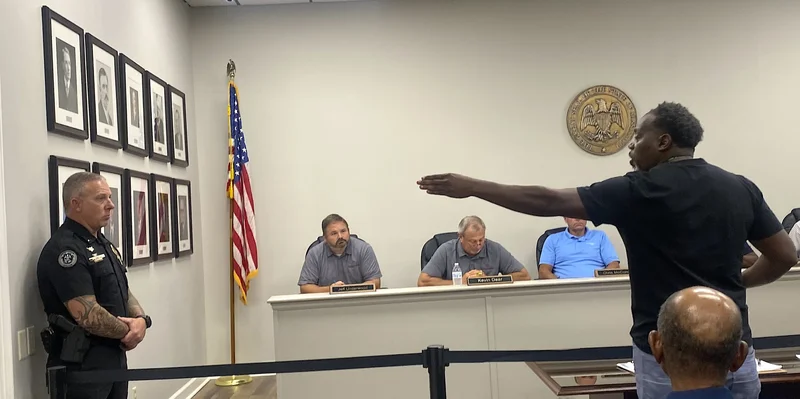
The following week a crowd filled a room inside Senatobia City Hall. Lumumba, the local activist, had been given time to speak at the bimonthly board of alderman meeting, along with two women from the Building Bridges Coalition. He gave the aldermen copies of Kohen’s obituary. “Kohen brought joy to everyone he met,” it read. “He loved playtime with his mom, playing with his toys, and cutting the grass with his toy lawnmower.”
Lumumba reminded the aldermen of the history of police violence in Senatobia. He and his neighbors had urged the city to act. “We told y’all, ‘Y’all gonna kill somebody,’” he said. Now, police had gone too far. “This ain’t going away.”
Shatoya House reminded the officials that protesters are not “the enemy.” Yet that’s how they’d been treated. Police had deployed tear gas on one demonstration outside Walmart. And on the day the commissioner of public safety came to town, snipers had watched from the rooftops.
House also felt compelled to respond to an accusation about the activists. Many critics seemed convinced they were bigoted against white people. “I am not racist,” House said. “If it was your 1-year-old baby, what would your response be?”
When the speakers were done, no one said anything. With a placid air, Mayor Greg Graves simply moved on to the next agenda item.
“We must not be good enough for them to talk back to us,” one woman said loudly. Only one alderman had addressed them directly — to confirm that Foster was still collecting a paycheck. “Do the rest of y’all care?”
“No, they don’t care,” another replied.
A white lieutenant interrupted with a warning. “All right, that’s it,” he snapped.
“Let the mayor run the city,” the woman snapped back. “You a police officer, bro.”
He gave her a hard stare and nodded. “Yes, ma’am, I am,” he said. “Yes, ma’am, I am.”
Neither Graves nor individual aldermen responded to emails from The Intercept. Senatobia Police Chief Harold Vanderford said any questions should go to the MBI. “I can’t say anything or do anything until they do what they’re gonna do,” he said. In an email, the MBI wrote, “This remains an open and ongoing investigation, no further comment will be made.”
Activists have continued to show up at city hall. At one recent meeting, Lumumba introduced Kohen’s mother and grandmother to the aldermen, who again had nothing to say. Outside the meeting on August 4, Lumumba passed out postcards urging people to join the cause. He was joined outside by community members wearing shirts that read, “Your baby is our baby.”
Elsewhere in town, others seem anxious for it all to go away. Last month, an anonymous woman posted in the Senatobia UNCENSORED group. Her family was moving to Senatobia but, based on what she’d seen on the page, she worried it was a mistake. “I’ve never seen so much drama and hatred,” she said. “Please tell me it’s a good place.”
Several people sought to reassure her. “I have rarely experienced any racism or hate,” one white woman wrote. The original poster thanked her. “This eases my heart.”
“You are so welcome,” the white woman replied. “I promise it’s peaceful here.”
“There will be some turmoil when the MBI releases their findings,” she added. “But it will be outside agitators. And it will be temporary.”
IT’S EVEN WORSE THAN WE THOUGHT.
What we’re seeing right now from Donald Trump is a full-on authoritarian takeover of the U.S. government.
This is not hyperbole.
Court orders are being ignored. MAGA loyalists have been put in charge of the military and federal law enforcement agencies. The Department of Government Efficiency has stripped Congress of its power of the purse. News outlets that challenge Trump have been banished or put under investigation.
Yet far too many are still covering Trump’s assault on democracy like politics as usual, with flattering headlines describing Trump as “unconventional,” “testing the boundaries,” and “aggressively flexing power.”
The Intercept has long covered authoritarian governments, billionaire oligarchs, and backsliding democracies around the world. We understand the challenge we face in Trump and the vital importance of press freedom in defending democracy.
We’re independent of corporate interests. Will you help us?
** IT’S BEEN A DEVASTATING** year for journalism — the worst in modern U.S. history.
We have a president with utter contempt for truth aggressively using the government’s full powers to dismantle the free press. Corporate news outlets have cowered, becoming accessories in Trump’s project to create a post-truth America. Right-wing billionaires have pounced, buying up media organizations and rebuilding the information environment to their liking.
In this most perilous moment for democracy, The Intercept is fighting back. But to do so effectively, we need to grow.
That’s where you come in. Will you help us expand our reporting capacity in time to hit the ground running in 2026?
We’re independent of corporate interests. Will you help us?
** I’M BEN MUESSIG,** The Intercept’s editor-in-chief. It’s been a devastating year for journalism — the worst in modern U.S. history.
We have a president with utter contempt for truth aggressively using the government’s full powers to dismantle the free press. Corporate news outlets have cowered, becoming accessories in Trump’s project to create a post-truth America. Right-wing billionaires have pounced, buying up media organizations and rebuilding the information environment to their liking.
In this most perilous moment for democracy, The Intercept is fighting back. But to do so effectively, we need to grow.
That’s where you come in. Will you help us expand our reporting capacity in time to hit the ground running in 2026?
We’re independent of corporate interests. Will you help us?
Latest Stories
The Intercept Briefing
The Most Expensive Democratic Senate Primary Has a Winner
Intercept reporters break down progressives’ wins and losses in Michigan and Missouri.
Voices
There’s No Time for Centrists to Be Doomers About El-Sayed’s Victory
The public health official faced down AIPAC — and the entire Democratic Party establishment — to beat Haley Stevens. That’s well worth celebrating.
Targeting Iran
When a President Promises a Massacre
Harkening back to colonial massacres, Trump abandons the premise of proportionality for butchery in Iran and beyond.