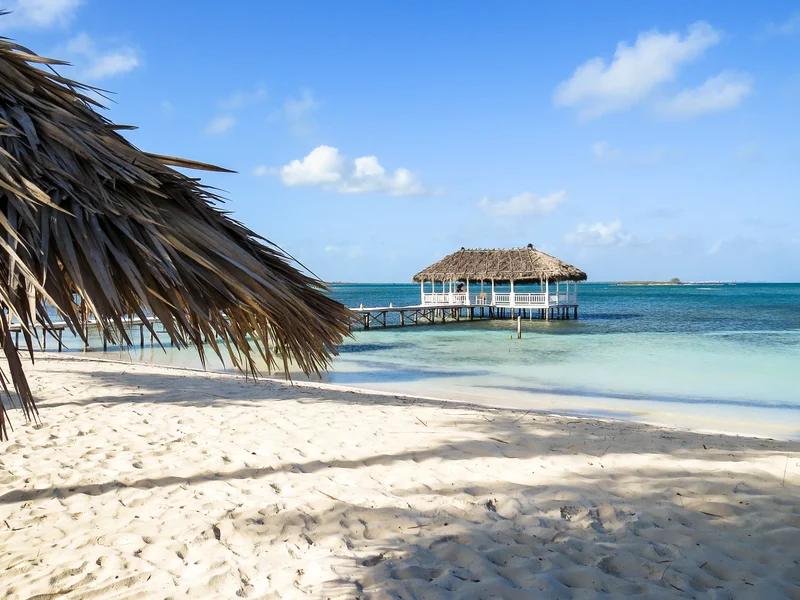
The idea has already been outlined in certain documents mapping out the Cuba of the future: on Cayo Santa María, a small island of powder‑white sand on the country’s northern coast, about 240 miles from Havana, an exclusive resort with two towers topped by golden domes would be built, and that stretch of sand and water that Cubans have always known as El Cayo would be renamed “Trump Island.”
The proposal runs counter to everything the government in Havana resisted for more than half a century but which it now appears to welcome — or to accept resignedly — amid the most crushing crisis Cuba has faced. It also lies at the heart of the Cold War‑style revival that Washington unleashed against Havana in January. Since then, with the island under a cloud of sanctions, international companies have packed up and left: Canadian miner Sherritt and the hotel chains Meliá, Iberostar, and Blue Diamond pulled out. The German shipping company Hapag‑Lloyd and the Spanish airline Iberia suspended operations, and multinationals such as Visa and Mastercard have left. The country is becoming a little more isolated.
With their back to the wall, and with international companies unwilling to violate Trump’s sanctions, the government is beginning to send a clear message: the country’s doors are open, even to the person responsible for those sanctions.
The idea of naming a Cuban island after the U.S. president came to light in June, when tourism officials met with investors to begin promoting a package of opportunities that would persuade entrepreneurs eager to expand into the Caribbean. The offering included the possibility of investing in inactive hotels, empty cruise terminals, undeveloped coastal zones and the 18 international airports and 10 international marinas the country has, according to The National, based in Abu Dhabi, which had access to the meeting.
Among the projects on the table was the construction of a Trump‑branded tourist complex, a proposal from investor Ali Bin Haidar, president of the family business Abdulla Ali Bin Haidar Group, based in Dubai, which is at the front of the queue to enter Cuba the day Washington lifts its sanctions. “Cuba is too attractive to ignore,” he told The National from Havana. “Sooner or later, the world will open its doors to Cuba.”
According to Haidar, the letter of intent to acquire land in Cayo Santa María has already been signed with the Cuban government. A response from the other side is still pending. The businessman has contacted the Trump family, “although no formal agreement has been reached yet,” he said. If the project is confirmed, construction of the luxury hotel would begin at the end of this year. “We spoke with Trump’s office and they were receptive,” Haidar told the cited outlet. “We presented the idea, but it has not yet been approved by the U.S. side.” He added the workforce would be made up of Cuban workers and engineers, supervised by specialized foreign managers.
The offer has not particularly frightened the Cuban government; rather, it has shown itself open to hearing any proposal that might help it stay afloat. In a recent interview with The New York Times, Cuba’s vice minister of foreign affairs, Carlos Fernández de Cossío, not only said he was aware of the Trump Island idea, but expressed no opposition to it.
“If he wants to do it peacefully, we see no specific reason to exclude [Trump],” the official said. “If somebody comes and says they have connections with important business people in the United States, we’re ready to engage. If it’s with the Trump administration, in principle, there’s no reason for us to say no. What prohibits Donald Trump from investing in Cuba are U.S. laws. We don’t exclude him or his organization from doing business in Cuba, if it does it respecting Cuban laws.”
Cuban authorities are desperately seeking to attract foreign investment in a country that is struggling to stay afloat, where power‑grid failures, a shortage of diesel for transport, scarce food, and overwhelmed hospitals have become commonplace. Tourism, the country’s leading economic sector, is at its lowest historical levels. As of May this year only 30,883 international visitors had arrived, according to the National Office of Statistics and Information.
Carlos Luis Jorge Méndez, vice minister of foreign trade and foreign investment, addressed U.S. businessmen in particular in an interview with The National. “We want U.S. entrepreneurs to know and understand that Cuba is a country open to investment… in sectors that range from mining and tourism to real estate, banking and finance,” he said. “There are differences between our governments that should not prevent the business community from participating in the Cuban economy.”
Since Washington decreed the oil chokehold on the island, the situation has become a humanitarian one. Daily life for ordinary Cubans has become unbearable, far more so than it already was. Although Havana recently announced a package of changes to restructure its economy — the most radical since 1959 — the White House still considers them insufficient while President Miguel Díaz‑Canel and his cabinet are not contemplating a change in their political system.
Therefore, they have shown themselves willing to consider anything. Many feel the country, mired in economic desperation, is for sale. Several hotel groups have put dozens of properties on offer for contracts or leases, and real estate listings have increased. Egyptian businessman Ahmed Faisal, known in Cuba as “The Architect,” has also shown interest in investing in tourism, aviation, pharmaceuticals, mining, fertilizers and other sectors.
“The urgency of the current crisis has informed the design of these measures. To get out of this impasse, Cuba needs capital, and a majority of that must come from abroad: from the diaspora, from governments, from international financial institutions,” Ricardo Torres, an economist and former researcher at the Center for Studies on the Cuban Economy and a professor at American University in Washington, told EL PAÍS. “Cuba has to open up to the world. It is regrettable that, given this urgency, advantages end up being offered to those who come from ‘outside.’”