In 2002—the year Elon Musk founded SpaceX—the notion of a space startup was far-fetched at best, a doomed wild goose chase at worst.
Now, SpaceX is a public company with a trillion-plus market cap that just reported its first earnings. And there’s a whole new generation of founders looking to build out a space economy that once seemed like science fiction, like Impulse Space’s Tom Mueller, Apex’s Ian Cinnamon, and Northwood Space’s Bridgit Mendler.
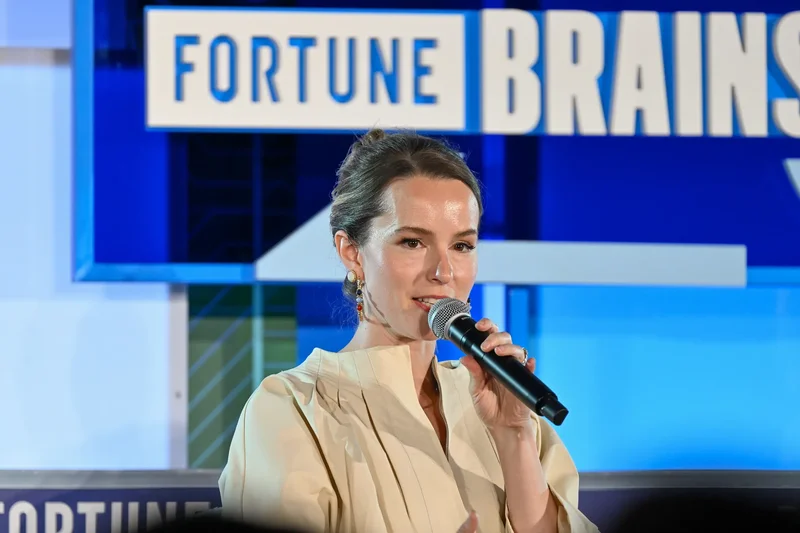
Mendler—a Harvard and MIT grad who cofounded Northwood in 2022—draws attention for her childhood as a Disney Channel star. But she’s chasing one of the most granular (and most vital) space economy problems: How do we move more data reliably between satellites in space and Earth—without the process getting absurdly expensive? Fortune connected with Mendler this week, as she offered clear-eyed best and worst-case scenarios for space startups like hers.
The bull case: Startups actually can execute on the commercial demand she’s seeing clearly. (Northwood’s current customers include the Space Development Agency and a division of the U.S. Space Force.)
“The best case scenario is that folks are able to execute and deliver,” said Mendler. “Everything a space operator says they can do, they can do. If companies can technically execute, we know the budgets on the government side are growing, market demand on the commercial side is growing, and you only need to look at Starlink to know demand is there on the consumer side.”
Starlink, SpaceX’s internet service made possible via thousands of the company’s satellites, has more than 12 million users and proved to be a surprise revenue machine when the company’s IPO filing dropped. The demand’s there for satellite-centric services, says Mendler. (Northwood, it should be said, has raised $136 million at an undisclosed valuation, and is functionally a telecom company.) So, the bear case is the other side of the proverbial coin: Executing on anything in space is famously hard. A small mistake or miscalculation on Earth is catastrophic in space, where there’s no margin for error.
“Space is just hard, and executing against missions is really technically complex,” said Mendler. “You can only build a certain amount of product and launch them into space. If they burn up in the atmosphere, what are you going to do the next time? You may not get a second chance. The market is there, there are good demand signals. And there’s a certain number of viable businesses, but there aren’t a million viable businesses in space either.”
Case in point, on the execution question: the problem of a tumbling spacecraft, when a satellite, rocket, or space probe starts rotating uncontrollably.
“Once a spacecraft starts spinning or moving, it’s really hard to recover,” said Mendler. “It’s harder to connect with the antenna that might be pointing away from Earth. You can’t just reach up and move an antenna on a satellite. So, you have to figure out a way to communicate with it even under those conditions.”
To Mendler’s point, even though Musk says the space economy can within years be a trillion-dollar market, there will only be so many startup winners. And SpaceX did create the playbook all startups in the space (pun intended) will be pulling from as they tussle for their future: serious vertical integration, reusability and unit economics awareness, and unconventional monetization.
“What SpaceX and Starlink have represented to me is that the economics of space have just changed,” said Mendler. “There were so many markets that weren’t available to space because you could not meet or beat terrestrial economics, and what SpaceX has really demonstrated is that they can be competitive with terrestrial economics for a bunch of different use cases [like internet and data centers].”
There is a lot that will be different in this new era: Mendler believes that the first era of the space economy asked “is this possible,” while this new chapter asks “can this company run at scale and remain cost-efficient?” In SpaceX’s early days, the company had to be wildly self-reliant. Today, companies can turn to each other.
“If you have to cover every edge case 100% of the time, that’s wasteful and expensive,” said Mendler. “If you can do something shared, that offers a lot of peace of mind.”
There will only be so many space race winners—but those who win, will win big. I always think it’s interesting that space and defense are lumped together: There’s overlap but the two sectors have very different market dynamics, and I actually think Musk could be very right, that the economy revolving around space could be massive in ways that seem impossible today.
The question isn’t if, to me, so much as on what timeline, how, and who wins.
“If you can accomplish how hard it is, it’s like there’s this pot of gold at the end of some rainbow,” said Mendler.
See you tomorrow,
Allie GarfinkleX: @agarfinks
Email:alexandra.garfinkle@fortune.com
Submit a deal for the Term Sheet newsletter here.
- Joey Abrams curated the deals section of today’s newsletter.* Subscribe here.
VENTURE CAPITAL
-
Expedition Therapeutics, a San Francisco-based developer of therapies for inflammatory and respiratory diseases, raised $115 million in Series B funding. General Atlantic led the round.
-
Obsidian Security, a Palo Alto, Calif.-based SaaS security platform designed to protect third-party applications and AI agents, raised $85 million in Series D funding. Crescent Cove Advisors led the round and was joined by existing investors.
-
Faye, a Richmond, Va.-based AI-powered platform for travel protection, raised $50 million in Series C funding. Madrona led the round and was joined by BRM and existing investors.
-
QuantHealth, a Worcester, Mass. and Tel Aviv, Israel-based AI-powered clinical trial simulation company, raised $45 million in Series B funding. Qumra Capital led the round and was joined by Pitango HealthTech, Sanofi Ventures, Artofin Venture Capital Fund, and others.
-
Sapiom, a San Francisco-based platform that helps builders ship, run and scale AI agents, raised $35 million in Series A funding. Dragonfly led the round and was joined by Accel, Gradient, Coinbase Ventures, Operator Collective, Formus Capital, and VanEck Ventures.
-
Wordsmith AI, a New York City and Edinburgh, Scotland-based AI platform designed for in-house legal teams, raised $14 million in a Series B extension from Intact Private Capital and others.
-
Mitti Labs, a Bangalore, India and New York City-based developer of satellite, AI, and operations technology designed to reduce methane emissions in rice farming, raised $9.5 million in Series A funding. Aramco Ventures led the round and was joined by Lightspeed India, Godrej Industries Group, Cisco Foundation, Francis Family Fund, and Volta Circle.
-
Pinegap, a New York City-based equity research platform, raised $8 million in Series A funding. Stellaris Venture Partners led the round and was joined by existing investors Inventus, Silicon Valley Quad, and DeVC.
-
Avatar Robotics, a San Francisco-based developer of robots for industrial labor, raised $6.5 million in seed funding. AlleyCorp led the round.
-
SkinBit, a Los Angeles, Calif.-based developer of a full-body scanner designed for skin cancer screening, raised $6 million in pre-seed funding from Boost VC, Cleo Capital, Manna Ventures, Profluent Capital, and angel investors.
PRIVATE EQUITY
-
ATIS, a portfolio company of Thompson Street Capital Partners, acquired Buckley Belcher & Company, a New York City-based elevator consulting and managed services company. Financial terms were not disclosed.
-
BV Investment Partners acquired a majority stake in Thomas & Company, a Nashville, Tenn.-based workforce compliance provider. Financial terms were not disclosed.
-
Frontenac acquired NutriScience Innovations, a Milford, Conn.-based specialty ingredients provider. Financial terms were not disclosed.
EXITS
-
Bain Capital agreed to acquire Gong cha, a London, U.K.-based bubble tea chain, from TA Associates. Financial terms were not disclosed.
-
New Mountain Capital agreed to acquire Jensen Hughes, a Columbia, Md.-based fire protection and nuclear risk engineering company, from Gryphon Investors. Financial terms were not disclosed.
-
Veritas Capital acquired a majority stake in Trinity Consultants, a Dallas, Texas-based environmental consulting firm, from Oak Hill Capital. Financial terms were not disclosed.
FUNDS + FUNDS OF FUNDS
- White Star Capital, a London, U.K.-based investment firm, raised $250 million for its fourth fund focused on technology companies from the seed through Series B stage.
PEOPLE
- Norwest, a Menlo Park, Calif.-based venture capital and growth equity firm, hired Allison Toman as a Principal. Formerly, she was with Medtronic.