Your support helps us to tell the story
From reproductive rights to climate change to Big Tech, The Independent is on the ground when the story is developing. Whether it's investigating the financials of Elon Musk's pro-Trump PAC or producing our latest documentary, 'The A Word', which shines a light on the American women fighting for reproductive rights, we know how important it is to parse out the facts from the messaging.
At such a critical moment in US history, we need reporters on the ground. Your donation allows us to keep sending journalists to speak to both sides of the story.
The Independent is trusted by Americans across the entire political spectrum. And unlike many other quality news outlets, we choose not to lock Americans out of our reporting and analysis with paywalls. We believe quality journalism should be available to everyone, paid for by those who can afford it.
Your support makes all the difference.
Read more
SpaceX has launched a robotic spacecraft into orbit designed to fix aging satellites and prevent the build up of space junk.
The robot mechanic, developed by aerospace giant Northrop Grumman, launched aboard a Falcon 9 rocket from Cape Canaveral Space Force Station in Florida on 21 July.
The first-of-its-kind mission will see it service satellites in geostationary orbit, around 36,000 kilometres (22,300 miles) above Earth, where many spy, communications and weather satellites reside.
“Today’s launch is the start of something bigger,” Northrop Grumman wrote in a post to X. “Our Mission Robotic Vehicle is opening the door to a future where repairing, upgrading and building in space is part of the routine, not the exception.”
If successful, it could save satellite operators huge amounts of money by extending the lifespan of broken satellites that cost hundreds of millions of dollars to design, launch and operate.
“Even fully functional satellites often have their operational lives cut short simply because they carry obsolete payloads – a frustrating situation for owners of assets worth hundreds of millions of dollars,” the US Defense Advanced Research Projects Agency (DARPA) said.
“With no support once in orbit, GEO satellites are equipped with redundant systems and maximum fuel capacity, which increases their complexity, weight, and expense.
“[The robotic mechanic] is made to perform complex tasks, such as in-orbit upgrades, inspections, anomaly resolution, and satellite relocation.”
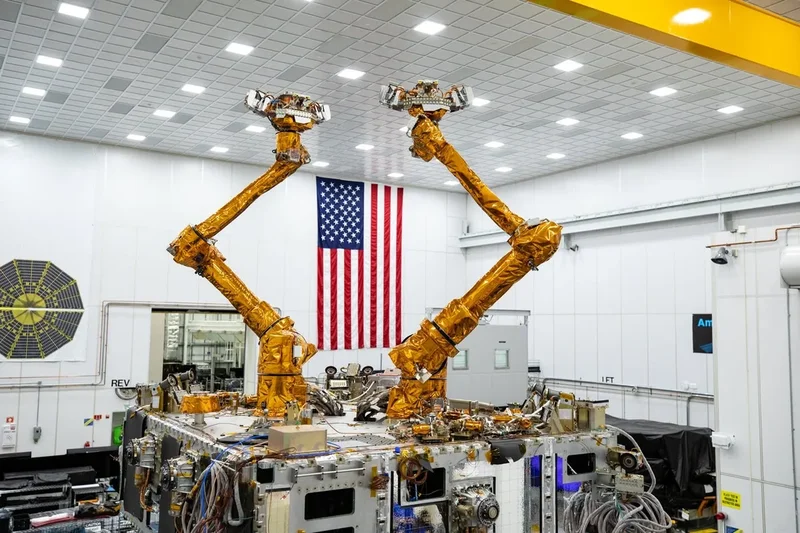
The robotic payload can fix satellites in geostationary orbit more than 35,000 kilometres above Earth (DARPA)
The space robot is equipped with three-metre-long (10 foot) arms built by the US Naval Research Laboratory, which will be able to install Mission Extension Pods (MEPs) to aging satellites.
These MEPs will allow satellites to reposition themselves and could provide up to eight years of life extension for a typical 2,000 kg satellite, according to Northrop Grumman.
“Once installed, the MEP uses electric propulsion to provide orbit control and momentum unloading for a client satellite,” the firm said.
The robotic arms will also be able to “relocate, inspect, repair and upgrade spacecraft while in orbit”, while also moving from one customer to another.
The first operations are expected to begin in the coming weeks once the spacecraft has reached geostationary orbit.