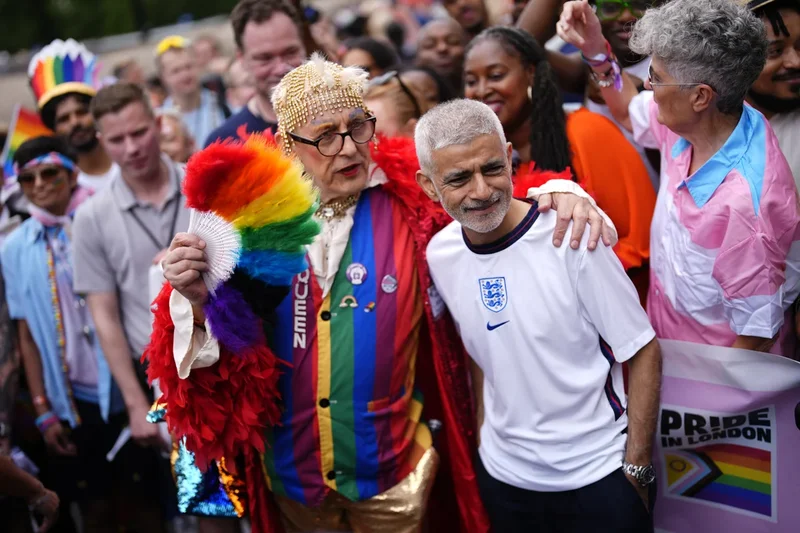
Last week, I stood alongside thousands of Londoners in Soho Square to show our solidarity with the LGBTQIA+ community in the wake of the horrific terrorist attack at Berlin Pride.
It was a moment of grief, but also of defiance, as Londoners of all backgrounds came together to send a powerful message: we will not be silenced, and hate will never win.
What happened in Berlin showed us that we cannot take progress for granted, and the rights and freedoms won by previous generations still need to be defended today. Now is the time to come together and celebrate Pride – and all that it stands for – more loudly and proudly than ever before. That’s why I’m backing London’s bid to host WorldPride in 2032.
2032 will mark 60 years since the first official Pride event in London, organised by the Gay Liberation Front just three years after the Stonewall uprising. Back then, this was a very different country. There were no legal protections against sexuality-based discrimination. Homosexuality still carried a prison sentence in Scotland and Northern Ireland and was heavily stigmatised elsewhere. It was in that context that 2,000 brave marchers proudly paraded from Trafalgar Square to Hyde Park, in what organiser Ted Brown called ‘a declaration of freedom’ and a ‘declaration of rights.’
The activists who took to the streets that day were met with no end of hostility and hysteria. But, against all the odds, they started a movement – a movement that, in the last six decades, has fought to build a society where LGBTQIA+ people aren’t just tolerated, but celebrated.
Nothing about that fight was ever easy or inevitable. In 1988, a full sixteen years after the first Gay Pride Rally, Section 28 was introduced, spreading fear, silence, and self-censorship about same-sex relationships in British schools, and leaving a generation of LGBTQIA+ young people to grow up isolated and alone. It wasn’t until 2003 that it was scrapped.
Looking back today, it is startling to think about just how recent that was – and just how far we have come since. This year, I joined more than a million people attending Pride-related events across London, as similar celebrations were held in cities and towns around the world. Between the stages, there was singing, dancing, and chanting – with love and laughter as far as the eye could see. The phenomenal success of the event was yet more proof that our global city has become a blazing beacon of hope for LGBTQIA+ rights and freedoms.
Today, many of us take for granted that we live in a city where you’re free to be whoever you want to be, and love whoever you want to love. But the truth is that, both at home and abroad, the fight for equality has started to stall. In the first half of this decade, hate crimes based on sexual orientation rose across the UK, and what happened in Berlin is another painful reminder that the struggle for acceptance is far from over.
At a time when LGBTQIA+ rights are under attack, a diverse, dynamic, and proudly progressive city like ours cannot just sit on the sidelines. If we are to remain true to our long history of fighting for justice, we must step up and lead – championing the values of freedom, equality, and inclusivity that have come to define our capital city.
That’s why I’m proud to be providing £100,000 to support London’s bid to host WorldPride in 2032. And it’s why – working with Pride in London, UK Black Pride and Outernet – we’ll be doing everything we can to make the strongest possible case for London hosting this landmark event.
Sixty years after London’s first Pride march, WorldPride would give us the chance to celebrate the extraordinary progress we’ve made, while recognising how much further we have to go. It would be an opportunity to showcase our values to the world – and encourage others to stand up for equality, celebrate diversity, and defend people’s right to be themselves.
Hosting WorldPride would also attract thousands of visitors to our city, providing a major boost to our tourism and hospitality sectors. Last year’s event in Washington DC welcomed more than a million visitors and generated more than $310m for the local economy. Sydney’s 17-day celebration for WorldPride 2023 brought a worldwide audience, created jobs, and delivered an economic boost of almost £100m to the region.
Of course, the true legacy of WorldPride will not be measured in pounds and pence. It will be measured by the message it sends. At a time when extremists are seeking to spread hate, deepen divisions, and turn our communities against one another, London can show a different way forward.
Throughout London’s history, our LGBTQIA+ community has changed the world for the better. Where would we be without the writing of EM Forster, Virginia Woolf, and Bernadine Evaristo, or the music of Skin, Freddie Mercury, and George Michael? Without the footballing talent of Justin Fashanu, the films of Derek Jarman and Ian McKellen, or legends like Sue Perkins and Sandi Toksvig on TV? The same goes for the hundreds of thousands of uncelebrated LGBTQIA+ Londoners who bring love and joy to our lives every day.
Together, they have made London the modern, multicultural metropolis it is today – and they are the reason that WorldPride belongs in our city. Given the opportunity, we’ll show the world that, in the face of division, our diversity remains our greatest strength.