Clinic for people with disabilities to open in Khatib polyclinic by end 2026
AI generated
SINGAPORE - A clinic dedicated to serving people with disabilities (PWDs) aged 18 and above, and their caregivers, will open by end 2026 at a polyclinic in Khatib, expanding access to healthcare for a group that often struggles to navigate the healthcare system.
This includes people with intellectual disabilities, autism and other conditions.
The SPARk Clinic, which stands for Supporting PWDs with Accessible Resources and (k)are, at NHG Khatib Polyclinic will be run by a team of healthcare staff who understand the unique challenges faced by this community.
It first started as a two-year pilot at NHG Ang Mo Kio polyclinic in July 2024. Healthcare provider NHG Health announced the expansion on Aug 6 to the media.
About 400 PWD patients in NHG’s polyclinics are expected to benefit from the two dedicated clinics, which will run fortnightly and cover the central and north regions of Singapore.
Dominique Phang, a family physician and principal staff at NHG’s Ang Mo Kio polyclinic, said medical consultations can be stressful for PWDs due to communication difficulties and sensory sensitivities.
They may not be able to express their symptoms clearly and are less motivated to follow up regularly on medical appointments, leaving chronic conditions to progress silently for years.
Managing multiple appointments can also be overwhelming for caregivers, said Phang, noting that getting to the clinic itself is a challenge for some families.
These issues prompted Phang to start the pilot in Ang Mo Kio.
She said: “We don’t expect the patient to fit into the healthcare system. We want to think about how to adapt care in a person-centered way, to make it successful for them.”
At each clinic, there will be four family physicians on rotation, along with one care manager and a care coach. They are trained by community partners which serve PWDs, including MINDS and IDHealth, a clinic in Upper Thomson which specialises in serving those with intellectual disabilities.
The same team of six at each clinic will handle each case, which builds familiarity and trust with the patients and caregivers.
Patients may also receive materials before their appointments to familiarise them with clinical processes, such as a simple step-by-step video explaining what happens during a blood test.
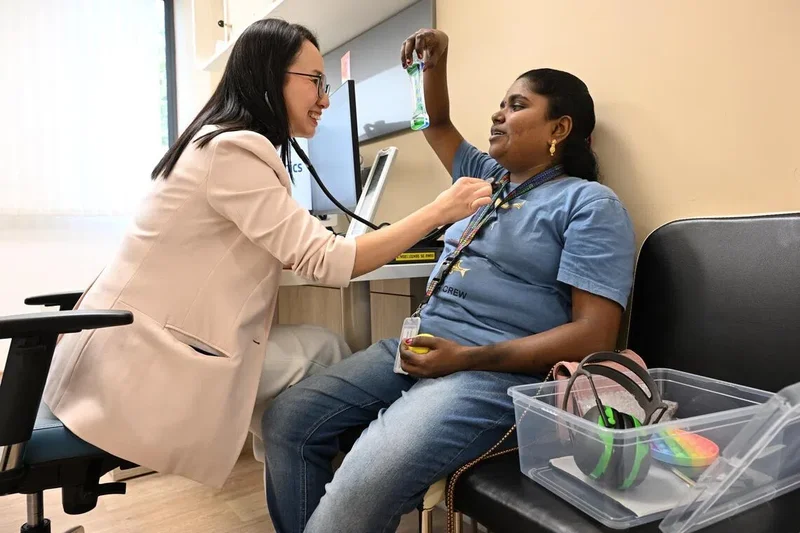
During consultations, staff may use sensory kits containing items like headphones and stress balls to manage patients’ anxiety. Their consultation slots are also longer to accommodate their needs.
The team also checks on caregivers’ health, looks out for signs of burnout and starts conversations about future care planning.
This new approach has helped patients like Archanaa, 25, who has autism and intellectual disability and was diagnosed with diabetes in 2023.
She used to scream while getting her blood drawn for tests, which drew stares from other patients, said her mother Subramanian Vasuki.
When she started going to the SPARk clinic in 2024, staff gave her stress balls to play with during blood tests, which calmed her down.
Now, Archanaa, who goes by one name, can even do weekly finger-prick tests at home by herself after learning from her care manager.
“They (the staff) don’t stress the patients like Archanaa… they (know) that they are special, so they can understand caregivers’ and patients’ feelings,” said Vasuki, 53, a part-time secondary school teacher.
The pilot, which started with 37 PWD patients, has since grown to 85, through referrals from community agencies and word-of-mouth.
Of these, 80 have returned for regular follow-ups, remained compliant with medications or completed preventive health screenings.
“For a population that has traditionally found healthcare very difficult to access, this level of sustained engagement is encouraging for us,” said Phang.
This development comes after years of advocacy for better healthcare for PWDs. In 2019, medical doctor Chen Shiling started IDHealth as a pilot clinic after noticing gaps in support for this community.
IDHealth broke ground as Singapore’s first community-based dedicated healthcare service for people with intellectual disabilities. Chen was awarded The Straits Times Singaporean of the Year 2025 for her work.
Phang said doctors like Chen go the extra mile for such patients out of goodwill, but NHG’s initiative represents a more intentional and systematic approach to make support sustainable.
NHG will assess if these two clinics can serve their patients’ needs, before considering any future expansion plans, added Phang. The healthcare group currently runs 10 polyclinics in Singapore.
Though they moved to Tengah in October 2025, Vasuki still brings Archanaa to the Ang Mo Kio SPARk Clinic as it is a familiar environment.
She hopes more specialised clinics will open across Singapore so that other families like theirs can benefit, said Vasuki.