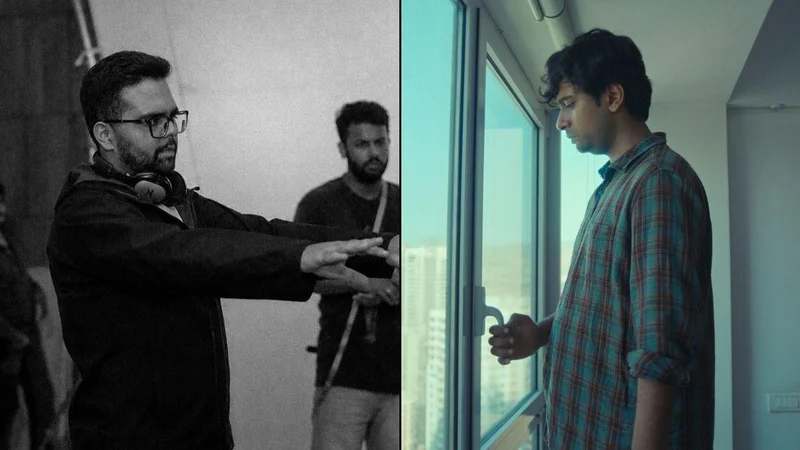
For a country that keeps producing entirely new reasons to lose sleep, Indian horror has remained frustratingly committed to recycling old ones. Haunted havelis, cursed villages, ancestral sins, forgotten folklore — the genre seems to have exhausted every original idea that doesn’t involve turning to the past as an inexhaustible source of terror. But upcoming filmmaker Syed Shadan’s Chaar Diwari points the camera somewhere considerably more contemporary. Premiered at this year’s Fantasia International Film Festival as the festival’s only Indian selection and winning the Bronze Audience Award and Best Asian Short, the independently produced psychological horror film builds off an experience familiar to almost every young Mumbaikar: a broker saying, ‘ek perfect flat hai.‘
Set in Mumbai, the film follows a tenant whose suspiciously affordable apartment begins shrinking around him, turning one of the city’s most relatable nightmares into a very literal manifestation of its suffocating housing crisis. The approach reflects how Shadan understands horror itself. He sees it as an elastic form capable of carrying deeply personal stories. “If you want to talk about whatever it is that needs a certain kind of processing, it needs to be very engaging and something very primal,” he says.
The 27-year-old writer-director credits the past decade of international horror, particularly the wave associated with studios like A24, with broadening his own understanding of what the genre could accommodate. “The ideas of loneliness, especially urban loneliness, was something that I wanted to talk about,” he says. “Horror is uniquely placed to do both: have the freedom to speak about so many things while being able to also tell a very entertaining story.”
Shadan describes Chaar Diwari as “semi autobiographical”, recalling how he and two friends spent months searching for a larger apartment after finding themselves crammed into a 400-square-foot flat. “Between the three of us... we started hating each other after a point because there was no escaping each other in such a tiny flat.”
Finding another home involved navigating Mumbai’s familiar hierarchy of compromises. There was the budget and there were landlords reluctant to rent to people working in the film industry. “And then again,” he says, “the added ‘bonus’ of me being a Muslim fully reduces your options to just a handful.” When they finally secured what appeared to be the perfect apartment, complete with air conditioning in every room and comfortably within budget, they overlooked the obvious question. “We weren’t wise enough to think, ‘Why such a good house?’”. They soon found out.
Every evening during the monsoon, termites emerged from inside the apartment. “This was the first time we ever got to know that termites could fly,” he chuckles. But the problem quickly became all-consuming. “You’re not working on your spec script... you’re not meeting the right kind of people. All you’re trying to do is find a house for yourself. And that is everything that you’re doing with all the energy that you have.”
The image that eventually anchored Chaar Diwari surfaced only after he had moved elsewhere. Living alone, he realised several days had passed without speaking to another person or even leaving the apartment. “That’s when the thought of, ‘What if the house was getting smaller every day?’ came to me,” he recalls.
The shrinking apartment naturally invites comparisons to the growing fascination with liminal spaces and internet-born spatial horror à la Kane Parson’s breakout A24 hit, Backrooms, though Shadan is quick to distinguish Chaar Diwari from that lineage. He readily admits to being “a big fan” of the aesthetic, but argues that it grows out of a distinctly Western relationship with architecture. “They have such big infrastructure for not a lot of people,” he says. “As Indians, I think that is such a counterintuitive thing to see because we have so little for so many.” Instead, he found himself thinking about Jonathan Glazer’s The Zone of Interest, a film he readily classifies as horror. “Just the fact that you understand where this house is, and what is happening around it is horrifying,” he says. “What is happening inside of the house... doesn’t matter as much.”
That emphasis on physical space extended to the film’s striking climactic one-take sequence, where the apartment itself appears to close in around its protagonist. Shadan readily redirects credit towards cinematographer Rajiv Malu and production designer Avni Goyal, who proposed building the sequence practically inside a real Mumbai apartment.
The logistics proved every bit as unnerving as the scene itself. Temporary walls sealed the crew inside the room while they filmed on the fifteenth floor, leaving nobody able to step outside until the take was complete. “We couldn’t get out until we finished the shot,” he recalls. As phone signals weakened and conversations drifted toward the possibility of being trapped, the stifling atmosphere slowly began affecting everyone on set. ”I never experienced claustrophobia before... I had a little anxiety attack. I rushed out and just took some very deep breaths because I was honestly so unnerved by what we had just done.”
The apartment itself came with another surreal detail. Its owners had temporarily relocated to London, leaving behind an 89-year-old grandmother who continued living there throughout production. “Whenever she’d step outside she’d see at least 30 random people doing unimaginable things to the house,” he laughs.
Entirely self-financed by Shadan and producer Shivek Gupta, Chaar Diwari reached Fantasia before Anurag Kashyap entered the picture as presenter. “When he saw the film, he said, ‘I like this. I’m happy to give my name to you in whatever aspect you’d like.’ Honestly, that was all that we needed.” The festival also reshaped how Shadan viewed his own film. Its programmers responded particularly strongly to the film’s treatment of the housing crisis, which made him realise that the anxieties he had written from a specifically Mumbai perspective travelled far more easily than he had expected.
His optimism about horror itself sits alongside a more cautious assessment of the Hindi film industry. “Hindi cinema keeps looking out for formulas,” he says. Citing the recent success of Curry Barker’s Obsession, he adds, “I’ve had a lot of people ask me if I had something similar. The idea is that until and unless there is something proven, nobody wants to experiment. Nobody wants to take a punt.” He also argues that decades of Ramsay Brothers sleaze and similar B-movie associations have made many studios reluctant to treat horror as seriously as other genres.
His own influences span Rahi Anil Barve’s Tumbbad, Rahul Sadasivan’s Malayalam horror films including Brahmayugam, Bhoothakaalam and Dies Irae, alongside Ari Aster, Robert Eggers and Jordan Peele, filmmakers who have collectively “changed the way that I have now ended up looking at horror films.” He also cites Talk to Me as a recent favourite, particularly for its inspired conceit of treating possession “as a party drug”, calling it “such an obvious and such a fun thing to even look at.”
But he singles out one collaborator before anyone else, crediting editor Sanyukta Kaza, who cut Chaar Diwari after working on Tumbbad and serving as producer on its upcoming sequel, with fundamentally sharpening the film. “Having someone who has the best Hindi horror film experience, I think it was honestly a game changer,” he says, praising Kaza’s ability to “pack so much in so little time.”
Published - August 06, 2026 06:48 pm IST