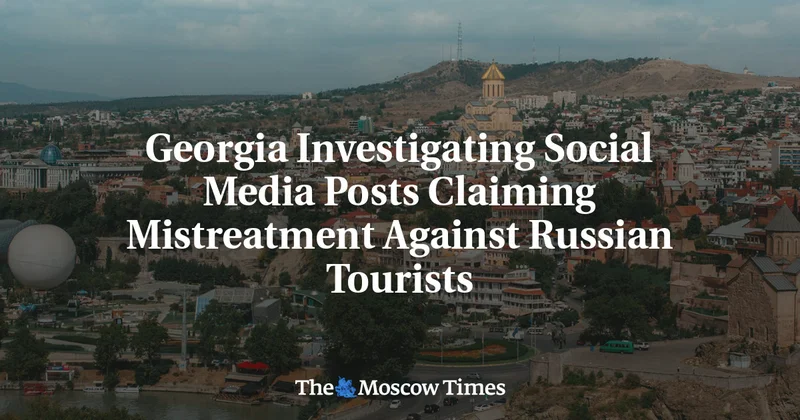
Law enforcement in Georgia on Wednesday announced a criminal investigation into alleged “sabotage” over a series of social media posts claiming systematic mistreatment of Russian tourists, with authorities in the South Caucasus country claiming the posts are part of a disinformation campaign aimed at undermining the local economy.
Georgia’s State Security Service (SSSG) said foreign-controlled “bot accounts” spread false claims on X boasting about urinating and spitting in food served to Russian tourists. Foreign media outlets later amplified the posts, the agency added without identifying the outlets in question by name.
On Saturday, the pro-Kremlin Telegram news channel Mash, which is widely believed to have ties to Russian security services, shared screenshots of the X posts alongside the caption: “Don’t look at this if you’re planning to visit Georgia.”
“The goal of this targeted effort is to undermine Georgia’s economic interests by creating a false perception through disinformation that Russian tourists face a hostile environment in Georgia,” the SSSG said in a Facebook post.
Under Georgian law, sabotage carries a maximum sentence of four years in prison. The SSSG said investigators are still working to identify the individuals and potential funding sources behind the X accounts.
According to Georgian media, the X accounts used Georgian names written in Cyrillic script — an unusual choice given that the Georgian language uses its own unique alphabet distinct from the Cyrillic script used by Slavic languages.
One X user who claimed to have urinated in food served to Russian tourists accessed the social media platform via the Russian App Store, though the account’s location was listed in the United States. While the account was created in 2011, it made its first post only on July 29.
The SSSG probe comes two days after Georgian Prime Minister Irakli Kobakhidze accused “pseudo-liberal” opposition groups of spreading anti-Russian sentiments on behalf of foreign interests.
It also follows a recent scandal that erupted after a Georgian man was arrested and fined for hitting a female Russian-speaking tourist at a hotel in the city of Telavi.
A Message from The Moscow Times:
Dear readers,
We are facing unprecedented challenges. Russia's Prosecutor General's Office has designated The Moscow Times as an "undesirable" organization, criminalizing our work and putting our staff at risk of prosecution. This follows our earlier unjust labeling as a "foreign agent."
These actions are direct attempts to silence independent journalism in Russia. The authorities claim our work "discredits the decisions of the Russian leadership." We see things differently: we strive to provide accurate, unbiased reporting on Russia.
We, the journalists of The Moscow Times, refuse to be silenced. But to continue our work, we need your help.
Your support, no matter how small, makes a world of difference. If you can, please support us monthly starting from just $2. It's quick to set up, and every contribution makes a significant impact.
By supporting The Moscow Times, you're defending open, independent journalism in the face of repression. Thank you for standing with us.
.