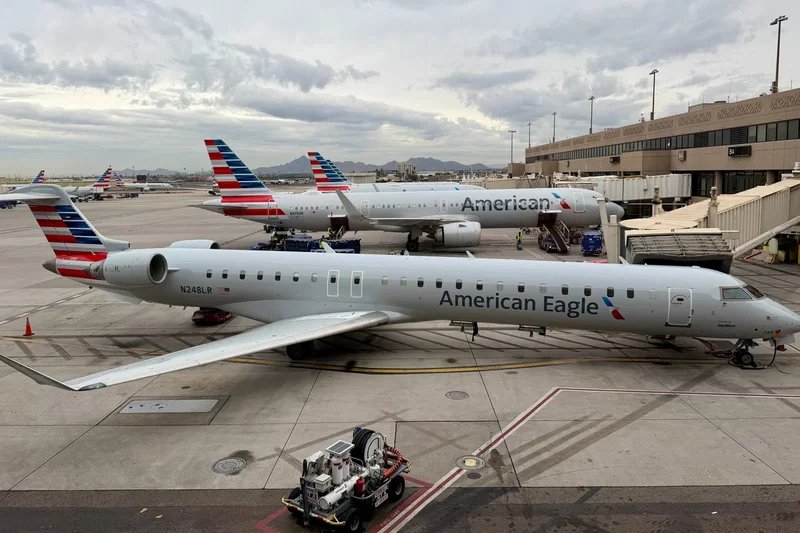
While travelers typically brace for flight delays during storms or heavy snow, a less obvious culprit is increasingly disrupting air travel: extreme heat.
On scorching summer days with clear skies, the soaring temperatures can render the air too thin for aircraft to safely take off, forcing airlines to lighten their loads by offloading passengers, cargo, or even fuel. This phenomenon, once primarily associated with desert climates, is becoming a more widespread challenge, exacerbated by human-caused climate change.
The impact was recently illustrated in Las Vegas, where American Airlines offered compensation to customers who voluntarily gave up their seats on a July 24 flight from Harry Reid International Airport. Temperatures had climbed to a blistering 114 degrees Fahrenheit (47 degrees Celsius), necessitating a reduction in the plane's weight to ensure a safe departure. The airline confirmed this practice as a standard industry procedure in hot-weather destinations when conditions demand it.
The explanation lies in fundamental physics. Hot air is inherently thinner than cool air, a condition that significantly impedes an aircraft's ability to generate sufficient lift from its wings and for jet engines to produce the necessary thrust for takeoff, explained Ross Aimer, a retired United Airlines captain and CEO of Aero Consulting Experts.
"There is a science behind all this," Aimer stated. "You can’t deny the science of flight and what it takes for an airplane to operate.”
Airplanes struggle in hot, thin air
Aimer draws a parallel between the effect of high temperatures on aircraft performance and athletes competing at high altitudes. Just as foreign teams in Mexico City's 7,300-foot elevation struggled with thinner air during this year’s World Cup, jet engines, like human beings, require ample cool, dense air to function optimally.
"Just like human beings, jet engines require lots of cool, dense air to perform well," Aimer said.
Before every flight, pilots and airlines meticulously calculate an aircraft's safe takeoff capability, considering crucial factors such as the plane’s weight, the airport’s elevation, and the ambient temperature, according to Alan Price, a retired Delta Air Lines captain. Airports situated at higher elevations, such as Denver, which sits over 5,000 feet above sea level, already contend with thinner air, meaning even moderately high temperatures can quickly compromise takeoff performance.
Runway length also plays a critical role. Aircraft need ample space to build sufficient speed for takeoff when temperatures are high, and shorter runways, like those at New York’s LaGuardia and Washington’s Reagan National, offer less distance, making them more susceptible to takeoff restrictions or weight limits during extreme heat.
When preflight calculations indicate an unsafe departure, airlines may opt to reduce cargo, carry less fuel (planning a refueling stop later), await cooler temperatures, or solicit volunteers to take a subsequent flight.
However, there comes a point where simply reducing weight is insufficient to guarantee a safe takeoff.
"At some point, the numbers just don’t make sense," Aimer warned. "You could roll down a runway as long as you want, and you still can’t take off."
Delays due to hot weather could become more common
The Federal Aviation Administration does not impose a universal maximum temperature for takeoff. Instead, operating limits are tailored to an aircraft's make and model, its weight, and the airport’s altitude.
Projections from a 2017 study by researchers from Columbia University, NASA’s Goddard Institute for Space Studies, and the Logistics Management Institute indicated that some airports could face weight restrictions on 10% to 30% of flights departing during the hottest part of the day by midcentury, particularly if greenhouse gas emissions continue their upward trend.
A more recent analysis suggested that current climate models predict planes departing from four European airports might need to shed the equivalent weight of 10 passengers per flight by 2065.
While triple-digit temperatures are a given in desert regions, the frequency of hot days impacting flights is markedly increasing in cities like Phoenix and Las Vegas. Phoenix Sky Harbor International Airport has recorded an average of 43 days annually since 2020 where temperatures reached at least 110 F (43 C), an analysis of weather data by The Associated Press revealed.
This figure represents more than triple the average during the mid-20th century. Similarly, Harry Reid International Airport in Las Vegas saw temperatures hit that threshold approximately 18 days a year between 2020 and 2025, doubling the annual average from the 1940s through the 1960s.
The 2020s have also brought exceptionally high temperatures to Palm Springs International Airport, where the annual average of days reaching 110 F has surged to 55 this decade, an 83% increase compared to the 2000s.
Safety determines when airlines reduce weight
Airlines have long grappled with these challenges. In June 2016, American canceled several regional flights between Palm Springs and Phoenix due to scorching heat.
The following year, the airline grounded dozens of regional flights in Arizona as Phoenix temperatures neared 120 F (49 C). In July 2018, some airlines bumped passengers at Denver International Airport as temperatures hit 98 F (37 C), according to KDVR-TV.
More recently, in July 2023, Delta Air Lines requested volunteers to disembark a flight in Las Vegas during an excessive heat warning, citing weight restrictions due to extreme temperatures. That flight was ultimately canceled after passengers endured hours aboard the aircraft in the heat.
Airports are particularly susceptible to the urban heat island effect, a phenomenon where built-up areas become significantly hotter than their surrounding environments, noted Jennifer Brady, a data scientist with Climate Central.
With extensive heat-absorbing pavement, minimal shade, and constant activity from aircraft, ground vehicles, and air conditioning systems generating waste heat, "all of the elements are there for it being one of the hottest spaces in a city," Brady said.