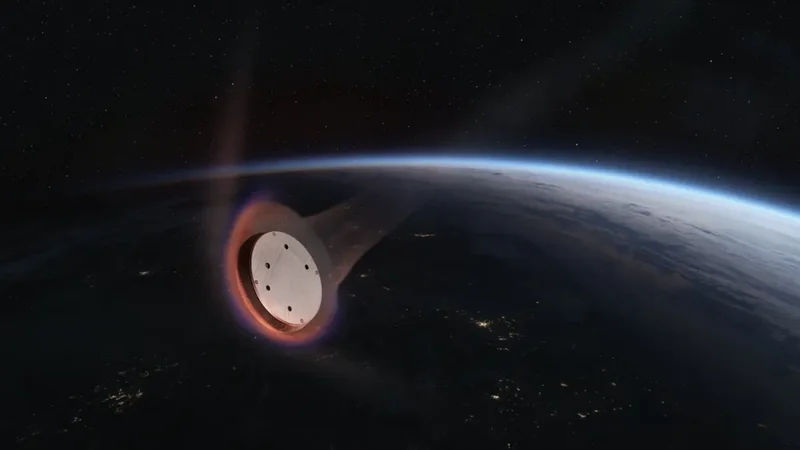
WASHINGTON — A Redwire subsidiary working on space biotech and pharmaceutical applications has signed an agreement to fly microgravity research payloads on SpaceX’s Starfall reentry vehicle.
Space Microgravity Development, or SpaceMD, a subsidiary of Redwire, announced Aug. 6 it purchased a dedicated Starfall mission scheduled to launch in late 2028. Starfall is SpaceX’s reentry vehicle that made its first test flight in June.
The spacecraft will carry up to 32 of Redwire’s Pharmaceutical In-Space Laboratory, or PIL-BOX, experiment packages, which the company said will be redesigned to optimize the capabilities offered by Starfall. SpaceMD said it will use the mission to perform pharmaceutical research, taking advantage of what it calls the “highly tailorable microgravity environment and mission duration” offered by Starfall.
“Space-based pharmaceutical development is reaching an inflection point,” said John Vellinger, chief executive of SpaceMD, in a statement. “By combining our flight-proven microgravity payloads, such as PIL-BOX, with SpaceX’s innovative transportation capabilities, we’re dramatically expanding our ability to serve customers, increase research cadence and accelerate the creation of life-changing therapies.”
SpaceMD is the first established microgravity research company to announce plans to use Starfall. SpaceX said little publicly about Starfall before the June test flight, with some technical details about the spacecraft disclosed in a Federal Aviation Administration environmental assessment published in May.
Redwire has flown 54 PIL-BOX systems to the International Space Station since 2023, with 12 more slated to launch later this year. SpaceMD has used those systems to crystallize compounds for pharmaceutical research.
Peter Cannito, chairman and chief executive of Redwire, announced the Starfall contract in the company’s second-quarter earnings call Aug. 6. “The unprecedented capabilities that SpaceX’s Starfall offers will dramatically accelerate our ability to deliver pharmaceutical, biotech and other in-space microgravity manufacturing capabilities,” he said.
He noted the Starfall mission, as planned, will be the largest dedicated commercial microgravity research mission to date. “SpaceMD’s Starfall mission provides a major leap forward in scaling our microgravity capabilities. It’s a game changer.”
The contract illustrates both the interest in commercial microgravity research and manufacturing and the competitive threat posed by SpaceX. That interest has stimulated work on reentry spacecraft by several startups in the United States, Europe and Asia. Most are still developing their vehicles, but one, Varda Space Industries, has flown six missions to date, several carrying pharmaceutical payloads.
The entry of SpaceX into the market has raised concerns that it may be able to undercut those startups, based in part on the experience in the launch market, where SpaceX rideshare missions offered cheaper access to space for smallsats than dedicated small launch vehicles.
Those startups have countered that SpaceX’s entry into the field is a validation that there is a market for microgravity research and manufacturing. They also believe they can find niches to avoid directly competing with Starfall, based on the payload capacity of their vehicles or other attributes.
Redwire’s Cannito, though, said Starfall was the best fit for them. “With a platform partner like SpaceX’s Starfall, we are creating a new path to accelerate commercial microgravity manufacturing at scale.”