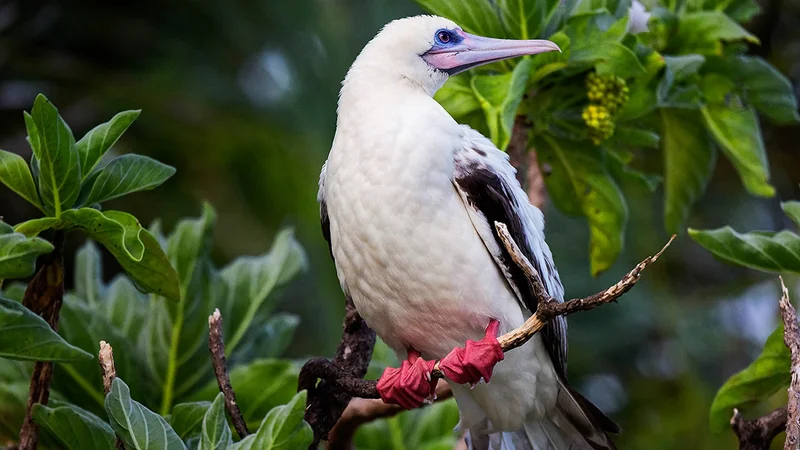
Boaters and birders enjoying the early days of summer on Maryland’s Chesapeake Bay knew that a bird with colorful feet didn’t belong there. The red-footed booby (Sula sula) was spotted off Thomas Point Park in Anne Arundel County, hundreds of miles away from its usual haunt in the tropics.
“It was only the second red-footed booby officially recorded in the state,” Steve Sheffield, a field biologist at the University of Maryland and president of the Maryland Ornithological Society, tells Popular Science. “The range for the red-footeds is extensive. It goes all the way out into the Pacific Ocean, and in the east, it goes to the West Indies, Caribbean. It’s more of a Pacific bird, but extremely rare here.”
They typically spend long periods of time out at sea, and are prone to wandering far out of range. Combine this wanderlust with increasingly abnormal weather patterns and rapidly warming ocean waters, and sightings of these tropical birds can increase. Maryland saw its first red-footed booby back in 2024.
“I think it was off course, so there was probably some kind of a tropical storm that knocked off course and up here,” says Sheffield. “That’s not that big of a deal because they can change their course easily.”
According to the boaters and birders on the bay, the bird appeared friendly, jumping from boat to boat, and landing at various points along the shoreline.
While it has not been seen since late June, another rare tropical species has been spotted in Maryland. Birders caught its relative the brown booby (Sula leucogaster) visiting boats and stopping on buoys around the Chesapeake in July. They are slightly more common than their red-footed relatives, but still excited the region’s avian enthusiasts.
“The birders in this area were trying to find any boat owner that would take them out,” Sheffield laughs.
As temperatures have warmed due to climate change, a number of southern bird species have settled in Maryland. Usually spotted in Texas, Anhingas (Anhinga anhinga) are now breeding in the Bay State. Brown pelicans (Pelecanus occidentalis), and even some southern bat species are also moving up the coast and changing the ecosystems in ways that we don’t fully understand yet.
Despite the summer heat, both the brown and red boobies are not putting down roots in Maryland and have gone on their way. Their quick visits highlight how fleeting and exciting nature can be.
“One of the things that’s great about being a field biologist is you never know what you’re going to see. It’s like Christmas every day,” Sheffield says. “I can go out birding and see this weird bird flying by with red feet, that turns out to be a red-footed booby. It’s just a thrill to be outside when you never know what you’re going to see.”