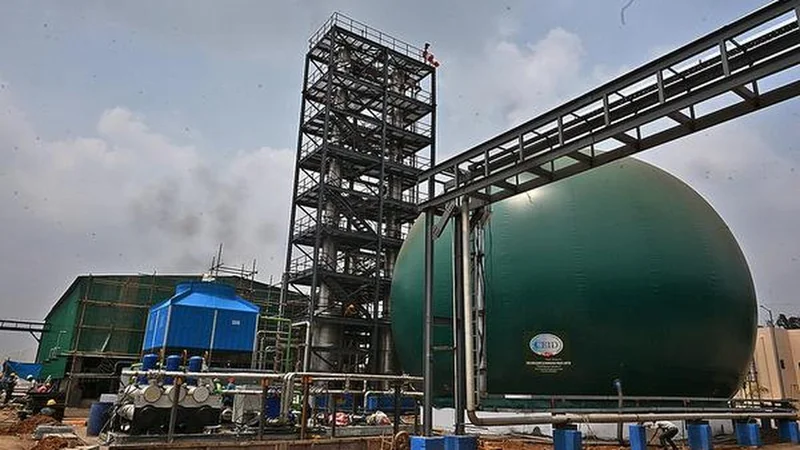
The Union cabinet on Thursday approved the National Circular Bioenergy Scheme – GOBARdhan, provisioning a ₹23,731-crore as part of efforts to catalyse the growth of compressed biogas (CBG).
The GOBARdhan (Galvanising Organic Bio-Agro Resources Dhan) scheme, to be in place until 2036, seeks to increase domestic compressed biogas production nearly ten-fold through assured offtake, administered pricing, capital subsidies, pipeline infrastructure and easier access to finance, the government said.
The government emphasised the scheme would seek to impart a “strong and predictable framework” to fuel the uptick of the CBG ecosystem.
The programme would involve the use of agricultural residue, cattle dung, sugar industry waste such as press mud, municipal organic waste and other biomass to produce compressed biogas, which can be blended into CNG used in automobiles.
Welcoming the government initiative, A.R. Shukla, President of the Indian Biogas Association said the scheme addresses three imperatives -- remunerative price, assured offtake and capital support -- sought by the industry.
“This scheme delivers all three,” he said, adding, “moving from roughly 300 operating plants towards 5,000 [plants] will create lakhs of rural jobs. Industry must now respond with speed, quality and discipline. We commit our members to that. Waste-to-wealth is no longer a slogan; it is an investable business.”
Supporting pipeline infra
One of the most critical components is the development of the necessary pipeline infrastructure, which is essential for the widespread adoption of CBG, as it ensures reliable offtake and enables seamless integration with the broader gas grid.
GOBARdhan seeks to support both cluster-based and standalone pipeline infrastructure connecting CBG plants with trunk pipelines and city-gas distribution networks.
“Greater pipeline connectivity will reduce evacuation costs, improve reliability, expand market reach and enable higher utilization of domestically produced CBG,” said the government statement.
Imparting predictability
GOBARdhan further introduces a stable-administered price of ₹2,110 per Metric Million British Thermal Unit (MMBTU) for CBG.
The objective is to impart long-term revenue visibility alongside protecting consumer affordability. The scheme seeks to achieve this via a combination of government-centred support and a market-based cost-sharing mechanism.
Further, the scheme shall accord eligible greenfield and brownfield CBG projects looking to expand, with capital assistance of up to ₹2 crore per tonne per day (TPD) of installed CBG capacity.
Extending support across the spectrum, from core plant machinery to feedstock aggregation and manure processing, the scheme intends to lower the initial capital burden, speed up financial closure and increase participation from private entities, micro, small and medium enterprises (MSMEs) and rural entrepreneurs.
The programme is expected to spur private investment, create additional income opportunities for farmers and rural entrepreneurs, improve management of agricultural and municipal waste, expand production of organic manure and lower greenhouse gas emissions.
India has been expanding the use of natural gas as part of its energy transition strategy while seeking to reduce its reliance on imported liquefied natural gas through greater domestic production of renewable gaseous fuels such as compressed biogas. (With inputs from PTI).
Published - August 06, 2026 08:34 pm IST