Between The Transporter, The Incredible Hulk, Clash of the Titans, and Now You See Me, director Louis Leterrier has spent much of the last decade orchestrating controlled blockbuster chaos. Then the French filmmaker inherited Vin Diesel’s Fast X… midway through production. Less controlled, more chaos.
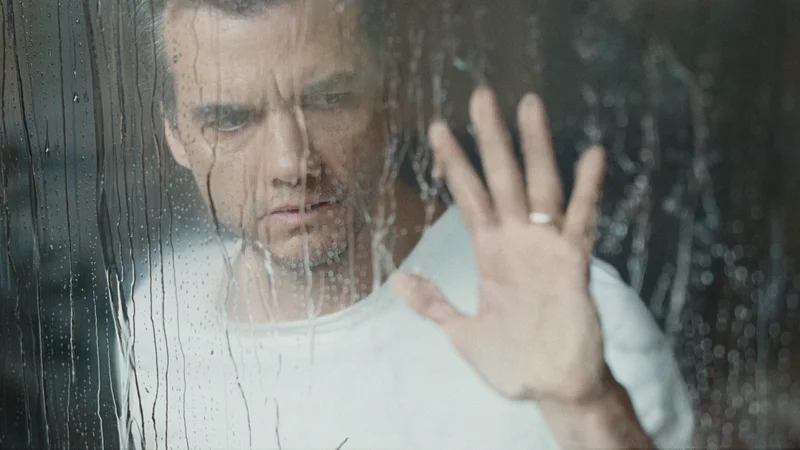
So the first few pages of his new movie, The Last House, was a welcome respite from his usual business: A mother, father, and their children find themselves unable to leave home after an inexplicable paranormal event seals them inside their suburban refuge. Days stretch into weeks. Weeks become years. Personalities clash as food becomes scarce. The rain pours and pours and pours and never stops. There’s a hot second where you think the drama between Greta Lee (Past Lives) and Wagner Moura (The Secret Agent) might descend into the tragedy of a Michael Haneke film. Might.
A few twists later and Leterrier’s bag of explosive action tricks comes back into play. He couldn’t resist the chance to make a genre-bending movie that undulates from small to bigger scales and still required a few days shooting in a massive water tank. (No spoilers.)
“Usually I want to jump into an adventure, a world that I don’t know,’” Leterrier says of reading The Last House for the first time. “I read and it felt strange because I recognized myself in it.’” As a father, he saw his own fears and responsibilities in a story about parents trying to keep their family alive. “For the first time in my life, I was about to do something very personal, where I was seeing myself in it — what I thought I would do, or hoped I would do.”
According to Leterrier, the script for Last House, from Good Luck, Have Fun, Don't Die writer Matthew Robinson, had an immaculate foundation, with room for a filmmaker to play as it answered its mysteries and widened in scope.
“[The script] was kind of like a first act, maybe a second act — there was no real third act,” the director says. “What was interesting for me was to stay within the box slightly, never breaking out of the confines of the four walls of this house.” The challenge was avoiding repetition and preserving “emotional gas” as the family’s ordeal evolved “from physical survival to mental survival to emotional survival, psychological survival. And then you add the uncanny and you add everything.”
That house — cramped and lived in, even before disaster — eventually fills with water. Again, no spoilers, but clearly Leterrier was pushing for it. “Put me in a tank and I’m the happiest person in the world!” the director says, laughing. But the water was only one part of an unusually ambitious visual strategy. Leterrier wanted the film to evoke the “dark Amblin movies of the ’80s” — Poltergeist, Close Encounters of the Third Kind, and E.T. — because “there’s a texture to these movies that is only found with film. There’s a depth of film that these movies have.”
To capture that feeling, Leterrier shot the early sections on 35mm film with “literally the same” anamorphic lenses that Steven Spielberg used to shoot Raiders. That’s a rarity for a Netflix movie (which has a fairly strict digital-forward approach to cinematography) but for the filmmaker, it was integral to the story. When The Last House makes a five-year time jump, the production moved to a high-end digital sensor paired with older glass from the 1960s, creating an image that was clearer but still textured and slightly uncanny. Eagle-eyed viewers will notice the frame itself gradually tightens as the family’s world closes in, before opening back up. In fact, Leterrier says he actually shot the film to be projected in IMAX, a technical choice he considers a long-term investment: “Movies are forever, so give your best. Shoot your best negative.”
Leterrier remains set to reunite with Vin Diesel for Fast Forever and go back into the chaos of tentpole filmmaking (even if he’s still waiting to read the script that reportedly left his star in tears). But darrnit, he’ll be thinking about The Last House when he does.
“I really loved working with this medium-sized budget,” he said. “It was not a big budget. It was not a small budget. It was a contained universe, contained budget. I really stretched the limits within my box, but I really loved doing that.”
These were the movies he loved growing up: films inexpensive enough to “push the limit and ask real questions,” and “talk about us more than just superheroes and gods.” For Leterrier, saying yes to The Last House after one read was really simple: “I wanted to do something different.” I’d say he came pretty dang close… despite the water tank. No spoilers.
The Last House hits Netflix on Aug. 7.