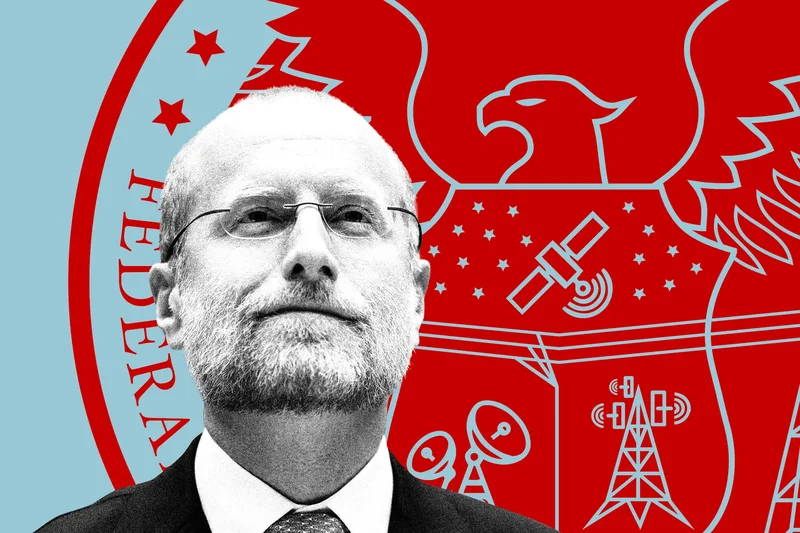
The era of set broadcast ownership limits is officially over, after the Federal Communications Commission (FCC) voted Thursday to end the national ownership cap rule.
Brendan Carr officially unleashes broadcast consolidation
The FCC voted to end a cap on broadcast ownership in favor of case-by-case review.
The FCC voted to end a cap on broadcast ownership in favor of case-by-case review.
The agency’s two Republicans, Chair Brendan Carr and Commissioner Olivia Trusty, voted to end the ownership cap, which restricts broadcast owners from holding stations that reach a combined more than 39 percent of US TV households, while Democratic Commissioner Anna Gomez dissented. It formalizes a policy Carr has long criticized, and which he announced last month that he would seek to end at Thursday’s open FCC meeting. In place of a set limit, the FCC says, there will now be “granular, case-by-case review” to determine if broadcast consolidation is in the public interest. That will let the agency avoid having to “show special circumstances that would justify a waiver of a rule that no longer serves the public interest,” according to an FCC press release.
In place of a set limit, the FCC says, there will now be “granular, case-by-case review”
Carr has often criticized the rule as an artificial limit that restrains broadcast owners from competing with social media and streamers that can reach “100 percent of the country” without accessing broadcast licenses. This is happening at the same time Carr and President Donald Trump have threatened broadcasters for coverage they view as unfair. For example, the FCC demanded early renewal of ABC’s broadcast licenses shortly after Trump criticized the network for late night host Jimmy Kimmel’s joke about his wife. The agency said its decision was connected to an investigation into the company’s diversity, equity, and inclusivity (DEI) policies.
Those who oppose ending the ownership cap, including Gomez, say that allowing broadcast owners to gobble up as many stations as they can buy will disincentivize local reporting on public airwaves and drive up consumer costs. They also say that only Congress has the power to lift the ownership cap, since the figure was written into a 2004 law, leaving it open to legal scrutiny.
Still, the FCC under Carr has already found ways to work around the rule, even before voting it off the books. Carr agreed to waive the cap to approve the $6.2 billion merger of broadcasters Nexstar and Tegna. A federal judge has paused the merger pending a challenge by a group of state attorneys general.
Follow topics and authorsfrom this story to see more like this in your personalized homepage feed and to receive email updates.