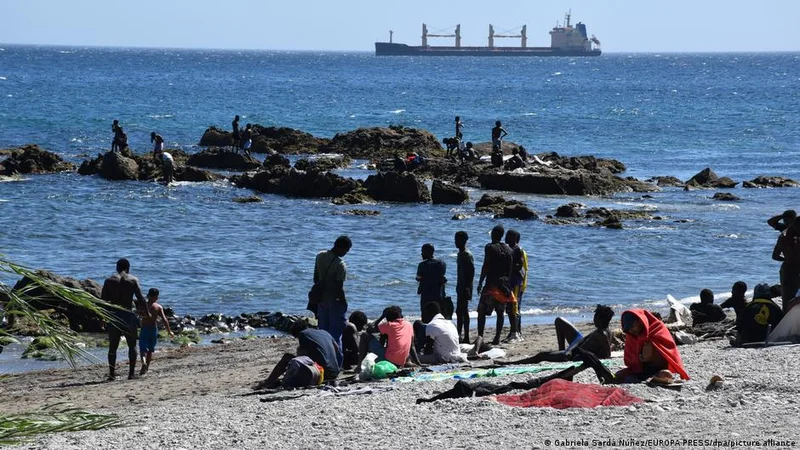
Ceuta's leader Juan Jesus Vivas spoke at the European Parliament on Thursday, where he told EU lawmakers that some 100 people had died during last week's border surge. He also said the city was still reeling from the event and now dealing with leftover unaccompanied migrant minors.
Vivas' visit to Brussels comes a week after some 72,000 migrants rushed through the border between Morocco and Spain's North African territory of Ceuta. The incident caused a spat between several EU countries and Spain, with Italy suspending the Schengen free-travel pact with Spain.
On Wednesday, Spanish NGO Caminando Fronteras said some 141 people had died on July 30, with 63 bodies found in Morocco and 78 in Ceuta.
Ceuta asks for more security resources
The Spanish government said that nearly all of the migrants had returned to Morocco, but Vivas noted that between 3,000 and 5,000 migrants were still in Ceuta.
Vivas also said Ceuta lacked the security resources necessary to deal with the situation.
"Security forces have not been deployed with the intensity required by the situation we are still facing," he told a European Parliament committee.
"Immigration services have not been sufficiently reinforced to handle the border rejections," he added.
Large number of migrant children in Ceuta
Of great concern for Ceuta are the large number of migrant children left there after last week's border rush. Vivas said the situation is "unsustainable," pleading for government help.
It is estimated that hundreds of unaccompanied minors are currently in Ceuta, enduring difficult conditions with limited access to food, water, shelter and sanitation.
In 2025, a Spanish immigration law reform was passed after a surge of migration overwhelmed reception centers in the Canary Islands, and the new law mandated the redistribution of unaccompanied minors overstretched territories within 15 days of their case file being completed.
The redistribution of the children to the rest of Spain is expected to meet resistance from regions governed by the center-right Popular Party (PP) and the anti-immigration, far-right Vox party.
But Spain's socialist government has warned against it, with deputy prime minister Carlos Cuerpo saying that PP and its regional governments "must comply with the law just like everyone else."
Don't let the algorithm hide the news. If you rely on our team for trusted reporting, please take a moment to select us as your Preferred Source on Google by clicking here and hitting the "star" or "preferred" button, so you'll always see our verified news first.
Edited by: Sean Sinico