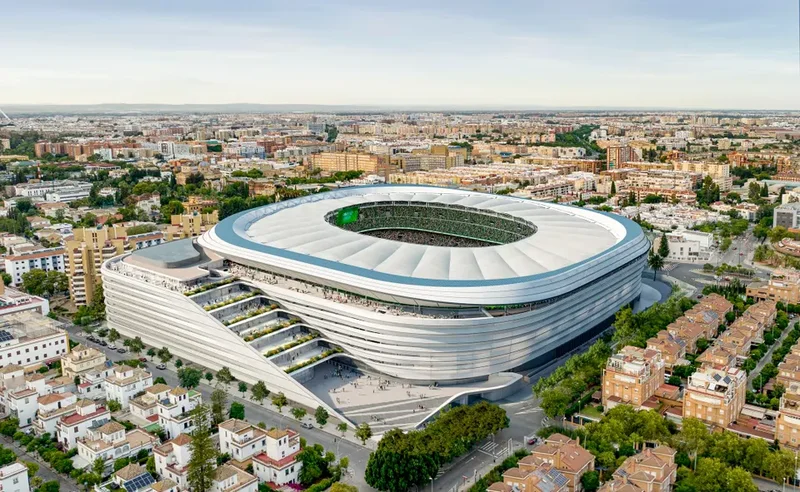
Drive into Seville from any direction and the Estadio Benito Villamarín is impossible to miss, a green-and-white fortress that has sat at the heart of Real Betis’ identity for over a century. What’s less visible from the outside is that the club is quietly turning that same stadium into the financial engine behind an entirely different ambition: closing the gap on Spanish soccer’s “big three” without the transfer budgets, sponsorship deals, or Champions League history that separate them.
Real Betis will never match Real Madrid's balance sheet, and president Ramón Alarcón says so without hesitation. What Betis is building instead is a growth model that narrows the gap without pretending to erase it, anchored by a new stadium, an international expansion strategy, and a social identity the club believes money can't easily buy for its rivals.
The proof of concept arrived on the pitch before it arrived on the balance sheet. Betis beat Premier League champions and Champions League finalists Arsenal 3-1 at the Aviva Stadium in Dublin in a pre-season friendly, with first-half goals from Rodrigo Riquelme, Nelson Deossa and Pablo Fornals all scoring for the La Liga side in the first half. It was a statement result and it doubled as exactly the kind of visibility Betis is chasing abroad.
The financial numbers frame the wider challenge. “The difference compared with those major clubs will remain considerable,” Alarcón told me, when asked how Betis' new stadium stacks up against Real Madrid, Barcelona and Atlético Madrid.
Real Madrid and Barcelona’s stadiums are projected to generate between €360 million ($416 million) and €400 million ($462 million) a year each. Atlético already pulls in more than €300 million ($346 million) annually from its stadium alone. Betis’ newly renovated arena is projected to produce €70 million ($81 million) to €80 million ($92 million) a year, up from around €30 million ($35 million) today.
But Alarcón isn’t chasing parity. “What is truly important is that the new stadium will enable us to consolidate operating revenues of close to €200 million ($231 million), widen the gap over other clubs in La Liga, and firmly establish ourselves within that second tier of clubs that consistently aspire to compete in European competitions,” he said.
The multiplier is in the seats, not the stadium
The headline capacity number understates what’s actually happening at the Benito Villamarín. Overall capacity will stay roughly the same, with the real shift coming in composition: premium seating grows from around 1,200 seats to approximately 6,000, a fivefold increase that Alarcón expects to nearly triple average revenue per fan.
“General admission ticket prices are expected to increase much more moderately, broadly in line with inflation,” he said, making clear the economics rest on hospitality and premium inventory rather than pricing out the ordinary fan.
Layered on top is an adjacent development, including a hotel, retail space and food and beverage outlets, expected to add another €10 million ($15 million) a year. Combined, Alarcón projects the stadium complex’s revenue rising from €30 million ($35 million) to around €90 million ($105 million) annually. The ambition, in his words, is a venue that generates “footfall 365 days a year” through tours, restaurants and corporate events, rather than 19 matchdays a season.
It’s a familiar shift for anyone who has watched Premier League stadiums evolve over the past decade, where premium seating and non-matchday events have become the primary drivers of revenue growth even as general capacity stays flat. What's notable is that Betis is compressing that evolution into a single redevelopment rather than the incremental expansions typical of English clubs.
An unusual ownership structure funding the ambition
Part of what makes Betis’ project distinctive is who is paying for it. Unlike Madrid and Barcelona’s member-owned structures, or the state and private-equity money reshaping much of European soccer, Betis operates under a fan ownership model in which supporters hold 55% of the club, alongside local businessmen Ángel Haro and José Miguel López Catalán as the other principal shareholders.
That structure means the stadium project has to be financed largely through the club’s own commercial growth rather than an external capital injection of the kind that funds the rise of many clubs in recent years.
It also shapes the tone of the project. An international architecture competition for the redevelopment drew 30 proposals from architects across 19 countries, reflecting an approach built on broad engagement rather than a single benefactor’s vision, consistent with a fanbase that owns a majority stake in the outcome.
Internationalization in this sense remains a core part of the club’s approach, and Dublin friendly wasn’t a standalone brand exercise. “Our internationalisation strategy and the new stadium are clearly interconnected and mutually reinforcing,” Alarcón said. Seville already draws heavy tourism, and Betis wants to convert part of that flow into stadium visitors year-round, turning Villamarín into what he calls “both an iconic landmark for the city and a must-visit destination for anyone coming to Seville”.
Betis’ domestic fanbase gives that strategy a real foundation to build from abroad. Within Seville, support is close to an even split with rival Sevilla, but nationally Betis draw around 3.2% of Spain’s soccer fans compared to Sevilla's 1.1%, and government statistics rank Betis as the country's sixth-most popular club, a footprint built partly on Andalusian migration to other parts of Spain over previous decades. At home, average attendance at Benito Villamarín already exceeds 45,000, and television ratings place Betis as the third most-watched team in LaLiga.
That domestic base is the platform international expansion is meant to extend, not replace. Friendlies in Dublin, along with previous tours to the United States against clubs like Manchester United, function less as one-off exhibition revenue and more as long-term brand placement in markets Betis hopes will eventually convert into stadium visitors, sponsorship interest, and international membership growth.
It's a different playbook than Real Madrid or Barcelona run, where global reach exists somewhat independently of any single venue. For a club at Betis' revenue level, tying international growth directly to a physical, monetizable space is arguably the more capital-efficient route: every euro spent on visibility abroad has a direct line back to stadium revenue, rather than sitting as a separate marketing cost with a harder-to-measure return.
A model built for the gap, not around it
None of this closes the distance to Real Madrid, Barcelona or Atlético in raw revenue terms, and Alarcón isn't claiming it will. What Betis is doing is building a version of sustainable growth suited to a club of its actual size: a stadium designed around premium yield rather than raw capacity, an international strategy tied directly to that stadium's commercial potential, an ownership model that keeps growth self-funded, and a social identity built into the sponsorship pitch itself.
Whether it’s replicable elsewhere depends on circumstances few clubs share, given Seville’s strong tourism economy, Betis’ Andalusian identity, a fan-majority ownership structure, and a supporter base that treats the club’s social commitments as seriously as results on the pitch.
But this summer has already shown that beating Arsenal 3-1 in Dublin was a reminder that the on-field side of the project is moving in step with the financial one. As a case study in how a club outside Europe’s traditional elite can build sustainable growth on its own terms, without outside capital reshaping the club’s identity in the process, Betis’ current project is one of the more coherent examples in European soccer.