Sign in. It’s quick, free and it’s up to you.
An account is an optional way to support the work we do. Find out more.
Politics by Numbers is a new series for The Journal where broadcaster, author and spreadsheet stan Gavan Reilly takes a data deep dive into a political point of the week.
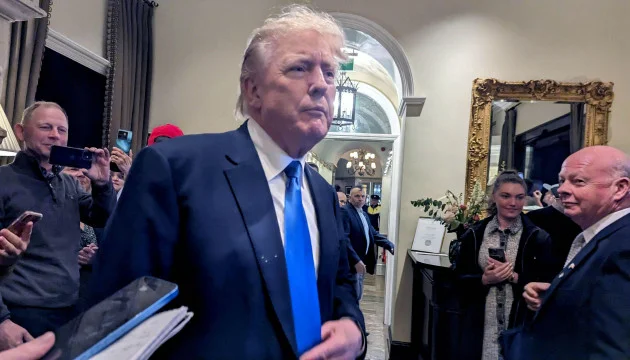
AS IF THE European presidency and all of the related security complications weren’t enough, here comes the President of the United States.
Not that Donald Trump will see much of Ireland – or that much of Ireland will see him.
By all accounts, Trump’s forthcoming visit might last for as little as 36 hours, arriving early on Saturday morning and possibly jetting away again at teatime on Sunday.
If that plan is what finally emerges, barely four of those hours will be spent in Dublin. The rest will be at Doonbeg.
The Irish Open, for its illustrious proprietor, is a priceless opportunity to showcase his golf resort – and, simply by virtue of his presence, will attract far more attention to the Irish Open than it would otherwise receive.
Trump is a master of the attention economy. Aside from the occasional fairytale – like last year, when Rory McIlroy audaciously claimed victory in a playoff, merely weeks after his career-Slam heroics at Augusta – the Irish Open has struggled in recent years to command the attention many Irish golf fans would like.
A relatively off-Broadway DP World Tour event might struggle to get a mention on ESPN’s Sunday night SportsCenter, particularly on an NFL Sunday.
But bring Donald Trump to the 18th green to present the winner’s trophy, and it’s a different story: his presence muscles its way into any bulletin and closer to the top of any TV running order.
The visit is thus less a diplomatic mission than it is a marketing minibreak. As with last year’s trip to his Turnberry course in Scotland, the pesky work merely gets in the way: last year during a trip to his course in Turnberry, Ursula von der Leyen jetted over to secure an objectively humiliating trade “agreement” with a 15% tariff levied on most European exports to the United States, and a 0% rate on American produce coming the other way.
This year, instead of striking a major deal with the most influential player in Brussels, he’ll likely make a courtesy call to Áras an Uachtaráin to meet a counterpart who has made little secret of her dislike for him, before sitting down with a pragmatic Taoiseach – possibly in Farmleigh, rather than bringing a security ring of steel to Dublin’s city centre – under pressure from more idealistic voices to take a tougher line.
But all of that will be of little concern to the visitor. His bigger motivation is likely to be in harvesting the indirect adulation of his course being given the right to host a European tour event (unlike on the doomed Saudi-owned LIV Tour, where the balance between commerce and prestige is different) and bringing further eyeballs at an opportune time.
If you visited Trump’s resort website last night, you could have booked a round of golf this morning for the handsome sum of €550 — albeit with only a handful of tee times still available, most having long since been snapped up. Your best value would have been to wait until after 5 pm, pay the comparatively modest €255, and hope the fading light held out long enough to finish your 18 holes.
But check the first Thursday of next August, and there’s no evening discount: even a 6 pm tee time will set you back €550. By comparison, three years ago, golf bloggers recorded the most expensive round in Doonbeg as €375.
That inflation is hardly any surprise: that’s approaching the exact time that Ireland will be at the centre of the golfing universe, when Adare Manor hosts the 2027 Ryder Cup.
And Doonbeg, to be fair, is far from the only course that’s riding that commercial wave. Adare Manor itself charges a similar €550 for a round this summer, plus another €120 per player for the services of a mandatory elite caddie for guidance. That’s not quite as inflationary as its counterpart across the Shannon: in 2019 the comparable green fee was €450.
Lahinch Golf Club, which charged €275 for its most expensive round in the summer of 2023, now asks €450 for a game at its old course. The Old Head links in Kinsale, previously quoting €395, also now asks €550 at peak season. Royal Portrush in Co Down, which charged £295 (€340) in green fees when it hosted Shane Lowry’s epochal win in the 2019 Open, charges £420 (€490) a head in the wake of Scottie Scheffler’s 2025 win at the same venue.
When visitors are routinely dropping money of that quantity – and remember, many high-spending North American tourists will plan entire weeks playing high-end courses on a daily basis – you suddenly understand why there is an urgent desire to spend six months and €3 million building a temporary train station for a few days of visitors to Adare.
While tourism remains one of Ireland’s biggest industries – so much so that responsibility for it within Government was moved to the Department of Enterprise last year – it is a sector that could use a boost. Visits from North America in June of this year were 7% lower than the same month in 2025, but they spent more than their fair share: while making up just 27% of the numbers, they accounted for 39% of the spending.
That’s not to be sniffed at. The amount spent in Ireland by overseas visitors has fallen in recent years; our reputation as a ‘premium’ holiday destination, with high costs for high-quality produce and experiences, means Ireland has quietly priced itself out of many markets. International spending in Ireland in 2024 was estimated at €6.6 billion; last year it was down to about €5.6 billion. Again, however, it was visitors from North America who spent the most, averaging €1.282 per head, contributing almost €2 billion to the overall spend.
While there might well be an ulterior commercial motive to Donald Trump’s visit – and that would hardly be a surprise, given how his family wealth has rocketed in his second term of office – there is equally an ulterior commercial motive for Ireland to welcome him. The fleeting attention his visit will bring to Ireland can only be a helpful thing for the tourist trade that has been slowly suffocated by Ireland’s high cost of living.
Diplomatically, debate will (rightly) continue about the merits of welcoming Donald Trump to Ireland, but commercially, a welcome is a no-brainer.
Gavan Reilly is the Political Correspondent for Virgin Media News and the host of Monday with Gavan Reilly, which airs every Monday at 10 pm on Virgin Media Play and Virgin Media One.
To embed this post, copy the code below on your site