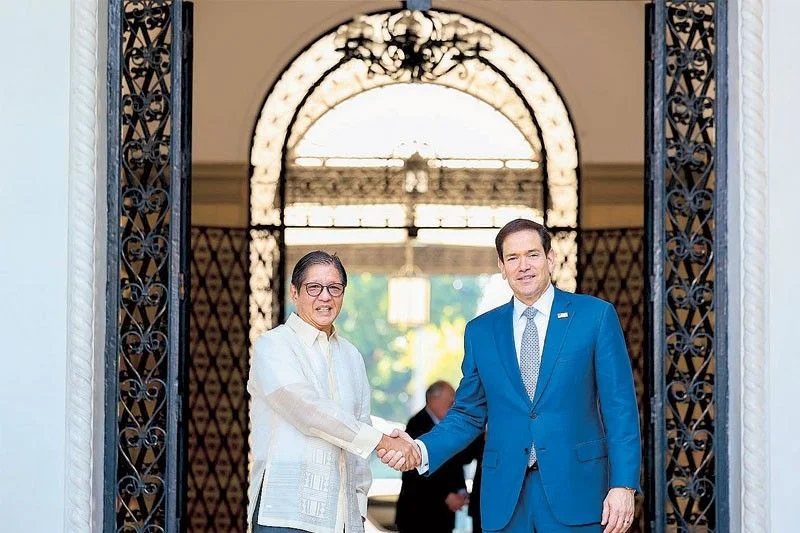
MANILA, Philippines — As they navigate through “interesting times,” President Marcos and US Secretary of State Marco Rubio yesterday reaffirmed the “deep ties” between the two allies as they tackled key issues, including China and artificial intelligence.
Rubio paid a courtesy call on Marcos at Malacañang as fresh tensions rose in the South China Sea following the Chinese coast guard’s attack that injured a Philippine Navy personnel at Ayungin Shoal on Monday.
Washington’s top diplomat is in the Philippines for the Association of Southeast Asian Nations (ASEAN) Post-Ministerial Conference with the United States, which highlighted the need to enhance cooperation to support regional peace, stability and prosperity.
“In addition to visiting here for the conference, we wanted to visit you. You know how much the President (Donald Trump) holds you in high esteem. This is a country that has deep ties to the United States for many, many years. And it’s a partnership that is only growing,” Rubio told Marcos during the meeting.
“And in light of recent events, I think (it is) more important than ever. And so we’re glad to be with you here today and to reaffirm that relationship and our commitment to the US-Philippines relationship,” he added.
Responding to Rubio, Marcos said, “And especially so, Mr. Secretary, as we are living the curse of ‘may you live in interesting times.’”
“And here we are, right in the middle of them. It doesn’t sound like a curse, but it turns out that it is. In any case, we try to bring together ASEAN. The entire process was a product of the lessons learned during the pandemic,” he added.
Rubio thanked Marcos for welcoming him and congratulated him for a “good job” in hosting the ASEAN, which he described as “critically important for the region.”
Philippine Ambassador to the US Jose Manuel Romualdez said Marcos and Rubio talked about strengthening the relationship between the two countries, whose formal diplomatic ties were forged in 1946 and who became treaty allies in 1951.
“The President, of course, expressed his gratitude for the continued support that we’ve been getting from the United States on all matters, not only in the defense but also on the economic front,” Romualdez told reporters after the courtesy call.
“It’s interesting times in the sense that there’s so much of these things that are happening and hopefully the partnerships that we’ve had, not only with the United States but other countries as well, will be a source of comfort for us, that we have a lot of allies and friends and partners all over the world.”
Romualdez said Rubio had wanted to make a call on Marcos to relay to him the best wishes of Trump.
“President Trump was actually talking to Secretary Rubio and he wanted to convey the message. And hopefully, President Trump will come in November during the ASEAN Leaders Summit,” Romualdez added.
Asked whether China was mentioned during the meeting, Romualdez said, “It was just in passing.”
“Well, China of course has always been a situation that is always part of the conversation in the sense that the hope is that countries will have a way to be able to persuade China to be able to respect the rule of law, international law of the seas and so forth and so on,” Romualdez said.
The July 20 incident at Ayungin Shoal, which saw the China Coast Guard (CCG) assaulting a Philippine Navy personnel, was not discussed during the courtesy call, he added
Aside from China, the Pax Silica, the US State Department’s effort on AI and supply chain security, was also tackled during the courtesy call.
“Pax Silica and the Luzon Economic Corridor is one of the main points that President Marcos has expressed. He’s very pleased that it’s moving quickly and that will definitely help the Philippine economy and our aspiration to have the kind of economic prosperity that we’ve been looking for because it spells economic security for us,” Romualdez said.
Under the Pax Silica framework, the Philippines and the US seek to build a 4,000-acre industrial hub in the Luzon Economic Corridor. According to the US embassy’s website, the site is being offered by the Philippines as an “economic security zone” to “surge production for inputs vital to US supply chains.”
However, some sectors are concerned that the initiative could expose the Philippines to security threats, result in foreign control of critical minerals, harm the environment, disrupt water supply and displace local residents.
Officials have given assurance that the plight of communities in areas covered by the project would not be neglected.
The Philippines and the US aim to sign a framework agreement on the Pax Silica by November. The Philippines is the 13th Pax Silica signatory.
Other countries that have joined the US-led initiative are Australia, Finland, India, Israel, Japan, Qatar, South Korea, Singapore, Sweden, the United Arab Emirates and the United Kingdom.
Palace press officer Claire Castro said Marcos and Rubio also talked about the importance of AI in promoting investments, creating jobs and expanding knowledge.
Marcos cited the Middle East conflict response, new and emerging technologies, defense and security and economy as cooperation areas between the two countries.
President Marcos tackled regional and international issues with Japanese Foreign Minister Motegi Toshimitsu, including the situation in the South China Sea, during their meeting at Malacañang on Tuesday.
Marcos also met with Australian Foreign Minister Penny Wong at the Palace.
Motegi and Wong are in the country for the ASEAN-related foreign ministers’ meetings. – Helen Flores