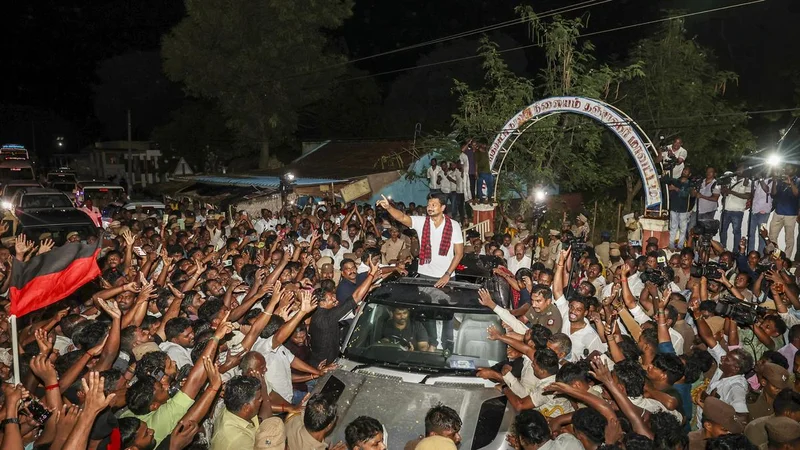
The arrest of the Leader of the Opposition in Tamil Nadu Udhayanidhi Stalin in connection with his allegedly obscene remarks during a demonstration on the Cauvery water dispute in Thanjavur has rekindled memories of an era when political leaders launched no-holds-barred attacks on their rivals.
In those days, political parties in Tamil Nadu had an unwritten division of labour. While senior leaders articulated the party’s ideology and policies, fiery oratory speeches — often punctuated with personal attacks and, at times, obscene remarks — was largely left to second- and third-rung leaders of the Dravida Munnetra Kazhagam (DMK), the All India Anna Dravida Munnetra Kazhagam (AIADMK), and, to a much lesser extent, the Congress.
These speakers had a devoted following. Their speeches were not merely exercises in invective; they forcefully explained the political issues of the day and defended their party’s positions. Yet, every now and then, they would veer into caustic attacks on rival leaders, employing language that, despite its crudeness, was relished by sections of the audience.
I vividly remember a speech delivered by Theepori Arumugam, one of the DMK’s most colourful platform speakers, in the aftermath of the assassination of Rajiv Gandhi. Renowned for his fiery style, he rarely exercised restraint and routinely launched obscene and deeply personal attacks on political rivals. On that occasion, he spared no one, even weaving in references about his own family life into his speech to entertain the crowd.
His inflammatory rhetoric also had consequences. On one occasion, angry members of a rival political party assaulted him, injuring the tip of his tongue. Ironically, after recovering from the injury, his speeches became even more scathing. Theepori Arumugam eventually joined the AIADMK — the very party he had spent years attacking with his acid tongue!
Theepori Arumugam’s contemporaries included Vetrikondan, Vagai Muthazhagan and Vannai Stella, all of whom were known for their combative style of platform oration. The AIADMK also had a few, with the most vocal among them being Nellai Balaji. Among contemporary speakers, Sivaji Krishnamoorthy of the DMK, perhaps offers the closest throwback to that era.
Party leaders generally turned a deaf ear to such rhetoric. They intervened only when there was public backlash, suspending the speakers for a brief period. More often than not, the suspension proved temporary, and the speakers returned to the political stage with renewed vigour.
Though Mr. Udhayanidhi has courted controversy over his choice of words in the past, his remarks in Thanjavur appeared to have been made in response to repeated prodding from sections of the crowd. However, he went on to reiterate the expression. He subsequently denied that he had used words with a double entendre, insisting that his words had been misconstrued.
Women — both politicians and those associated with political leaders — have often been at the receiving end of public political invective in Tamil Nadu. Personal attacks directed at women have long formed an unfortunate strand of platform rhetoric, reflecting the deeply gendered nature of political discourse.
Though former Chief Minister J. Jayalalithaa herself was often the target of deeply personal attacks, it did not prevent her from making personal remarks against her opponents. During one election campaign, she targeted DMK Parliamentary Party leader Kanimozhi, and on more than one occasion had ridiculed senior DMK leaders, including M. K. Stalin. In a sense, Jayalalithaa also brought some of the combative style of platform politics into the Tamil Nadu Assembly. She displayed extraordinary aggression on the floor of the House, using forceful body language and a high-pitched, confrontational tone to take on her political adversaries. Her exchanges with the founder of the Desiya Murpokku Dravida Kazhagam (DMDK), Vijayakanth, remain among the most dramatic confrontations in the Assembly’s history.
That style of politics appears to have found echoes in the present Assembly. Chief Minister C. Joseph Vijay’s aggressive delivery during his exchanges with the DMK leadership have reminded many of Jayalalithaa’s combative presence.
Published - August 07, 2026 12:51 am IST