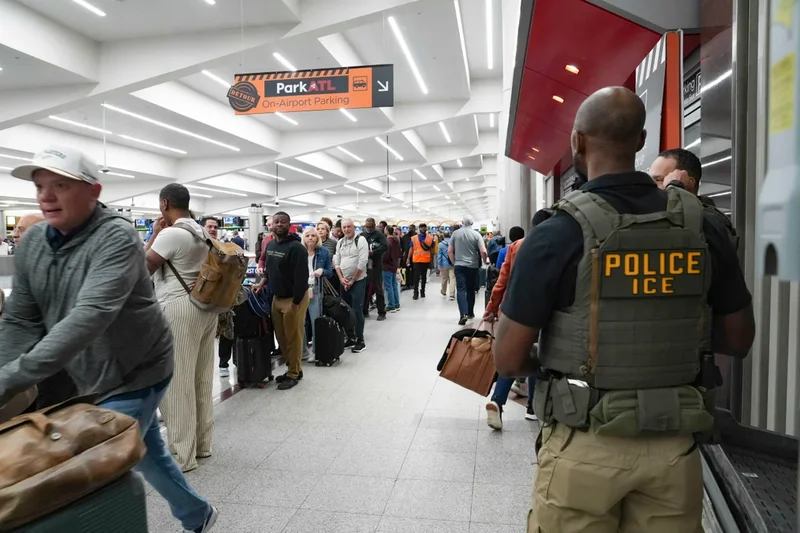
Airlines are reportedly increasing resistance to federal immigration authorities expanding enforcement inside U.S. airports, with industry representatives seeking clearer boundaries on how and where arrests take place.
Representatives from the airline industry recently met with Department of Homeland Security officials to outline concerns regarding enforcement actions inside terminals, according to reports by The Wall Street Journal. Carriers are requesting clarification on whether officers can execute administrative warrants and whether federal agents will refrain from boarding aircraft to make arrests.
“Airlines have had constructive discussions with ICE and TSA to ensure if law-enforcement activity occurs at an airport, there are proper procedures and protocols in place to prioritize the safety and security of all involved,” a spokeswoman for trade group Airlines for America told the publication.
The pushback comes as Immigration and Customs Enforcement expands operations beyond security checkpoints into gate areas and jet bridges across domestic hubs, including Miami, San Francisco and Kansas City.
Government sources familiar with internal figures told The Wall Street Journal that ICE officers conducted between 12 and 36 airport arrests per day last month.
The enforcement push was highlighted in late July when federal agents arrested Fatima Ameaka, a Johns Hopkins University researcher and former Fulbright scholar, as she boarded a domestic flight at Baltimore-Washington International Airport.
Ameaka, originally from Cameroon, was detained for allegedly overstaying her visa, as reported by The Baltimore Banner. Documents obtained by watchdog group American Oversight show her arrest was part of a broader data-sharing agreement established between ICE and the TSA in May 2025 to cross-reference passenger information.
The expanded measures follow directive updates from senior ICE leadership encouraging agents to make arrests at TSA checkpoints.
The shift is part of broader White House pressure on the agency to reach approximately 2,000 daily arrests nationwide. While previous operations centered on people with final deportation orders, current enforcement targets include travelers holding expired visas who have active green card or asylum applications pending.
The increased activity has led to confrontations between federal agents and airline staff. On July 25 at a Dallas airport, a Southwest Airlines gate agent refused to allow an ICE officer to board an Orlando-bound flight using an administrative warrant, requiring a judicial warrant signed by a judge instead, internal documents reviewed by The Wall Street Journal show. Airline employees also declined to share passenger data or display computer screens to the officer.
The Dallas incident is one of at least six similar interactions involving Southwest in recent weeks. In another case last month at a Southern airport, an unnamed airline declined an ICE request for jet bridge access to arrest a father traveling with his family, who ultimately did not board the flight.
In statements, Southwest affirmed its adherence to state and federal laws while maintaining strict policies on customer data sharing, and JetBlue stated it did not collect or report customer immigration status to federal agencies.
Labor groups have also raised safety concerns over the enforcement operations. In a March letter to major carriers, Sara Nelson, international president of the Association of Flight Attendants, wrote: “The actions that federal enforcement authorities have taken in our workplaces have raised glaring workplace, safety and legal concerns for flight attendants.”
Former Denver International Airport chief executive Phil Washington also expressed concern regarding potential conflicts in public terminal spaces.
“I’m worried about escalation — I’m worried about bystanders,” he said.
DHS spokeswoman Lauren Bis defended the agency’s actions, saying that the department is “simply enforcing our nation’s laws and established policy.”
Both ICE and TSA operate under DHS, which has shared passenger manifests to assist in identifying potential targets since last summer.
The Independent has contacted the Department of Homeland Security for comment.