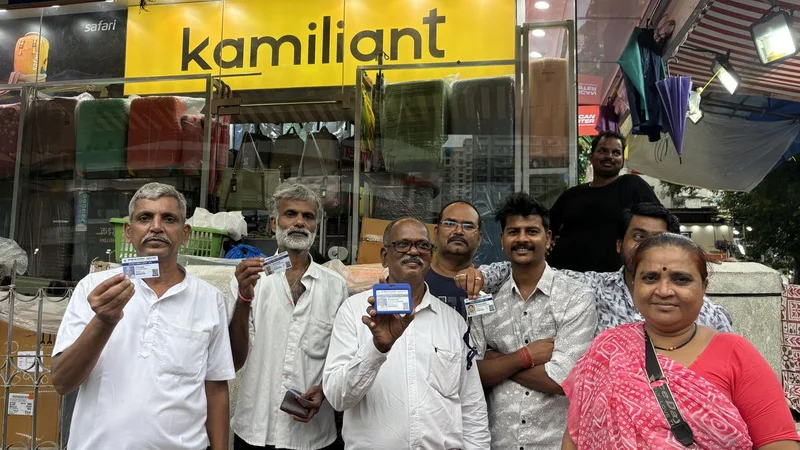
Holding up her laminated QR code-enabled ID card, Maya Satheliya, 52, said, “This card is not helping me as it holds no value in the eyes of the police.”
Ms. Satheliya hails from Gujarat’s Bhavnagar and has been running an authorised garment stall with her husband in Mumbai’s Borivali suburb for the past 35 years. She said the ID card was issued to her husband in June, but the “police treat us like robbers”.
“When the police aren’t around, we make a sale; when we see their car, we run like rats and they trail us. For the past one and a half years, business has been like this. Even after getting the card, there has been no change,” she said.
The Brihanmumbai Municipal Corporation (BMC) began issuing the ID cards in May after the Bombay High Court pulled up the civic body for failing to curb illegal hawking. The ID cards have been issued to 51,000 authorised vendors so far. When scanned, the QR code links to a BMC verification portal displaying the hawker’s name, ID number, and ward.
‘Clear demarcation’
“This is a smart identification system that will clearly distinguish licensed vendors from unauthorised hawkers. During anti-encroachment drives, those with ID cards will not be targeted. It will also help curb fake licences and illegal occupation of public spaces,” BMC Deputy Municipal Commissioner (Special) Vinayak Vispute said.
On May 6, a Division Bench of Justices A.S. Gadkari and Kamal Khata had given the BMC five weeks to issue the cards to 99,435 authorised hawkers identified by the civic body during a survey in 2014 under the Street Vendors Act, 2014. It added that hawkers outside this list, including Bangladeshi nationals, can be evicted. The Bench was hearing seven petitions filed by hawkers’ associations in August 2024 challenging the election process of the Town Vending Committee (TVC).
The 2014 Act mandates the constitution of the TVC within six months. Despite the Act coming into force on March 5, 2014, the Bench observed that the panel had not been formed and the process “appears to have become entangled in considerations of money, power, and politics rather than governance”.
The TVC’s role is to conduct surveys and designate vending zones and pitches.
“We are awaiting government nod. Wards have proposed hawker zones. The TVC will be formed within a week,” Mr. Vispute had said on August 5.
According to the BMC, Mumbai will have eight TVCs — one in each of the city’s seven zones and an apex panel for overall management. Each panel will have eight members drawn from the State government, hawkers’ unions, and other stakeholders.
‘Livelihoods affected’
However, the delay in forming the TVC is hurting authorised hawkers across the city. “The rampant crackdowns and delay in designating vending zones have been affecting our livelihood,” Jai Singh, representative of the Azaad Hawkers’ Association, said.
Nagraj, who runs a Chinese food stall in Kurla, said his cart was seized at least three times this year. “Each time, I had to pay ₹1,200 to get it back.”
In Borivali’s Jamli Gali, Shantaram Shinde, 57, questioned the logic of issuing the ID cards first. “They say hawking will be allowed only when the TVC is formed; is it fair?”
Hawkers in Borivali, Kurla, and Jogeshwari have demanded at least three to four hours of daily vending during non-peak hours until zones are notified.
Ravindra Yadav, 46, a third-generation fruit seller from Jogeshwari who migrated from Jaunpur, Uttar Pradesh, received his ID card in June. He submitted it at the local police station, but was turned away.
“The police say there is no such order from the court. They ask us to bring them a circular issued by the BMC. When we approach authorities in our ward, they say the BMC is yet to send it. There is no coordination,” he said.
Mr. Yadav and the Azaad Hawkers’ Association submitted a letter at the Jogeshwari police station on July 29 seeking clarity.
Published - August 07, 2026 01:18 am IST