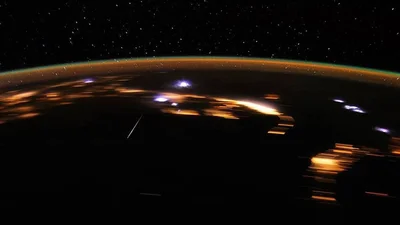
The Lyrid meteor shower peaks on April 22, offering a spectacular show of shooting stars and bright fireballs under moonless skies. This ancient meteor shower, caused by debris from Comet Thatcher, promises 10 to 20 meteors per hour, especially visible in the early morning around 5 a.m. Stargazers are advised to find dark, clear locations away from city lights for the best viewing experience. With the new moon ensuring minimal light interference, this year's Lyrids are set to dazzle skywatchers across North America and Europe.
Space & Exploration
Lyrid Meteor Shower Lights Up Dark Skies
More from Space & Exploration
-
Blue Origin Recycles New Glenn Booster
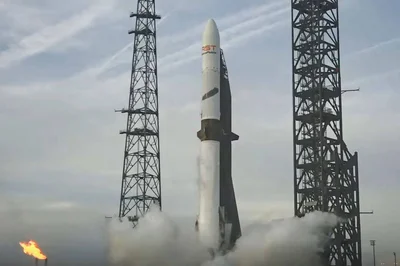
Blue Origin made history by successfully launching and landing a reused booster for its New Glenn rocket on Sunday. This milestone marks the company's first booster reuse, showcasing its growing capabilities in reusable rocket technology and intensifying competition with SpaceX. The booster, named "Never Tell Me The Odds," returned precisely to a drone ship after delivering a satellite to low-Earth orbit. This achievement could significantly reduce launch costs and increase flight frequency, with future missions planned to support NASA and Amazon's space ambitions.
-
CERN Trucks Antimatter for Breakthrough Science

In a groundbreaking move, CERN transported 92 antiprotons—the world's most expensive material—by truck across its France-Switzerland campus. This antimatter, produced and captured using CERN's particle accelerators, is crucial for probing fundamental physics mysteries, including why the universe favors matter over antimatter. The transport allows scientists to study antimatter away from magnetic interference, aiming for unprecedented precision. Researchers hope these experiments will unlock secrets dating back to the Big Bang.
-
Satellite Swarm Sparks Regulatory Chaos

The number of active satellites orbiting Earth has exploded from just over 700 at the century's start to an anticipated half a million by 2040, driven largely by SpaceX's Starlink and other mega-constellations. This surge threatens to clutter the night sky, disrupt wildlife navigation, and escalate space debris risks, potentially locking humanity out of space forever due to the Kessler syndrome. Despite international treaties, commercial and national interests race ahead unchecked, raising urgent calls for new governance frameworks. Experts warn that without coordinated regulation, the space environment could become dangerously congested, imperiling both scientific exploration and global communications.
-
Synthetic Universe Brings Galaxies to Life
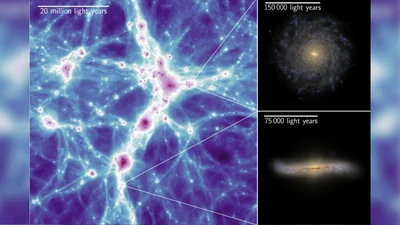
A groundbreaking synthetic universe simulation called COLIBRE now lets users see and hear galaxies evolving from the dawn of time, recreating billions of years of cosmic history with stunning accuracy. Developed using the standard cosmological model and powered by Durham University's COSMA8 supercomputer, it closely matches observations from the James Webb Space Telescope, validating key theories about galaxy formation. This immersive tool not only advances scientific understanding but also promises to make cosmic evolution accessible and intuitive for researchers and the public alike. Ongoing simulations and analyses will continue to reveal new insights into the mysteries of our universe.