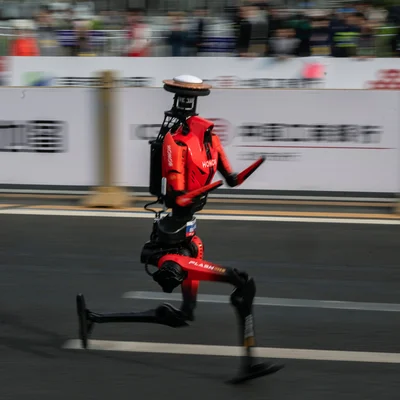
In a stunning feat at the Beijing E-Town Half-Marathon, the humanoid robot Lightning, developed by Honor, completed the race in just 50 minutes and 26 seconds, beating the human world record by nearly seven minutes. This autonomous machine showcased advanced AI, multi-sensor fusion, and liquid cooling technology, marking a major leap in robotics. With over 100 teams competing and rapid progress from last year’s event, this breakthrough signals a new era in humanoid robotics. The challenge now is translating this speed into practical applications beyond the track.
Space & Exploration
Robot Shatters Human Half-Marathon Record
Sources (4)
A Humanoid Robot Races to a Record Half-Marathon Finish
19 Apr 2026, 22:26

Beijing's robot half-marathon is back for its second year with far less embarassing results
19 Apr 2026, 19:13

A humanoid robot just beat the human half-marathon world record by seven minutes in Beijing
19 Apr 2026, 18:56
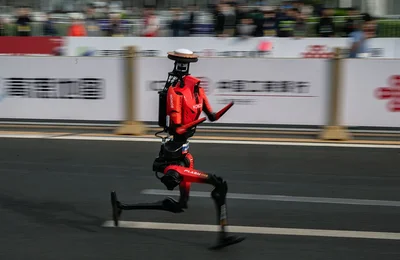
Robots beat human records at Beijing half-marathon
19 Apr 2026, 18:44
More from Space & Exploration
-
Victor Glover's Orion Odyssey: Artemis II Insights
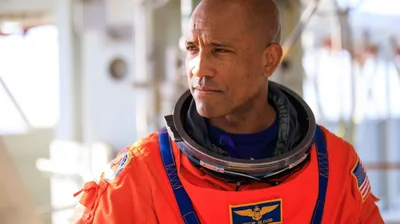
Astronaut Victor Glover, pilot of NASA's Artemis II mission, shared vivid details about life aboard the Orion spacecraft during its historic lunar flyby. Despite the cramped, bedroom-less capsule, Glover described the surreal experience of sleeping near an air vent and the thrill of manually flying Orion, calling it a "test pilot's dream." The crew traveled over 250,000 miles, surpassing Apollo 13's record, and captured stunning views of the moon and Earth, bringing the mission's wonder directly to the public through live streams. Glover emphasized the human side of space travel and NASA's goal to make audiences feel connected to this groundbreaking journey.
-
Catch the Lyrid Meteor Shower Peak
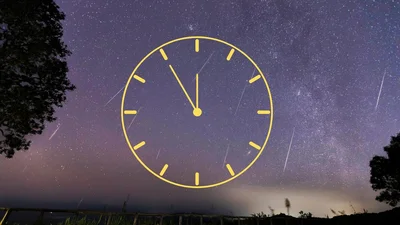
The Lyrid meteor shower reaches its peak around April 21-22, with the best viewing time before dawn on April 22, when up to 18 meteors per hour may streak across the sky near the bright star Vega in the constellation Lyra. This annual celestial event, caused by debris from Comet C/1861 G1 Thatcher, offers a spectacular natural light show best seen away from city lights and after the moon sets early in the morning. For optimal viewing, find a dark spot, let your eyes adjust for 20-30 minutes, and look about 40 degrees away from the radiant point. The shower will also be visible on the nights surrounding the peak, so there’s still a chance to catch it if you miss the main event.
-
SST Launches Cutting-Edge Space Observatory
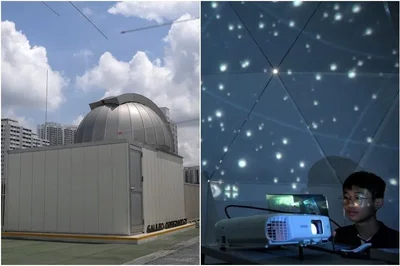
School of Science and Technology (SST) in Singapore has unveiled its new Space Technology Centre, featuring a 17-inch PlaneWave telescope and a dedicated amateur radio station. This facility allows students to track satellites, observe celestial bodies, and engage in hands-on space exploration, bridging classroom theory with real-world application. As one of only two secondary schools in Singapore with an observatory, SST is positioning itself at the forefront of STEM education and space innovation. The centre will also support special astronomical events and ongoing student research projects.
-
Voyager 1 Powers Down Instrument Amid Crisis
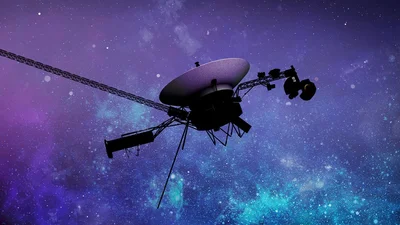
NASA has shut down Voyager 1's Low-energy Charged Particles (LECP) instrument to conserve power as its nuclear RTG source steadily fades after nearly 50 years in space. An unexpected power drop following a February maneuver forced this emergency measure to avoid automatic shutdowns and extend the probe's operational life. Engineers plan a 'Big Bang' upgrade to swap in lower-power devices, potentially reactivating LECP and pushing Voyager 1's mission beyond its original limits.
-
Blue Origin's New Glenn: Landing Win, Orbit Fail
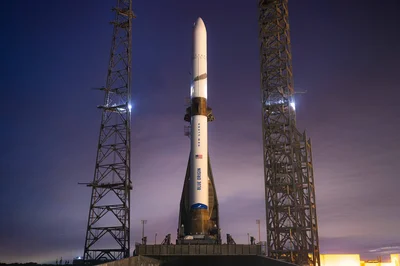
Blue Origin successfully landed its reused New Glenn booster for the second time, marking a milestone in rocket reusability. However, the mission faltered when the AST SpaceMobile BlueBird 7 satellite was placed into a dangerously low orbit, rendering it inoperable. Despite this setback, Blue Origin aims to resolve the upper stage issues ahead of upcoming launches, including Amazon Leo broadband satellites. The successful booster recovery underscores progress, but the satellite mishap highlights challenges in orbital deployment.
-
Rare 'Ring-of-Fire' Eclipse Seen by 12
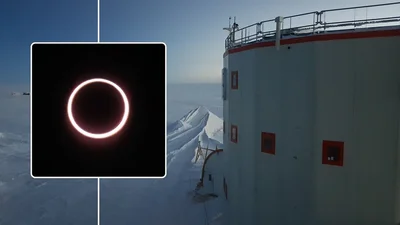
On February 17, 2026, only 12 people at the remote Concordia Research Station in Antarctica witnessed a rare annular solar eclipse, known as a 'ring-of-fire.' Amid harsh conditions and four months of darkness, the team captured a once-in-a-lifetime celestial event that was obscured elsewhere by clouds. Andrea Traverso, a scientist at Concordia, improvised a solar filter to photograph the eclipse, producing the only known Earth-based images. This unique observation highlights the station's value for scientific research and rare astronomical phenomena.
-
NASA’s Big Bang Boost for Voyager Probes
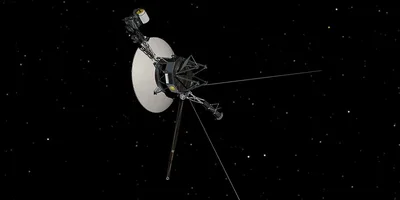
NASA is rolling out a bold new strategy dubbed "The Big Bang" to extend the lifespan of its Voyager spacecraft, now over 25 billion kilometers from Earth. After Voyager 1’s power dipped unexpectedly, engineers shut down its Low-energy Charged Particles experiment to buy time. The Big Bang plan involves swapping out power-hungry components for low-energy alternatives to keep the probes operational longer. Testing begins with Voyager 2 this May, with hopes to revive Voyager 1’s instruments later this summer, potentially adding years to these iconic missions.
-
SpaceX Launches Final GPS III Satellite
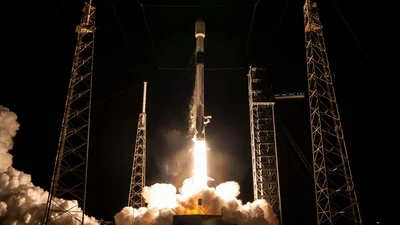
SpaceX successfully launched the GPS III SV10 satellite for the U.S. Space Force early April 20 from Cape Canaveral. This marks the final satellite in the advanced GPS III series, which offers three times better positional accuracy and eight times stronger jam resistance than previous models. The mission boosts U.S. military navigation and weapon system effectiveness worldwide. Next, the Falcon 9's first stage will attempt a seventh landing on the droneship 'Just Read the Instructions'.