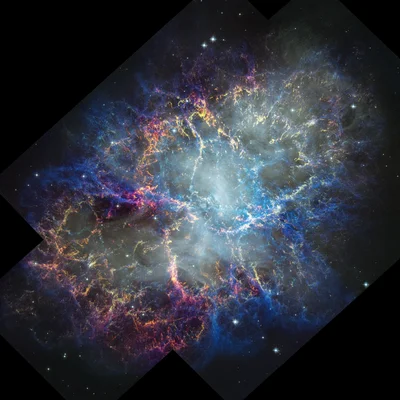
NASA's Hubble Space Telescope has released a stunning new image of the Crab Nebula, revealing intricate filaments racing outward at 3.4 million miles per hour. This fresh look, spanning 25 years of observations, offers unprecedented insight into the aftermath of a supernova explosion and the nebula's dynamic evolution. Scientists are now poised to deepen their understanding of supernova remnants and cosmic particle acceleration.
Space & Exploration
Hubble Unveils Crab Nebula's Fiery Dance
More from Space & Exploration
-
NASA's Roman Telescope Ready to Revolutionize Space Science
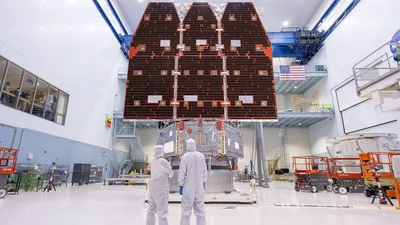
NASA has completed the assembly of the Nancy Grace Roman Space Telescope, a next-generation observatory designed to survey the cosmos with unprecedented speed and scope. With a mirror size comparable to Hubble but a field of view 100 times larger, Roman will capture vast panoramic images and process data over 1,000 times faster than Hubble. Scheduled for launch in September 2026, this telescope aims to unlock mysteries of dark matter, dark energy, and exoplanets, promising new discoveries that could reshape our understanding of the universe.
-
Jordan Joins Artemis Accords Space Pact
The Hashemite Kingdom of Jordan is set to become the 63rd nation to sign the Artemis Accords, a key international agreement promoting safe and transparent lunar exploration. The signing ceremony will take place on April 23 at NASA Headquarters in Washington, hosted by NASA Administrator Jared Isaacman. This move marks Jordan's entry into a growing coalition shaping the future of civil space exploration on the Moon, Mars, and beyond. The accord's expansion signals increasing global cooperation in space activities.
-
ISS Gets High-Powered Laptop Upgrade
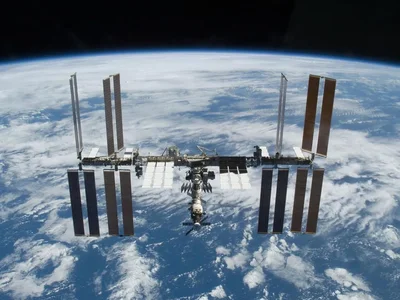
The International Space Station's Expedition 74 crew is receiving a major tech boost with new HP ZBook G9 laptops, featuring Intel Core Ultra 9 processors and Nvidia RTX Pro GPUs. NASA highlights these machines are specially adapted for the ISS's unique power system, ensuring smooth operation in space. This upgrade marks the third generation of HP workstations aboard the station, enhancing astronauts' computing capabilities. However, with the ISS scheduled for de-orbit by 2030, this may be one of the last major tech refreshes.
-
Artemis 2 Heat Shield Passes Test
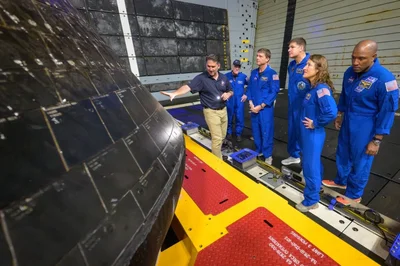
NASA's Artemis 2 mission successfully demonstrated a major upgrade to the Orion spacecraft's heat shield during its April 10 Earth reentry. Unlike Artemis 1, which suffered abnormal charring, the heat shield on Artemis 2 showed significantly reduced damage, confirming the effectiveness of design and trajectory changes. NASA will continue detailed assessments, but this success clears the way for future crewed lunar missions with Orion.
-
NASA Backs 30+ Startups for Space Tech
NASA has selected over 30 companies to receive approximately $16.3 million in funding through its SBIR and STTR programs, aiming to boost innovative technologies for space exploration and Earth applications. This investment supports early-stage development in areas like in-space manufacturing, advanced propulsion, and AI health monitoring, crucial for missions to the Moon and Mars. The agency's new Broad Agency Announcement framework promises more opportunities ahead for small businesses and research institutions.
-
Voyager 1 Powers Down to Survive
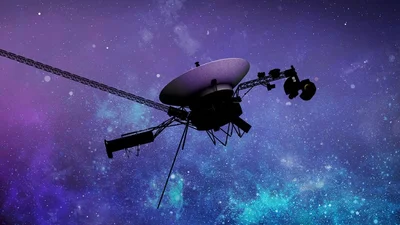
NASA has switched off the Low-Energy Charged Particle instrument on Voyager 1 to conserve its dwindling power supply after nearly 50 years in space. This move comes ahead of a planned risky 'Big Bang' maneuver aimed at extending the spacecraft's life beyond the expected one-year limit. With only two science instruments left active, the mission team hopes to regain power and reactivate instruments to continue exploring interstellar space.
-
NASA and UNOS Team Up for Faster Organ Delivery
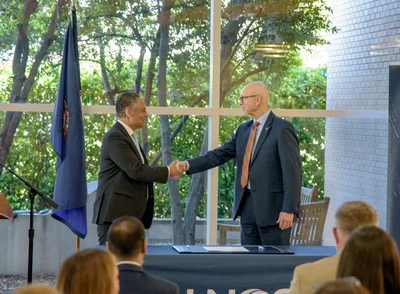
NASA Langley Research Center has partnered with the United Network for Organ Sharing (UNOS) to explore faster organ transport using advanced aviation technologies, including drones. This collaboration aims to reduce delays in organ delivery, potentially improving transplant outcomes by leveraging NASA's expertise in flight research and autonomous navigation. Initial tests will assess drone performance and organ viability after transport, with hopes to expand if successful. This initiative could revolutionize medical logistics and save countless lives.
-
NASA Shines at 30th Webby Awards

NASA has clinched two Webby Awards and five Webby People’s Voice Awards at the 30th Annual Webby Awards, highlighting its outstanding digital outreach. The agency's work spans podcasts, social media, and immersive apps, showcasing its commitment to science education and public engagement. With over 100 nominations since 1998, NASA continues to lead in digital innovation. Next up, NASA aims to expand its digital presence as the Internet evolves.
-
Lyrid Meteor Shower Captured from Space
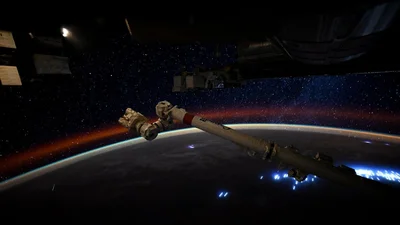
NASA astronaut Jessica Meir snapped a stunning photo of the Lyrid meteor shower from the International Space Station on April 20, 2026. Unlike Earth-bound viewers, Meir witnessed meteors streaking through Earth's atmosphere from above, offering a rare perspective on this annual celestial event. The Lyrids, debris from comet C/1861 G1 Thatcher, light up the night sky with up to 20 meteors per hour. This unique vantage point highlights Earth's thin protective atmosphere and the awe-inspiring experience of space living. Astronomers and skywatchers alike look forward to more such cosmic glimpses from orbit.